Health
AHA, ACC issue first guideline for cardiovascular-kidney-metabolic syndrome
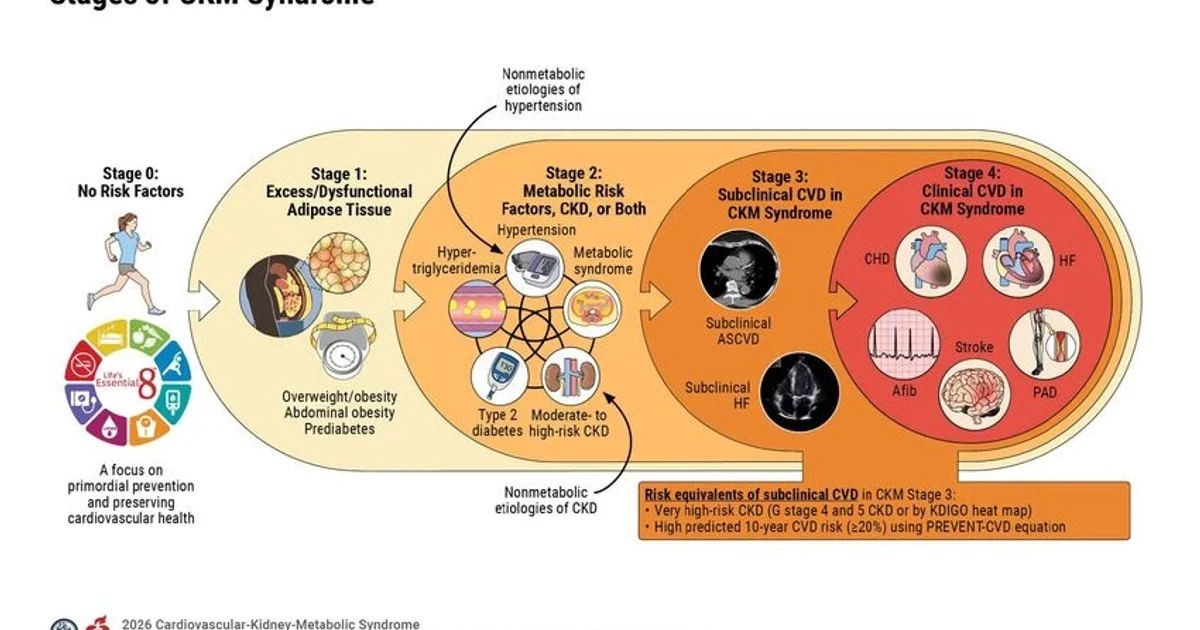
Doctors now have their first formal playbook for cardiovascular-kidney-metabolic syndrome, a condition the American Heart Association says captures the overlap of excess weight, diabetes, kidney disease and cardiovascular risk in one connected system. The joint guidance from the American Heart Association and the American College of Cardiology, issued with support from the American Diabetes Association and the American Society of Nephrology, is meant to push care upstream, before heart attack, stroke, heart failure or kidney failure develop.
The guideline replaced and expanded the 2013 AHA/ACC/TOS obesity document and is built around a four-stage CKM framework. Stage 1 covers overweight or obesity, or prediabetes, without other metabolic risk factors, kidney disease or cardiovascular disease. Stage 2 includes one or more metabolic risk factors or chronic kidney disease without cardiovascular disease. Stage 3 includes subclinical cardiovascular disease, high-risk chronic kidney disease or high predicted 10-year cardiovascular risk. Stage 4 covers established cardiovascular disease plus overweight or obesity, metabolic risk factors or kidney disease.
For ordinary care, the biggest shift is earlier screening. The guideline calls for routine assessment of metabolic and kidney health, using both estimated glomerular filtration rate, or eGFR, and urine albumin-to-creatinine ratio, or UACR, to better identify chronic kidney disease and guide kidney-protective treatment. It also recommends routine use of PREVENT equations to estimate 10-year and 30-year cardiovascular risk, a move meant to catch danger sooner and account for factors that have often been missed in standard heart-risk discussions.
Chiadi E. Ndumele, who chaired the writing committee and is director of obesity and cardiometabolic research at Johns Hopkins School of Medicine, said heart, kidney and metabolic conditions do not occur in isolation. The guideline, he said, calls for earlier screening and coordinated care to reduce cardiovascular risk before serious complications or a major cardiac event occur.

The document also treats excess weight, especially abdominal obesity, as a key driver of CKM syndrome. That matters in a country where the AHA and ACC say nearly 90% of U.S. adults have at least one CKM risk factor, and where 40% of adults and 21% of children and adolescents have obesity. For select patients with obesity and or type 2 diabetes and other cardiovascular risk factors, the guideline recommends GLP-1-based therapies, along with healthy lifestyle measures, SGLT2 inhibitors and, when appropriate, metabolic and bariatric surgery.
First defined by the American Heart Association in 2023, CKM syndrome is now being framed as one problem instead of three separate specialties fighting it in isolation. The new standard is designed to make cardiologists, endocrinologists, nephrologists and primary care clinicians work from the same map.