Business
AI data center boom is reshaping the economy and power grid

Stanford HAI’s 2025 AI Index found that global private AI investment reached a record $252.3 billion in 2024. The buildout is now showing up in national accounts, utility forecasts, and hiring patterns, with enough scale to push up U.S. growth even as it strains the power system and redirects capital into chips, servers, and grid upgrades. The central question is how much of the current boom is broadening productivity and how much is simply crowding other parts of the economy.
The money flowing into AI has become macroeconomic in size
That total was up 26% from the previous year. It is a capital allocation wave large enough to change the composition of investment across economies. It also helps explain why the AI story now reaches well beyond model releases and into semiconductors, construction, energy, and infrastructure.
In 2025, the International Energy Agency put the capital expenditure of five large technology companies, driven by data-center investment, at more than $400 billion in 2025 and projected a further 75% rise in 2026. The buildout depends on physical assets with long lead times, heavy power needs, and large upfront financing requirements.
The U.S. economy is already feeling the pull
S&P Global estimated that data-center and AI-related investments accounted for 80% of U.S. private domestic demand growth in the first half of 2025. That is an unusually concentrated source of demand growth, especially in an economy that otherwise depends on a broad mix of consumer spending, business investment, and housing. It means the AI cluster is not merely adding to growth; it is dominating the incremental expansion.
S&P Global also estimated that investments in data centers and related high-tech activities made U.S. GDP about 0.5 percentage point larger in the second quarter of 2025 than it would have been under prior-trend growth. AI infrastructure is now a macro driver rather than a niche corporate strategy.
Still, the scale of the contribution also raises the risk of imbalance. When one investment theme supplies such a large share of demand growth, it can mask weakness elsewhere, making the economy look healthier than its underlying breadth would suggest. The buildout can boost measured GDP while leaving other sectors competing for capital, labor, and grid capacity.
Power demand is becoming the binding constraint
The most visible pressure point is electricity. A July 2025 Thomson Reuters Institute analysis projected that AI-driven data centers could account for about 12% of U.S. electricity use by 2028. Power demand is becoming a systemwide planning problem for utilities, regulators, and large industrial users, not just an operating cost for data centers.
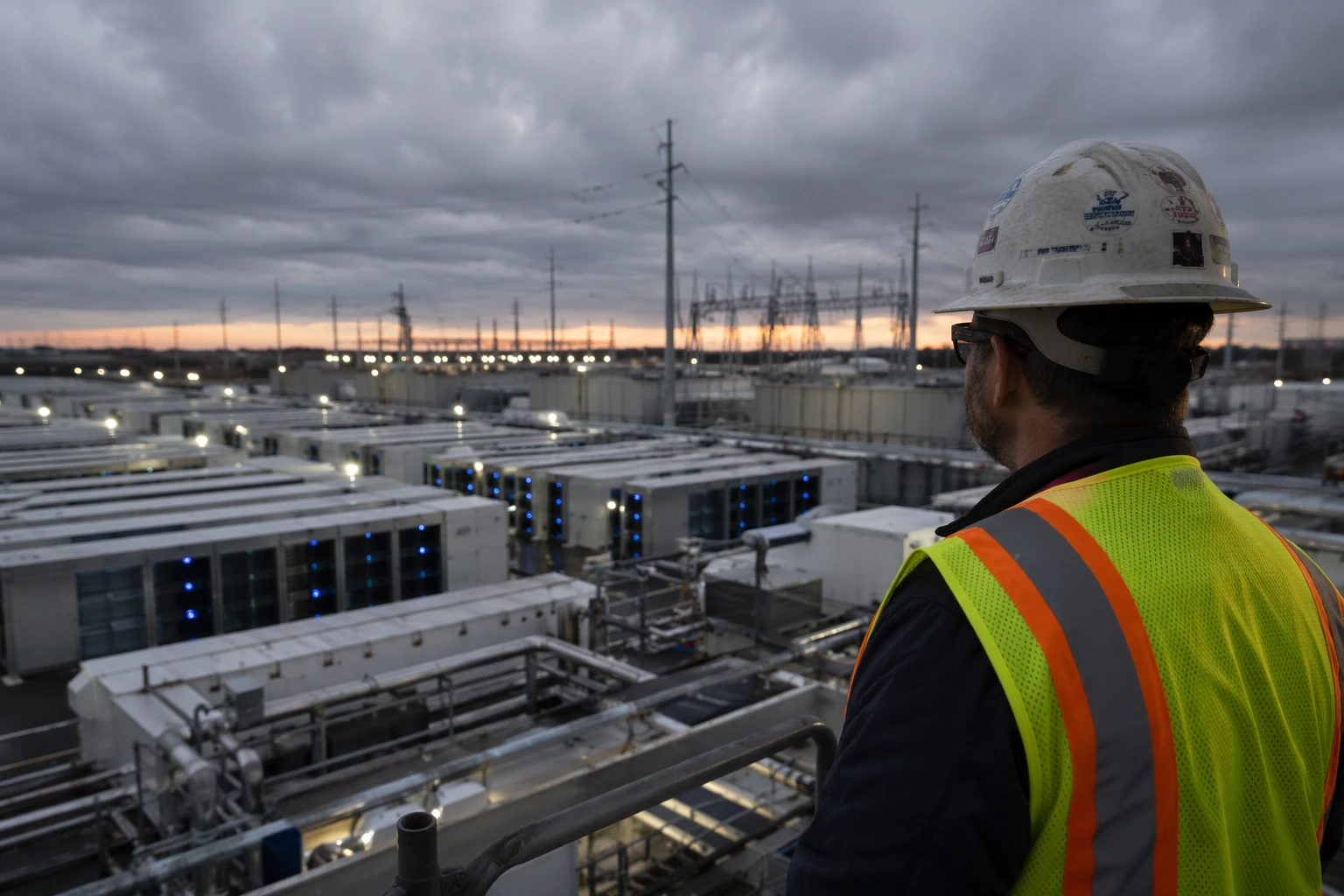
The strain shows up in several places at once. Data centers need reliable baseload power, new transmission, and faster interconnection timelines, while utilities must plan for load growth that can arrive faster than normal forecasting cycles allow. For households and businesses, the concern is that a concentrated surge in electricity demand could feed into higher bills, longer queue times for grid connections, and delayed upgrades for other projects.
AI is turning electricity into a strategic input again. The usual digital-economy assumption, that software scales without much physical infrastructure, no longer holds when model training, inference, and cloud storage require power-hungry facilities that compete with factories and ordinary commercial users for access to the grid.
The labor market story is more mixed than the headlines suggest
The European Central Bank’s June 2026 study found that AI’s impact on aggregate U.S. employment and wages has been muted so far, even though the occupational mix has changed. Jobs in high-exposure occupations such as economists and graphic designers declined, while lower-risk jobs such as electricians and high school teachers grew.
The ECB study also found that employment in high-risk AI-substitution jobs declined by more than 4% between 2019 and 2025. Over the same period, employment in low-risk jobs increased by 13%. That shift pushed the share of low-risk jobs in total U.S. employment from 23% to 25%, while the share of high-risk jobs fell from 35% to 33%.
Those numbers suggest that AI is reshaping labor demand unevenly rather than triggering a broad collapse in jobs or wages. The near-term effect looks more like reallocation than elimination: some tasks and roles are under pressure, while others, especially those tied to installation, maintenance, and human-facing services, continue to expand.
Why the distortion argument is plausible, and where it is overstated
The strongest case that AI spending is distorting the economy rests on capital intensity. When a narrow set of technology firms is responsible for more than $400 billion in data-center-driven capex and that buildout helps account for 80% of private domestic demand growth, it can crowd attention and resources toward one sector. It also channels money into chips, server farms, power plants, and transmission, rather than more diversified forms of investment.
But the argument becomes overstated if it assumes the spending is pure misallocation. The same outlays are also expanding productive capacity: more computing, more storage, and more infrastructure that can support future output.
Sources
- [1]nytimes.com
- [2]hai.stanford.edu
- [3]iea.org
- [4]press.spglobal.com
- [5]spglobal.com
- [6]thomsonreuters.com
- [7]ecb.europa.eu