Technology
AI glossary explains the new terms reshaping public understanding
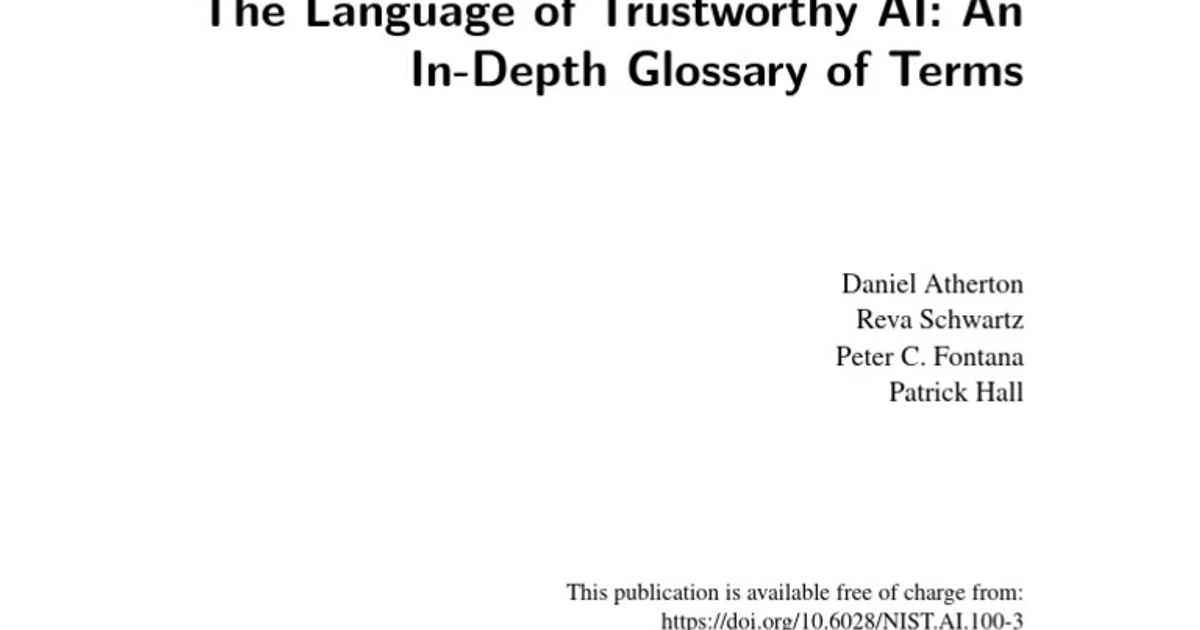
On March 29, 2023, NIST published its trustworthy AI glossary as AI moved through workplaces, classrooms, agencies, and consumer apps so quickly that its vocabulary became part of the story. The problem is not just unfamiliar words; it is that the same terms now show up in product menus, policy debates, and headlines, often with different meanings. A usable glossary has become a decoder ring for ordinary readers trying to tell real capability from marketing spin.
Why the new glossary matters
MIT Sloan built its generative AI glossary to help both newcomers and experienced users build a basic understanding of the tools now in circulation. AI terms and concepts are arriving at a breakneck speed, which is why even people who follow the field can lose the thread as new labels appear. NIST’s trustworthy AI glossary promotes a common understanding and supports effective communication around trustworthy and responsible AI.
OpenAI launched ChatGPT in November 2022, and by July 2025 the company put it at around 700 million users, roughly 18 billion messages sent each week, and adoption by around 10% of the world’s adult population.
The terms that drive policy and product design
Some of the most important words in AI now sit at the intersection of technology and governance. In Stanford HAI’s glossary, agentic AI covers systems that can set or interpret goals, plan and sequence actions, use tools, make decisions based on feedback, and adapt over time. MIT Sloan uses agents for autonomous or semi-autonomous AI entities that perform tasks, make decisions, and call tools or APIs based on goals.
The shift is from AI that only responds to prompts toward AI that can carry out multi-step work. A shopping assistant that suggests items is one thing; a system that can reason through a task, use software tools, and revise its approach after feedback is much closer to a digital operator. AI alignment is making a system’s goals and behavior match human values, rules, and intentions.
NIST’s glossary is built around the same concern. Its purpose is tied to the NIST AI Risk Management Framework and the practical challenge of operating trustworthy and responsible AI in real organizations.
The core terms people see in products
Several of the most common words in AI products describe how users interact with models. Prompts are the inputs to text-generation models, and prompt design is essentially how you program a model. That framing helps explain why tiny wording changes can produce very different outputs: the prompt is not just a question, it is the operational instruction.

Embeddings are vector representations that keep similar content close together in vector space. In practice, that is why embeddings are useful for search, clustering, recommendations, anomaly detection, and classification. They are one of the less flashy concepts in AI, but they power many of the systems that sort documents, surface products, or group related data behind the scenes.
Tokens are another word that often appears in pricing, limits, and model settings. OpenAI uses a rough rule of thumb that one token is about 4 characters or 0.75 words in English. The practical consequence is simple: a prompt and the model’s reply must fit within the model’s maximum context length, so long inputs can crowd out space for the answer itself.
MIT Sloan uses the term context window for that limit: the maximum number of tokens an AI model can consider at once. That is the model’s short-term memory. A larger context window can help a system handle longer documents or multi-step exchanges, but it does not automatically make the model more accurate or more trustworthy.
Hallucination is the warning label
No term has become more important to public trust than hallucination. Hallucination is generated content that is not grounded in the source data. A 2025 review on arXiv included false statements, fabricated references, or an incorrect reasoning path among hallucinations. NIST’s 2024 generative AI profile also refers to confabulation for AI generating false or misleading content, sometimes called hallucinations.
In journalism, education, legal work, and public administration, fabricated details can contaminate reporting, homework, filings, and decisions.
Where the phrase artificial intelligence came from
The vocabulary sounds new, but the field’s oldest label has been around for decades. In Stanford HAI’s glossary, the term artificial intelligence was coined in 1955 by John McCarthy, who described it as "the science and engineering of making intelligent machines."
Sources
- [1]techcrunch.com
- [2]mitsloanedtech.mit.edu
- [3]hai.stanford.edu
- [4]nist.gov
- [5]developers.openai.com
- [6]cdn.openai.com
- [7]nvlpubs.nist.gov
- [8]arxiv.org