Technology
AI spending surges as companies struggle to prove returns
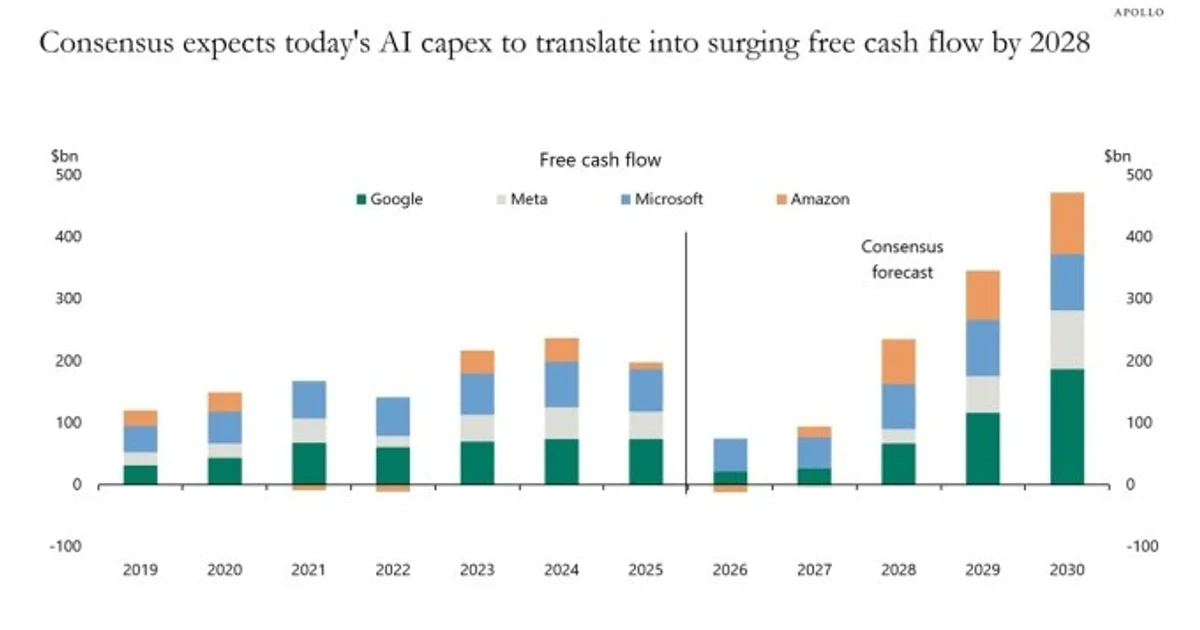
Global AI infrastructure spending reached $235 billion in 2024 and could rise to $2.8 trillion by 2029. That scale has turned the return question into a hard accountability test, because companies are still spending faster than they can show where the payoff is coming back.
McKinsey Global Institute set one of the biggest upside benchmarks in 2023, estimating generative AI could add $2.6 trillion to $4.4 trillion a year across 63 use cases and roughly double that if the tools were built into existing software. Around the same time, Sequoia Capital partner David Cahn was running the numbers on Nvidia’s reported $50 billion in annual GPU revenue and arguing the industry would need far more revenue to justify the data-center buildout.

The spending kept climbing even as the evidence of return stayed uneven. Bain & Company’s November 2025 survey found 74% of companies ranked AI among their top three strategic priorities. By June 2026, Bain said data access and integration had become the single biggest barrier to AI progress, cited by 41% of respondents, and 44% of companies said they were funding the next wave of AI from automation savings that had fallen short of target.
Deloitte’s 2025 survey of 1,854 executives found 85% of organizations increased AI investment in the previous 12 months, and 91% planned to raise it again. OpenAI said in 2025 that ChatGPT had reached 700 million weekly active users, a sign that adoption has moved at extraordinary speed even before businesses can clearly show profits, staffing changes or lower operating costs.
The productivity evidence points to a lag, not an immediate payoff. MIT Sloan found AI adoption in manufacturing firms was associated with a short-term productivity drop of 1.33 percentage points before later gains emerged over four years. That gap between spending, usage and measurable output is now the central test for the $3 trillion case: until companies can tie AI bills to higher productivity, lower costs or real labor substitution, the boom remains a forecast rather than proof.
Sources
- [1]techcrunch.com
- [2]mckinsey.com
- [3]bain.com
- [4]deloitte.com
- [5]openai.com
- [6]mitsloan.mit.edu