Technology
AI Tools Transform Healthcare, Finance, and Education
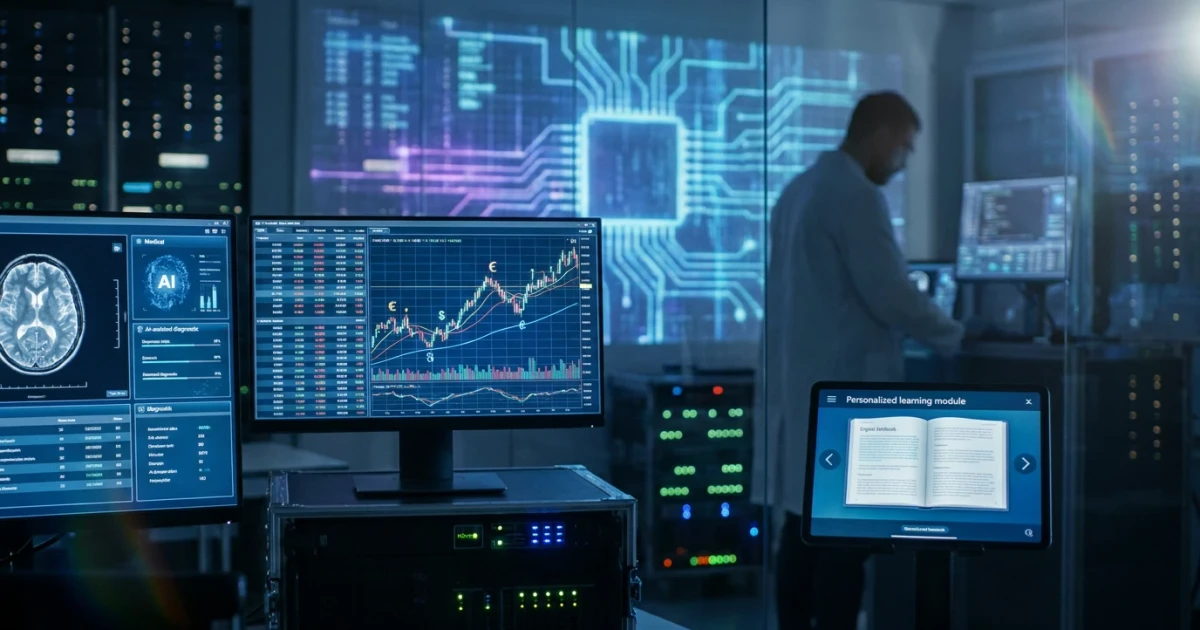
Artificial intelligence continues its rapid expansion across industries, powering some of the most impactful technology solutions of 2026. From healthcare and finance to education and logistics, AI’s real-world applications are reshaping the way organizations operate and individuals interact with technology, as reported by Tech Times.
Healthcare: Diagnosis, Drug Discovery, and Medical Devices
AI’s influence in healthcare is profound, enabling faster and more accurate diagnosis, streamlining drug discovery, and powering advanced medical devices. Machine learning algorithms now analyze medical images and patient data more efficiently than ever, supporting doctors in identifying conditions such as cancer, heart disease, and rare genetic disorders. The FDA has cleared numerous AI/ML-enabled medical devices, including diagnostic tools that use deep learning to interpret X-rays and MRIs.
- AI-assisted diagnostics reduce error rates and improve early detection.
- Drug development processes are accelerated by predictive models analyzing vast datasets.
- Wearable devices track health metrics and alert users and clinicians to potential issues in real time.
For those interested in technical details, the official patent filings outline the architecture and claims for machine learning systems used in medical diagnosis.
Finance: Fraud Detection and Automated Trading
Financial institutions leverage AI to enhance security, streamline operations, and optimize investment strategies. AI-powered fraud detection systems analyze transaction patterns, flagging suspicious activity with greater accuracy than traditional rule-based systems. Automated trading platforms use advanced state-of-the-art AI benchmarks to execute trades based on real-time market data, maximizing returns and minimizing risk.
- AI models monitor millions of transactions per second, identifying anomalies instantly.
- Natural language processing (NLP) tools extract insights from financial news and reports to inform trading decisions.
- Customer service chatbots handle routine inquiries, reducing workload for human agents.
Tech Times highlights that financial applications of AI are among the most mature and widely adopted, with banks reporting significant reductions in fraud losses and improved customer satisfaction.
Education: Personalized Learning and Automated Assessment
AI has become increasingly prevalent in education, enabling personalized learning experiences and automating assessment processes. Adaptive platforms analyze student performance, tailoring content and pacing to individual needs. Automated grading systems use NLP to evaluate essays and assignments, providing instant feedback and freeing teachers to focus on higher-level instruction.
- AI-driven tutoring systems offer real-time support for students struggling with specific concepts.
- Predictive analytics identify learners at risk of falling behind, allowing targeted interventions.
- Data from education datasets informs curriculum development and instructional strategies.
Tech Times notes that education technology startups are increasingly incorporating AI, making learning more accessible and efficient for diverse populations.
Logistics and Transportation: Route Optimization and Autonomous Systems
AI is also revolutionizing logistics, with route optimization algorithms minimizing delivery times and costs. Autonomous vehicles and drones, guided by sophisticated machine learning models, are being deployed for freight transport and last-mile delivery. Companies rely on AI to manage supply chains, predict demand, and allocate resources dynamically.
- Real-time tracking and predictive analytics reduce delays and improve customer satisfaction.
- Autonomous systems enhance safety and efficiency in warehouses and on the road.
Future Outlook and Ongoing Challenges
While AI’s benefits are clear, Tech Times underscores ongoing challenges around privacy, bias, and regulatory compliance. The EU Artificial Intelligence Act is shaping standards for transparency and risk management, especially for high-impact applications in healthcare and finance.
As AI continues to mature, experts anticipate further integration into daily life, enhanced by advances in deep learning, NLP, and robotics. The rapid pace of innovation suggests that AI’s most useful applications in 2026 are only the beginning, promising even greater transformation in the years ahead.