Politics
Albanese faces rising far-right challenge as Australia wrestles with inflation

Anthony Albanese on Tuesday rejected Pauline Hanson’s call for a “monocultural” Australia, calling the idea divisive and nonsense as One Nation pressed its anti-immigration message harder. The clash landed while inflation was still running at 4.2% in April 2026, keeping the cost of living at the center of Australian politics and sharpening the pressure on a prime minister trying to project stability.
That pressure sits on top of a commanding electoral mandate. Labor won 94 of 150 House seats in the federal election on 3 May 2025, its biggest tally ever in an Australian election, and the Australian Electoral Commission recorded the results as final on 12 June 2025. Albanese became the first Australian prime minister to win consecutive elections since 2004, a result that gave him room to govern cautiously as global conditions worsened.
The economic backdrop is far from calm. The Reserve Bank of Australia kept the cash rate target at 4.35% in June 2026, leaving borrowing costs high as tariffs from the United States, wars and volatile trade conditions continue to unsettle markets. The central bank’s hold, combined with April’s 4.2% annual inflation reading, shows why household budgets remain politically toxic and why voters are impatient for relief that is visible, not just promised.

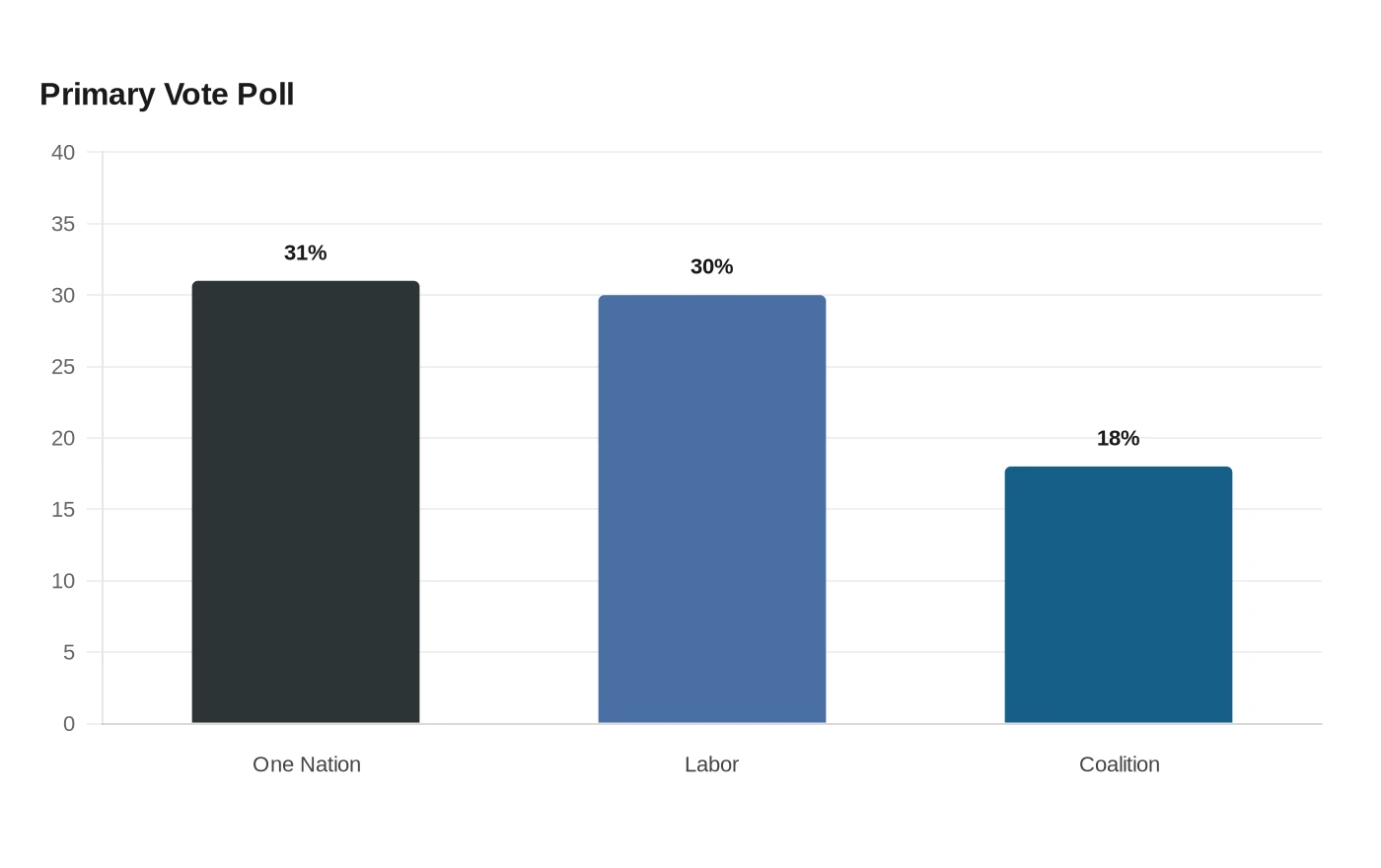
Hanson has seized on that unease. A Newspoll conducted from 1 to 4 June 2026 put One Nation on 31% of the primary vote, ahead of Labor on 30% and the Liberal-National Coalition on 18%. It was the first time since Newspoll began in 1985 that Labor and the Coalition together failed to reach 50% of the primary vote, a stark measure of how fractured the mainstream vote has become.
Hanson escalated the argument at the National Press Club on 17 June, saying Australia cannot be a multicultural society and blaming immigration for housing pressures. Albanese replied that migration levels were already falling and argued that populist parties are part of a global trend, while insisting social cohesion must remain central to Australian identity. The fight is unfolding against a demographic reality that makes migration politically combustible: Australia’s population reached 28 million in June 2026, 32.0% of residents were born overseas as of 30 June 2025, and net overseas migration added 306,000 people in the year to that date.
Home Affairs Minister Tony Burke said on 18 June that net overseas migration had dropped to 301,000, more than 45% below the post-Covid peak in 2023. That gives Albanese a narrow line to walk: argue that migration is easing, defend a multicultural settlement that still defines modern Australia, and show that a government elected on economic steadiness can do more than react to the next shock.
Sources
- [1]nytimes.com
- [2]results.aec.gov.au
- [3]aec.gov.au
- [4]rba.gov.au
- [5]abs.gov.au
- [6]minister.homeaffairs.gov.au
- [7]straitstimes.com
- [8]bloomberg.com