Business
Americans fear running out of money in retirement more than death

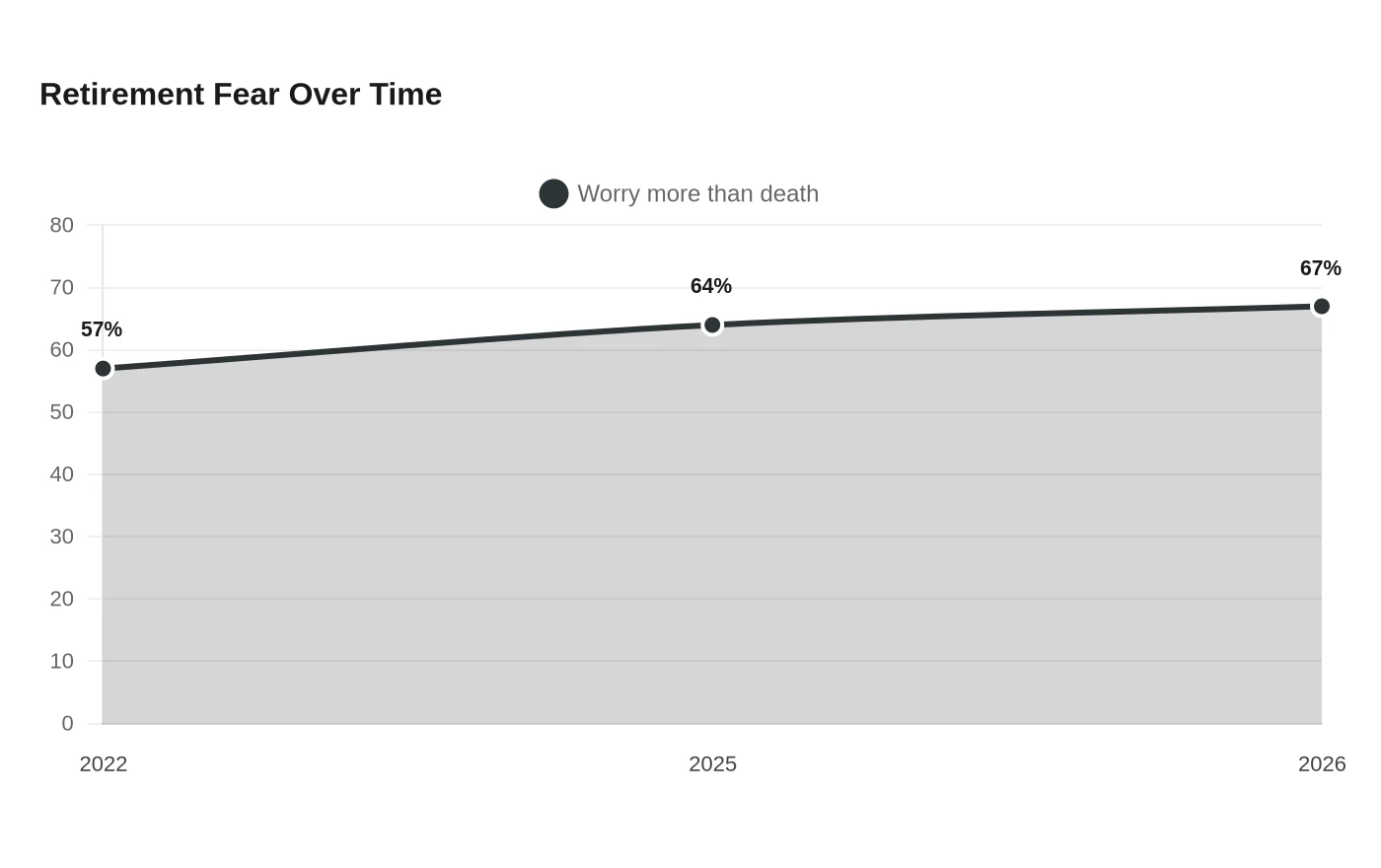
In Allianz’s 2026 Annual Retirement Study, 67% of Americans said they worry more about running out of money than death, up from 57% in 2022. Inflation, market swings and longer retirements are putting pressure on household budgets.
The anxiety is broad, and it starts well before retirement
The 2026 survey was fielded in January among 1,000 nationally representative respondents age 25 and older who either had at least $50,000 in annual household income if single, $75,000 if married, or at least $150,000 in investable assets. Gen X showed the highest anxiety at 73%, followed by millennials at 69% and baby boomers at 59%, while 48% said they do not have a written financial plan. Many Americans are juggling daily expenses, housing costs, debt and health care needs when they try to save for retirement.
In Allianz’s 2025 study, 64% worried more about running out of money than death, 62% said they were not saving as much as they would like, and 54% said inflation contributed to that fear. Taxes and uncertainty about Social Security were also major concerns that year.
Why inflation still dominates retirement anxiety
Consumer prices for all urban consumers rose 4.2% from May 2025 to May 2026, based on Bureau of Labor Statistics data. In Allianz’s 2026 study, 57% blamed high inflation for their worry about running out of money, while 53% pointed to high health care costs. In the same study, 57% said they feel anxious when retirement accounts lose value in a market drop.
In the same study, 50% of respondents immediately check their retirement accounts after a market drop, 34% say they typically withdraw money from investments to avoid further losses, and 59% worry that keeping most of their retirement savings in stocks risks significant losses. The same study found that 77% said guaranteed income would ease retirement spending anxiety.

The policy backdrop is part of the fear
The 2025 Social Security trustees report projected that the combined trust funds would be depleted in 2034, with the Old-Age and Survivors Insurance fund depleted in 2033 if no changes are made. Social Security is a self-financing program, and dedicated payroll tax contributions account for 90.6% of its income in Congressional Research Service data.
The Federal Reserve’s most recent published Survey of Consumer Finances is the 2022 wave. The survey tracks families’ balance sheets, pensions, income and demographic characteristics.
Where the fear is justified, and where it is overstated
RAND found that real spending declines after age 65 at annual rates of about 1.7% for single households and 2.4% for coupled households, and that pattern held across wealth quartiles, including the highest.
A separate 2026 summary of new research in CFP Board News found that retirees, including affluent retirees, tend to reduce inflation-adjusted spending over time.
What a stronger retirement plan needs to do
• Write the plan down. In Allianz’s 2026 study, 48% of Americans do not have a written financial plan, and 63% say juggling multiple financial goals makes it hard to prioritize retirement. A written plan forces the retirement income conversation to move beyond account balances and toward cash flow, taxes and withdrawal timing.
• Test the budget against inflation and medical costs. Inflation, health care costs and longevity were at the center of retirement risk in Allianz’s 2026 study, while the 2025 study showed inflation was already a major driver of fear. The point is not to predict every price increase, but to make sure rising essentials do not crowd out the rest of the budget.
• Decide how you will react to a bad market year before it happens. In Allianz’s 2026 study, the 57% who feel anxious after a market drop, and the 34% who would sell to avoid further losses, show how quickly fear can become a sequence of bad decisions. Income sources that continue regardless of market swings, including guaranteed lifetime income products, are attractive because they can reduce the urge to panic-sell.
• Treat longevity as a funding problem, not an abstract fear. The question is whether money can last a lifetime, and in Allianz’s 2026 study, 77% said guaranteed income would ease retirement anxiety.
Sources
- [1]news.google.com
- [2]usatoday.com
- [3]allianzlife.com
- [4]bls.gov
- [5]ssa.gov
- [6]federalreserve.gov
- [7]congress.gov