Health
Ancient DNA reveals plague outbreaks among hunter-gatherers 5,500 years ago
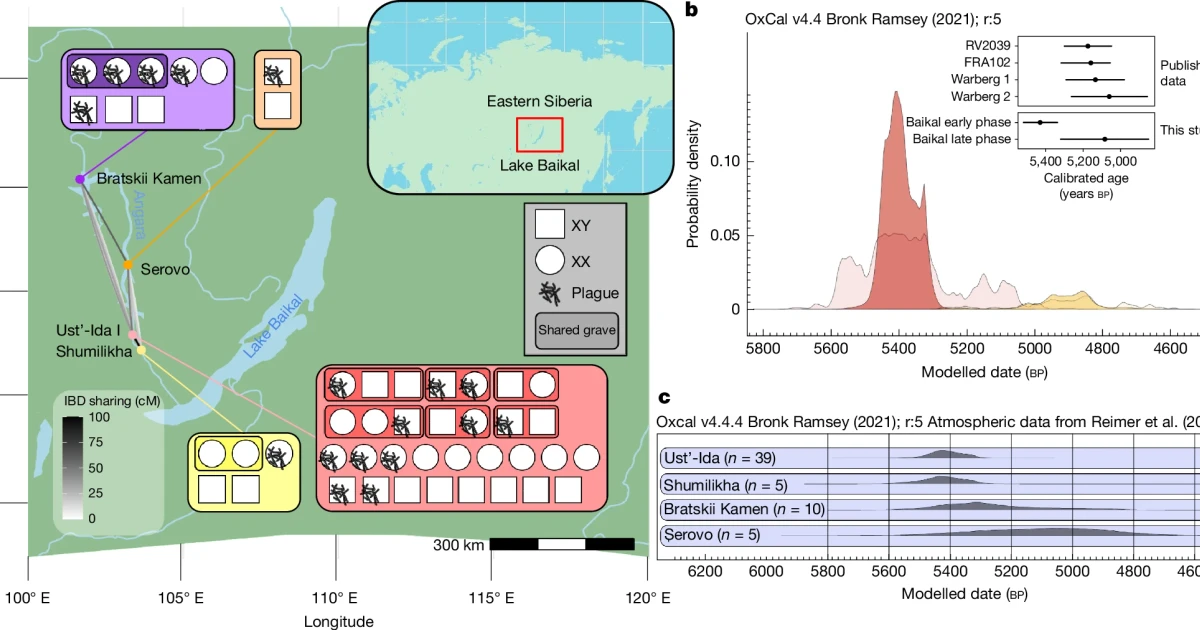
Ancient DNA pulled from hunter-gatherer teeth in southeast Siberia has pushed plague’s history deeper into prehistory, showing that lethal outbreaks were already moving through small mobile communities near Lake Baikal 5,500 years ago. Researchers identified plague infection in 18 of 46 people from four cemeteries, a 39% detection rate, and found that the first outbreak unfolded within a single generation.
The study, published June 17, 2026 in Nature under the title “Lethal plague outbreaks in Lake Baikal hunter-gatherers 5,500 years ago,” reconstructed early Yersinia pestis strains associated with two outbreak phases among mid-Holocene hunter-gatherers. The infections appear to have hit especially hard among children aged 8 to 11 years, and kinship analysis suggested that small familial groups were affected, a pattern consistent with human-to-human spread rather than a single isolated exposure.
That matters because plague is usually framed through the Black Death and later city-based epidemics. The new genomes show that plague was already lethal long before medieval Europe, and long before the classic flea-and-rat transmission model was fully established. The strains also diverge ancestrally from known Y. pestis lineages, suggesting plague emerged before about 5,700 years ago and challenging the idea that dense Neolithic settlements and agriculture were required for major epidemics.
Scientists were able to recover the pathogen because teeth preserve blood and tissue residues that can survive when bones and written records cannot. The University of Cambridge said the finding is the earliest-known evidence of plague outbreaks so far, and emphasized that previous work had already detected Y. pestis in prehistoric Europe. Here, the Lake Baikal cemeteries gave researchers a rare look at disease in a population that was still largely mobile, yet already vulnerable to fast-moving infection.

The historical stakes stretch beyond archaeology. Cambridge noted that the Black Death killed up to half the population of Europe, while the third plague pandemic peaked in the early 20th century, continued until 1959, reached every inhabited continent and caused about 12 million deaths. Other ancient DNA work has shown zoonotic disease was already present by about 6,500 years ago and became more widespread about 5,000 years ago, reinforcing a larger pattern in which human-animal contact and mobility helped microbes take hold.

Ruairidh Macleod said the team built a “really clear, complete picture” using plague DNA, genetic relationships, archaeology and radiocarbon dating. Eske Willerslev said understanding plague history is important for understanding human history. The deeper lesson from Lake Baikal is clear: epidemics did not begin with cities. They have shadowed human communities for millennia, and ancient genomes are now revealing how early that relationship began.
Sources
- [1]nature.com
- [2]cam.ac.uk
- [3]news.ku.dk