Science
Ancient Oklahoma Fossil Sheds Light on Mammal Breathing Origins
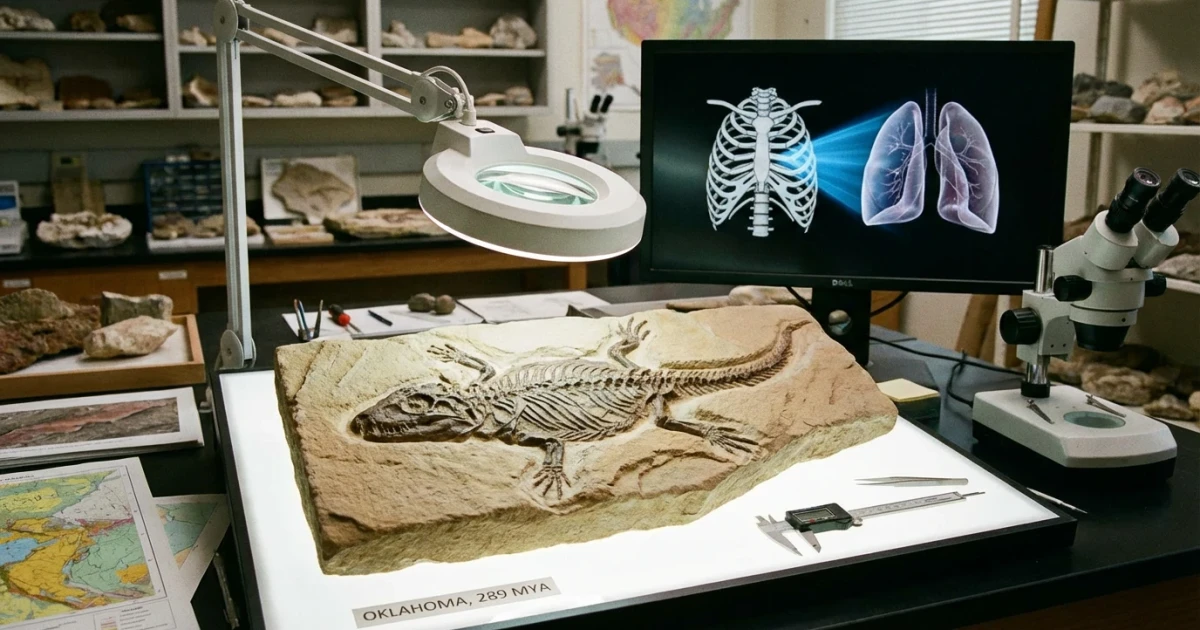
A newly described 289-million-year-old mummified reptile fossil from an Oklahoma cave is offering scientists unprecedented insight into the evolutionary origins of how mammals breathe—a fundamental trait that distinguishes them from other vertebrates.
Exceptional Fossil Preservation Reveals Ancient Anatomy
The fossil, believed to belong to a group of early amniotes, was found with much of its soft tissue—including skin, muscles, and internal organs—remarkably intact. According to the initial reports highlighted by IFLScience, the specimen’s state of preservation is rare for fossils of this age, which typically only retain hard tissues like bones or teeth. This exceptional preservation allowed scientists to analyze anatomical features in detail using modern imaging techniques.
High-resolution CT scan data provided three-dimensional reconstructions of the fossil’s internal structure, revealing the presence of an early version of the diaphragm—a muscular sheet crucial for the type of breathing seen in modern mammals. The fossil’s location in Oklahoma corresponds to a well-documented Permian fossil site known for its diversity of ancient vertebrates.
Understanding the Evolution of the Mammalian Diaphragm
Mammals are unique among land vertebrates in that they rely on a muscular diaphragm to ventilate their lungs, enabling high metabolic rates and sustained activity. Most reptiles and birds, by contrast, use rib and body wall movements for breathing. The discovery of this fossilized amniote with evidence of a proto-diaphragm bridges a crucial gap in evolutionary history. As explained in the research article describing the find, the presence of this structure in a Permian reptile ancestor suggests that the roots of mammalian breathing extend much further back than previously realized.
- The fossil is approximately 289 million years old, predating the earliest true mammals by at least 50 million years.
- It preserves not only skeleton but also soft tissues, allowing researchers to identify muscular and possibly connective tissues associated with breathing.
- The anatomical evidence indicates that the evolutionary lineage leading to mammals was already experimenting with more efficient lung ventilation mechanisms.
Broader Implications for Evolutionary Biology
This discovery, as highlighted by IFLScience and institutional explainers, fundamentally changes our understanding of when and how the mammalian breathing system originated. It supports the idea that adaptations for higher activity levels and more efficient oxygen exchange were underway long before mammals appeared. The findings provide crucial data for evolutionary biologists seeking to map out the origins of major vertebrate features.
Moreover, the fossil’s exceptional preservation provides a rare window into the soft tissue anatomy of early terrestrial vertebrates, which is usually lost to time. Such discoveries help refine evolutionary timelines and clarify the sequence of anatomical innovations that made mammals so successful.
What Comes Next for Ancient Breathing Research?
The Oklahoma specimen is likely to remain a focal point for research, as scientists continue to analyze its tissues and compare them to both extinct and living animals. Its CT scan data and anatomical reconstructions are now available to the broader scientific community, allowing for further exploration and verification of these findings.
As more fossils with preserved soft tissues are discovered and advanced imaging technologies improve, our understanding of evolutionary milestones—such as the origins of mammalian breathing—will continue to deepen. For now, this ancient reptile from an Oklahoma cave stands as a remarkable testament to how the distant past shapes the biology of today.