Science
Antarctic Ice Reveals Clues to Universe’s Deepest Mysteries
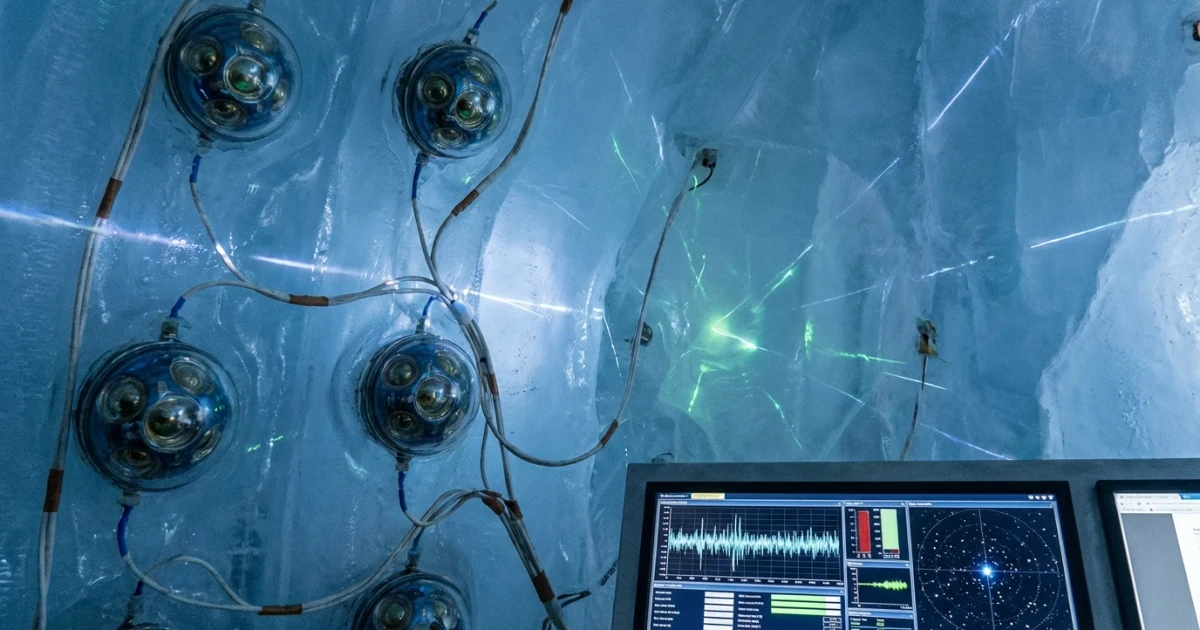
In the heart of Antarctica, an extraordinary scientific experiment is yielding insights into some of the universe’s most profound mysteries. Deep beneath the surface, the IceCube Neutrino Observatory is detecting elusive particles known as neutrinos, offering scientists an unprecedented window into the cosmos and its origins.
How Neutrinos Unlock the Universe's Secrets
Neutrinos are nearly massless, chargeless particles that rarely interact with matter, earning them the nickname “ghost particles.” Because they can travel unhindered across vast cosmic distances, neutrinos carry information from the most extreme environments—like exploding stars, colliding black holes, and the cores of distant galaxies—that is otherwise impossible to obtain.
The IceCube Observatory, located at the South Pole, uses a cubic kilometer of pristine ice to detect the faint signals produced when a neutrino occasionally collides with an atom inside the ice. According to the National Science Foundation’s official project page, IceCube is the world’s largest neutrino detector, comprising over 5,000 optical sensors suspended in deep boreholes.
Major Scientific Discoveries
- IceCube’s detection of high-energy neutrinos has traced some of these particles back to distant astrophysical sources, confirming that powerful cosmic events generate them.
- Analysis of NASA’s public dataset reveals dozens of neutrino events with energies far exceeding those produced in Earth’s particle accelerators.
- Findings from IceCube have provided key evidence supporting theories about how cosmic rays—high-energy particles striking Earth from space—are created.
The Significance for Fundamental Physics
By capturing and analyzing neutrinos that have traveled undisturbed from the farthest reaches of the universe, researchers can probe the properties of matter, energy, and space itself. These measurements help answer questions about the origin of cosmic rays, the nature of dark matter, and conditions moments after the Big Bang.
As highlighted in peer-reviewed publications from the IceCube Collaboration, the observatory’s results are enabling scientists to test and refine models of particle physics under conditions that cannot be recreated on Earth.
Continuous Data Collection and International Collaboration
The IceCube facility operates year-round, with a vast international team analyzing continuous streams of data. This collaboration has made large datasets and findings available to the global scientific community, accelerating the pace of discovery.
Looking Ahead
As technology advances, future upgrades to the IceCube detector are expected to increase sensitivity, enabling the detection of even fainter neutrino signals. This will further expand our understanding of the universe’s most energetic and mysterious phenomena.
With each new discovery beneath Antarctica’s ice, scientists come closer to answering fundamental questions about the cosmos, demonstrating how groundbreaking research in one of Earth’s harshest environments can illuminate the most profound mysteries of existence.