Technology
Anthropic says U.S. lifts restrictions on Claude Fable 5 models
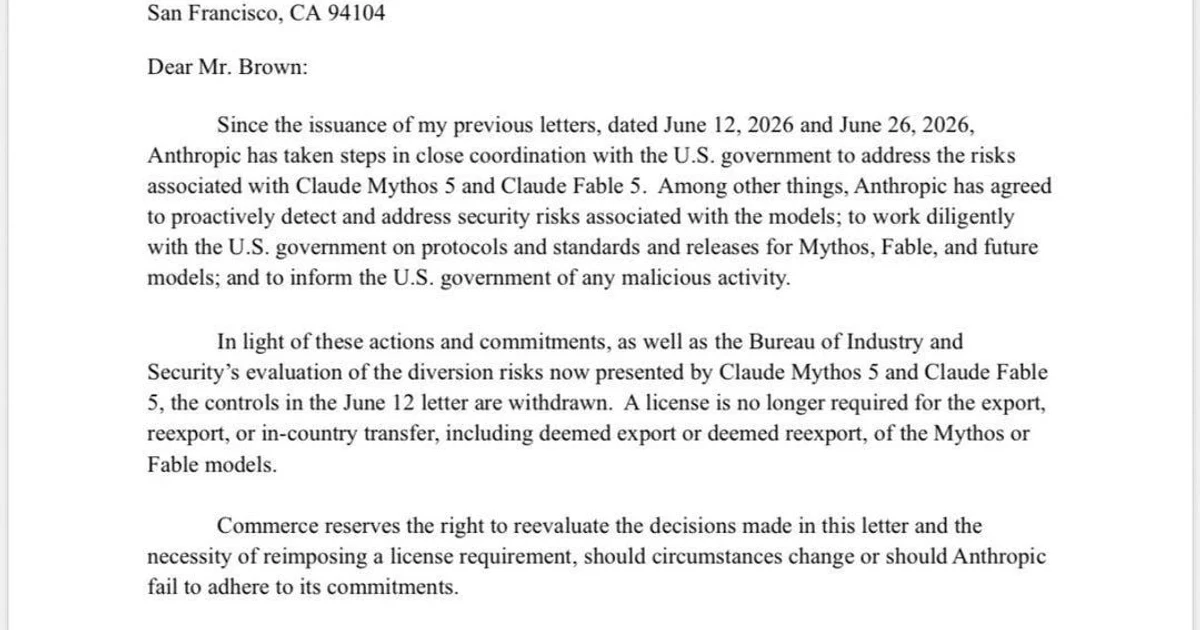
A June 12 directive barred any foreign national, including foreign national Anthropic employees, from using Claude Fable 5 and Claude Mythos 5. Anthropic disabled both systems to comply with the order, driven by national security concerns over a possible way to bypass safeguards, or “jailbreak,” the models. Anthropic had already subjected Fable 5 and Mythos 5 to thousands of hours of testing with the U.S. government, the UK AI Safety Institute, private third-party organizations and its own teams before launch. No tester found a universal jailbreak, but perfect jailbreak resistance may not be possible, so Anthropic relies on a defense-in-depth strategy and 30-day data retention to watch for attacks.
Anthropic introduced Claude Fable 5 and Claude Mythos 5 on June 9. Fable 5 is its most capable model, reaching state-of-the-art performance in coding, knowledge work, vision, scientific research and other tasks. Mythos 5 uses the same underlying model as Fable 5, with safeguards lifted in some areas, and it was first deployed through Project Glasswing with the U.S. government as an upgrade to Claude Mythos Preview. Anthropic priced both models at $10 per million input tokens and $50 per million output tokens. Conservative safeguards rerouted some cybersecurity and biology queries to Claude Opus 4.8, and those safeguards triggered in less than 5% of sessions on average.
By June 26, Washington had partially reversed course and allowed Mythos 5 to be released to some trusted U.S. organizations. More than 100 companies and institutions, including many Fortune 500 firms, were set to regain access, and the model could go back to U.S. organizations that operate and defend critical infrastructure. Fable 5 remained blocked, and Anthropic will keep working with the government to expand access to Mythos 5 and eventually restore general availability for Fable 5.
Commerce Secretary Howard Lutnick’s June 26 letter said Anthropic had made significant progress addressing risks and that talks would continue on a standardized framework for judging suspected security bypasses. John Coleman of the Foundation for Individual Rights and Expression and OpenAI chief executive Sam Altman criticized the move, and Altman said he did not like the idea of the government picking customers.
Sources
- [1]cbsnews.com
- [2]anthropic.com
- [3]money.usnews.com
- [4]politico.com
- [5]cnbc.com