Science
Artemis II Countdown Begins Amid Strong Launch Forecast
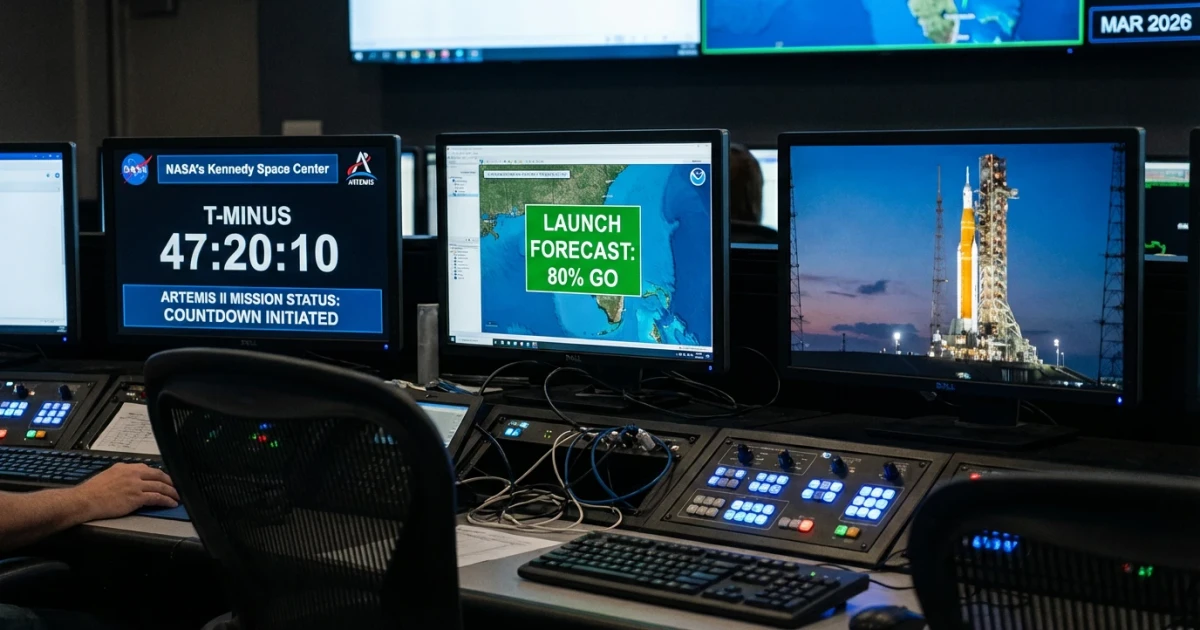
NASA’s Artemis II mission has entered its official countdown phase, with meteorologists projecting an 80% probability of favorable launch conditions over Florida’s Kennedy Space Center. The promising weather outlook marks a significant step as the agency prepares for its first crewed lunar mission in over half a century.
Weather Conditions Favor Launch Progress
According to FOX Weather, forecasts continue to hold at an 80% ‘Go’ for liftoff, with minimal chances of adverse weather impacting the scheduled launch window. The National Weather Service and NASA meteorologists are closely monitoring local atmospheric patterns, with current models indicating low probability of lightning, precipitation, or high winds—all critical factors for a safe and timely ascent. This robust forecast is encouraging for mission controllers and the public, as previous major launches have sometimes faced delays due to Florida’s unpredictable coastal weather.
Artemis II: Paving the Way for Lunar Exploration
The Artemis II mission is a pivotal chapter in NASA’s broader Artemis program, which aims to return humans to the Moon and establish a sustainable presence on and around the lunar surface. Unlike the uncrewed Artemis I test flight, Artemis II will carry a crew of four astronauts on a journey that will loop around the Moon before returning to Earth.
- Artemis II will be the first crewed mission to the Moon since Apollo 17 in 1972.
- The mission will test all spacecraft systems in deep space and serve as a precursor for future lunar landings.
- The crew will not land on the Moon but will travel farther from Earth than any humans have in decades, conducting vital systems checks and communication experiments.
Details on the precise timeline, mission trajectory, and technical milestones can be explored on NASA’s interactive Artemis II mission page.
Meet the Artemis II Crew
The four-person crew selected for Artemis II represents a new generation of explorers. Their training has encompassed spacecraft systems, lunar mission protocols, and emergency procedures, preparing them for the unique challenges of deep space travel. Readers can learn more about the astronauts’ backgrounds and roles on the official Artemis II crew page.
Countdown Milestones and What Comes Next
The Artemis II countdown sequence incorporates multiple critical milestones, including final system checks, crew ingress, and fueling of the Space Launch System rocket. As the clock ticks down, engineers will continue to monitor technical and environmental parameters, with real-time updates available on NASA’s mission tracking and timeline page.
- 80% ‘Go’ weather forecast remains the key indicator for an on-time launch.
- Backup launch windows are available should conditions change unexpectedly.
- Final ‘Go/No-Go’ calls will be made in the final hours before liftoff.
Significance for Lunar Science and Exploration
Artemis II is not only an operational test but also a precursor to more ambitious lunar science. The mission’s objectives include validating life support and navigation systems in the harsh lunar environment, laying the groundwork for the science goals of future Artemis missions, including the eventual landing of the first woman and the next man on the Moon’s surface.
Looking Ahead
With the countdown underway and weather prospects looking strong, the world watches as Artemis II prepares to launch a new era of human exploration beyond Earth. NASA’s progress on this mission will inform not only future lunar expeditions but also broader ambitions for Mars and beyond. For the latest updates, follow NASA’s official launch schedule and mission coverage.