Science
Artemis II Crew Prepares for Fiery Re-Entry Challenge
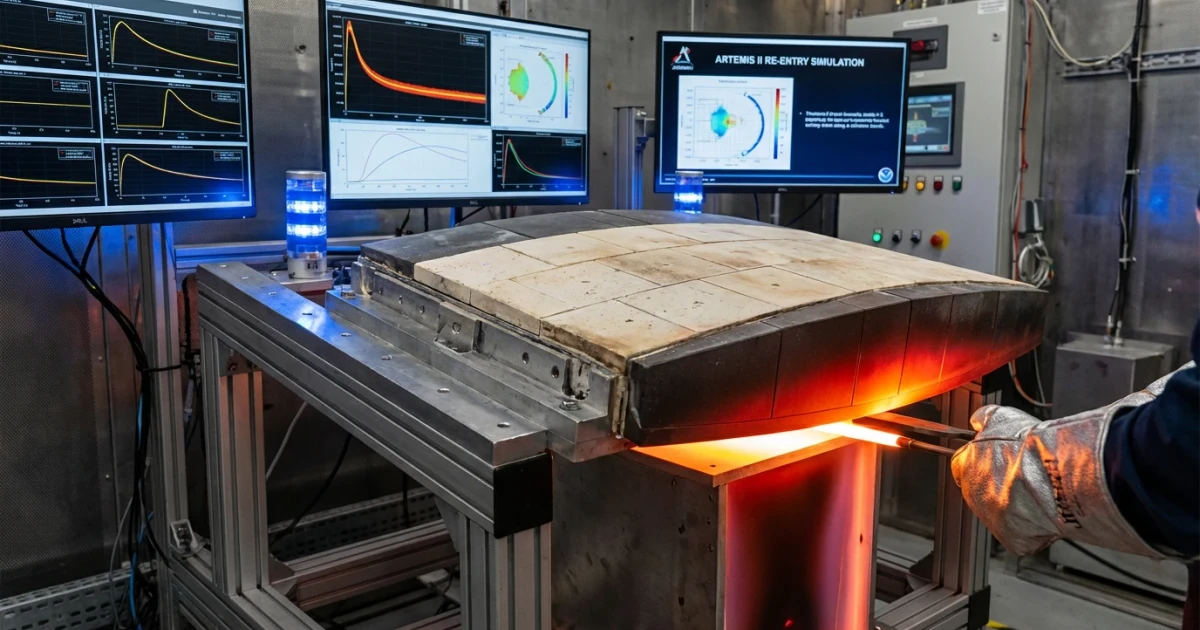
NASA’s Artemis II mission is set to send astronauts farther from Earth than any crew since Apollo, but their return will bring one of the most perilous challenges: surviving a re-entry into Earth’s atmosphere at temperatures approaching 3,000°C. As the mission draws closer, experts are shedding light on the technology and science that will protect the crew during this critical phase.
Hypersonic Re-Entry: Why It’s So Dangerous
When the Orion crew capsule plummets back toward Earth, it will be moving at hypersonic speeds. According to The Conversation, the friction between Orion and the atmosphere compresses the air in front of the spacecraft, generating extreme plasma and heat. Temperatures can soar to about 3,000°C (over 5,400°F), hot enough to melt most metals. Without proper protection, this would be deadly for the Artemis II astronauts inside.
How the Orion Heat Shield Works
To survive such extremes, Orion relies on a sophisticated thermal protection system (TPS). At the heart of this system is the heat shield, a layered structure designed to absorb and deflect the intense thermal energy of re-entry.
- Material composition: The heat shield is made from Avcoat, an ablative material that chars and vaporizes on the surface, carrying heat away as it erodes.
- Tested endurance: NASA data shows this material has been rigorously tested to withstand temperatures above 3,000°C and dynamic heating loads during simulated re-entry conditions.
- Layered safety: Beneath the outer shield are additional layers of insulation and the aluminum pressure vessel that forms Orion’s core structure.
This approach is based on decades of research and testing, including lessons from Apollo and the Space Shuttle. Each layer serves as a barrier, slowing the transfer of heat and preventing it from reaching the crew module’s interior.
Designing for Artemis II: A Step Beyond Apollo
While the approach echoes Apollo, the Artemis II mission requires Orion to endure a longer, steeper, and potentially hotter re-entry profile. The Conversation highlights that unlike the Space Shuttle, which used a reusable tile system, Orion’s ablative shield is single-use, sacrificing itself to keep the astronauts safe.
NASA’s technical reports and press materials emphasize that the Artemis missions have driven significant advances in heat shield design. The Orion heat shield is the largest of its kind ever built—measuring 5 meters in diameter—and is designed to protect the crew during both lunar and deep-space returns, which generate higher energies than low-Earth orbit re-entries.
Testing, Redundancy, and Crew Safety
Before any astronaut boards Orion, its thermal protection system undergoes extensive ground and flight testing. NASA’s testing results detail how sample shields are exposed to simulated re-entry conditions, using facilities like arc jet tunnels that can mimic the intense heat and airflow of atmospheric entry.
- Multiple tests: Both component-level and full-system tests are run, including uncrewed flight demonstrations.
- Redundant safety systems: Orion features multiple backup systems for life support, navigation, and communications in case of heat shield issues on re-entry.
- Crew monitoring: Sensors embedded throughout the spacecraft provide real-time data on temperatures and shield performance.
The Conversation’s hypersonics expert notes that should the heat shield perform as designed, the interior of Orion will remain at a survivable temperature, ensuring the safe return of the Artemis II crew.
Looking Ahead: Confidence in Technology and Engineering
The challenge of re-entry at lunar return speeds is one of the defining technical hurdles of the Artemis program. By combining proven ablative materials with modern engineering and exhaustive testing, NASA aims to ensure that the Artemis II astronauts will safely endure their fiery descent back to Earth. Experts agree that while the risks are significant, the depth of preparation and the legacy of past missions provide a strong foundation for success.
As launch approaches, the performance of Orion’s heat shield will be under intense scrutiny—not only as a test of technology, but as a critical step toward humanity’s broader ambitions for crewed space exploration beyond the Moon.