World
Asia’s oceans smash temperature records, raising extreme weather risks

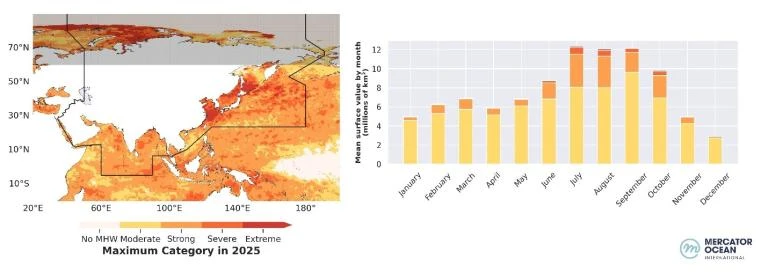
Asia’s seas absorbed another round of record heat in 2025, and the warning reaches far beyond the shoreline. The World Meteorological Organization said ocean heat reached a new record, marine heatwaves spread across almost the entire ocean area of Asia, and more than 10 million km2 were affected during July through September.
That kind of warmth is not just a measurement problem. Warmer water can add energy to tropical cyclones, raise humidity and heat stress inland, and change the rainfall patterns that govern monsoons, farming and flood risk across densely populated countries.

The scale of the change is stark. The World Meteorological Organization said Asia’s warming trend from 1991 to 2025 was roughly twice as fast as the pace seen from 1961 to 1990, and 2025 ranked between the second and fourth warmest year on record in the region, depending on the dataset. Japan, China and South Korea all logged their hottest summer on record.
The damage was visible on land and in the mountains as well as at sea. Exceptional monsoon and tropical cyclone-related rainfall caused devastating flooding in Pakistan, Sri Lanka and Viet Nam, while drought hit parts of West Asia, including Iran. In High-mountain Asia, all 23 monitored glaciers lost mass in 2025, adding pressure on water supplies and raising the risk of glacier-related floods and collapses.
The 2024 regional climate report had already pointed to a dangerous backdrop: sea surface temperatures in Asia were the highest on record, and sea level rise on the Pacific Ocean and Indian Ocean sides of the continent exceeded the global average. The 2025 findings sharpen that picture, showing continued ocean warming and acidification that threaten marine ecosystems and coastal communities, along with fisheries that depend on stable conditions.
The policy message is plain. Celeste Saulo of the World Meteorological Organization linked rising temperatures, warming ocean waters, higher sea levels and retreating glaciers to major hazards. Armida Salsiah Alisjahbana of the Economic and Social Commission for Asia and the Pacific said heat is intensifying multi-hazard risk across food systems, public health, infrastructure and oceans.

That risk may rise again. On June 11, 2026, the NOAA Climate Prediction Center said El Niño conditions were present and expected to strengthen into the Northern Hemisphere winter of 2026-27, with the Niño-3.4 index at plus 0.7C. The United Nations has urged countries to strengthen early warning systems as above-average temperatures and more extreme weather loom, a reminder that record ocean heat is not an isolated spike but part of a wider climate stress system.
Sources
- [1]nature.com
- [2]wmo.int
- [3]public.wmo.int
- [4]news.un.org
- [5]cpc.ncep.noaa.gov