Technology
Astronomers detect first true sugar in Milky Way cloud
Astronomers have detected erythrulose, a simple sugar with four carbon atoms, in a cloud of gas and dust near the Milky Way’s center, the first time a true sugar has been found directly in space between the stars. The signal came from G+0.6930.027, a chemically rich molecular cloud in the Galactic Center region, and the finding became public on July 13, 2026.
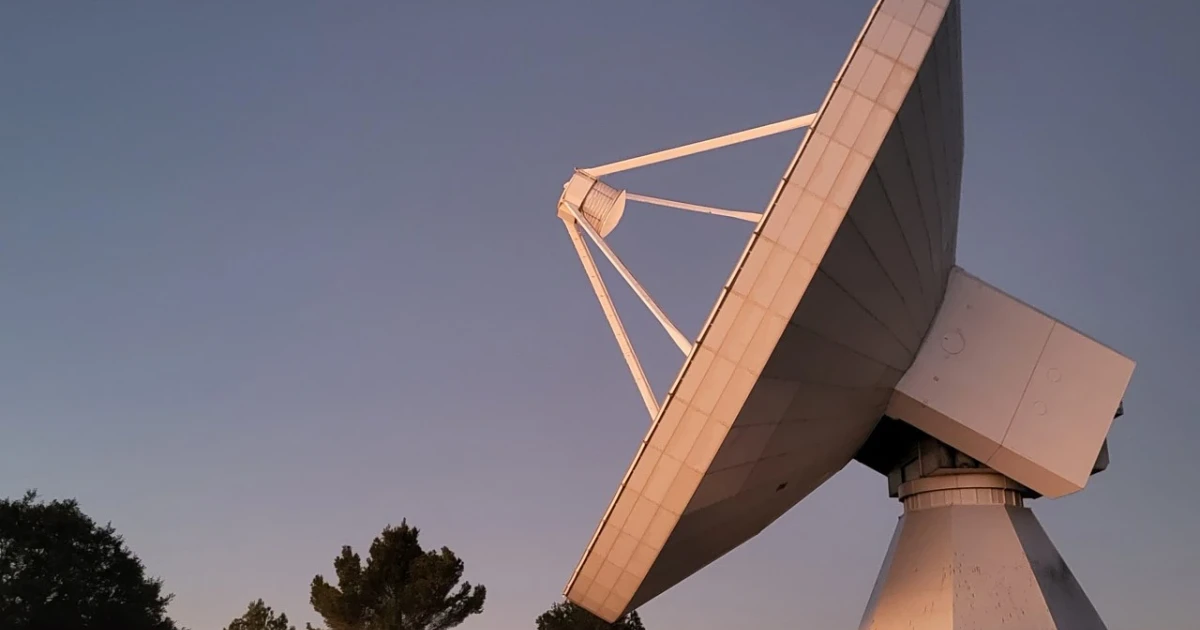
The identification rested on radio spectroscopy, a technique that reads a molecule’s unique pattern of frequencies like a fingerprint. Researchers used the 40-meter Yebes radio telescope in Spain and the 30-meter IRAM telescope to survey the cloud, then matched 12 spectral lines to laboratory spectra of erythrulose measured at the University of the Basque Country. That many matching lines gives the detection far more weight than a single spectral feature would.
The result matters because sugars sit at the center of origin-of-life chemistry. They are building blocks for RNA, DNA-related chemistry and other biomolecules, yet no sugar had ever been directly detected in the interstellar medium before this observation. Ribose and glucose had turned up in meteorite and asteroid samples, which already hinted that some prebiotic chemistry may have started off Earth. Erythrulose is now the most complex sugar identified beyond the Solar System, and the team says it appears to be at least eight times more abundant than analogous three-carbon sugars in the same region.
The researchers argue that erythrulose can form on interstellar dust grains from simpler two-carbon aldehydes and alcohols, rather than only through the step-by-step carbon growth route that has often dominated astrochemical models. That makes the cloud a stronger test case for how organic molecules can assemble in cold space before planets even form. It also helps explain why the Galactic Center has long been treated as a natural laboratory for complex chemistry, with earlier ALMA work on Sagittarius B2 revealing more than 40 dense cores and thousands of molecular spectral lines, including species related to sugars and other life’s ingredients.
The team estimates that between 0.5 million and 50 million tonnes of erythrulose could have reached Earth during the Late Heavy Bombardment, roughly 4.1 billion to 3.8 billion years ago. Carlos Briones said the discovery opens the possibility of finding other sugars in space, including ribose. The detection does not show life elsewhere, but it does show that one of biology’s core molecules can arise in interstellar clouds long before life has a chance to begin.
Sources
- [1]news.google.com
- [2]nature.com
- [3]eurekalert.org
- [4]arxiv.org
- [5]astro.uni-koeln.de
- [6]astrobiology.com