Science
Astronomers Detect Persistent Mega-Laser Signal from Distant Galaxy
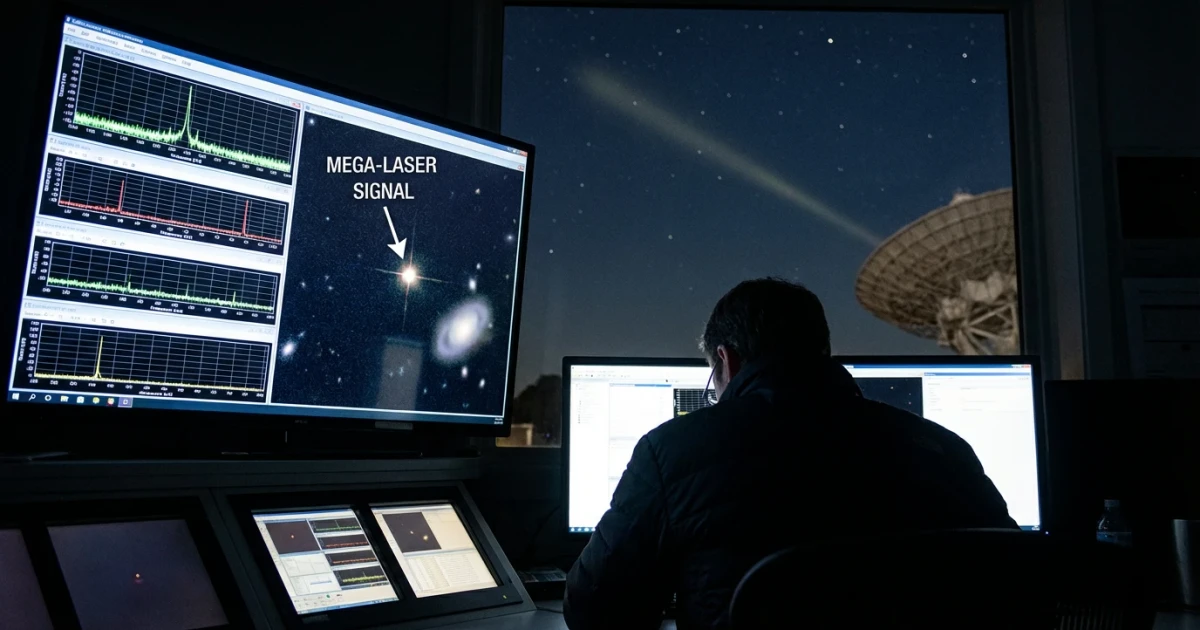
Astronomers have confirmed the detection of a rare and powerful 'mega-laser' beam, or megamaser, emanating from a galaxy nearly 8 billion light-years away. This persistent signal, first spotlighted by The Daily Galaxy, marks one of the most distant and luminous megamasers ever observed, underscoring the rapid progress in radio astronomy and providing a unique window into the universe's past.
What Is a Megamaser?
Astronomical masers are naturally occurring sources of stimulated microwave emission, where specific molecules, such as water or hydroxyl, amplify radio waves under unique physical conditions. When these emissions are millions of times brighter than typical stellar masers, they are dubbed megamasers. These cosmic lasers are often linked to the energetic environments of merging galaxies or active galactic nuclei, offering astronomers clues about star formation, galactic collisions, and the chemical makeup of distant galaxies.
The 8-Billion-Light-Year Discovery
The newly confirmed megamaser, detected by a network of African radio telescopes as highlighted by The Daily Galaxy, originates at a redshift of 0.65, meaning its light has traveled for approximately 8 billion years before reaching Earth. The discovery was further corroborated by data tables and observational parameters available through the VizieR catalog and discussed in technical detail in the peer-reviewed literature.
- Distance: 8 billion light-years (redshift z=0.65)
- Signal strength: Among the brightest megamasers detected to date
- Persistence: Signal remains steady, defying typical fading seen in similar phenomena
According to the European Southern Observatory, such high-redshift megamasers are exceedingly rare. They act as cosmic lighthouses, enabling astronomers to probe the conditions of galaxies when the universe was less than half its current age.
How Was the Megamaser Found?
The discovery relied on the advanced sensitivity of next-generation radio observatories in Africa, with complementary data from global facilities such as the Square Kilometre Array Observatory (SKAO). By targeting known galaxy mergers and using precise spectral analysis, astronomers identified the distinct signature of the megamaser—an intense, narrow radio beam produced by specific molecular transitions. The NASA/IPAC Extragalactic Database provides a searchable catalog of such sources for further exploration and comparison.
Why Does It Matter?
Megamasers like this one are crucial tools for astrophysics. Because their emissions are so powerful and tightly linked to dynamic galactic processes, they help researchers:
- Measure distances to remote galaxies with high precision
- Study the environments of galaxy mergers and supermassive black holes
- Trace the history of star formation and chemical evolution across cosmic epochs
The persistence of the detected signal is especially significant. Unlike transient events that fade quickly, this megamaser provides an ongoing beacon for astronomers to monitor, potentially enabling long-term studies of galaxy dynamics and the conditions that sustain such energetic emissions.
Looking Ahead
This discovery highlights the growing impact of African-led observatories in global astronomy and the promise of international collaborations for unlocking the universe’s deepest secrets. As more powerful telescopes come online, such as the full SKAO array, astronomers anticipate finding additional high-redshift megamasers, each offering fresh clues about how galaxies—and the universe itself—evolve over billions of years.