Science
Astronomers find giant exoplanets as light as shaving foam
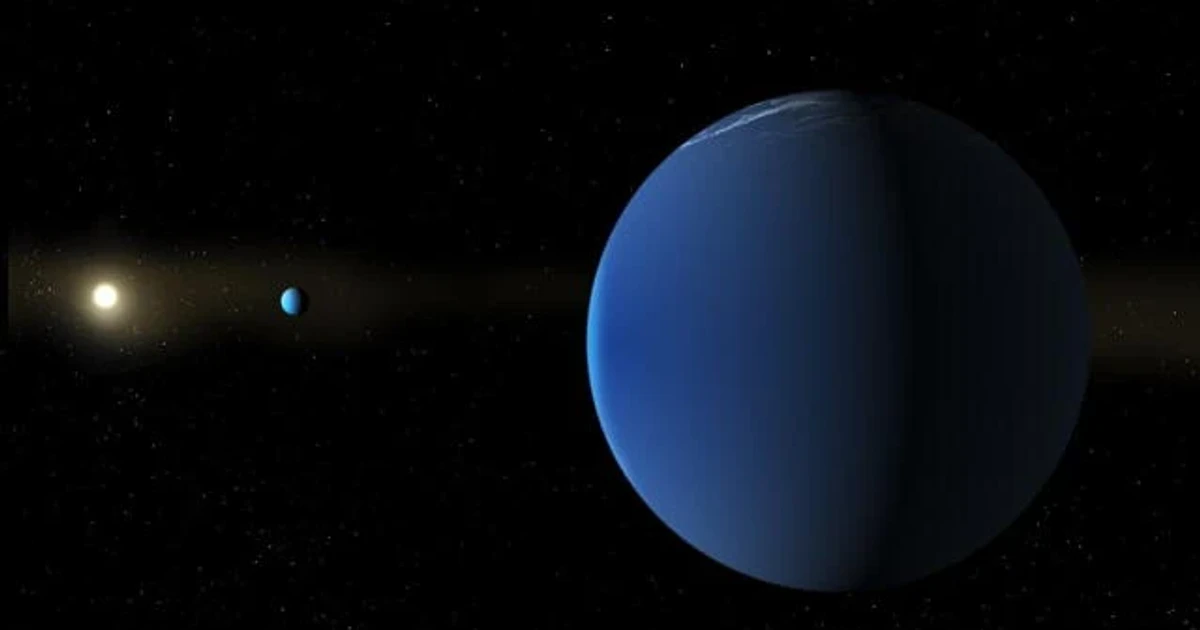
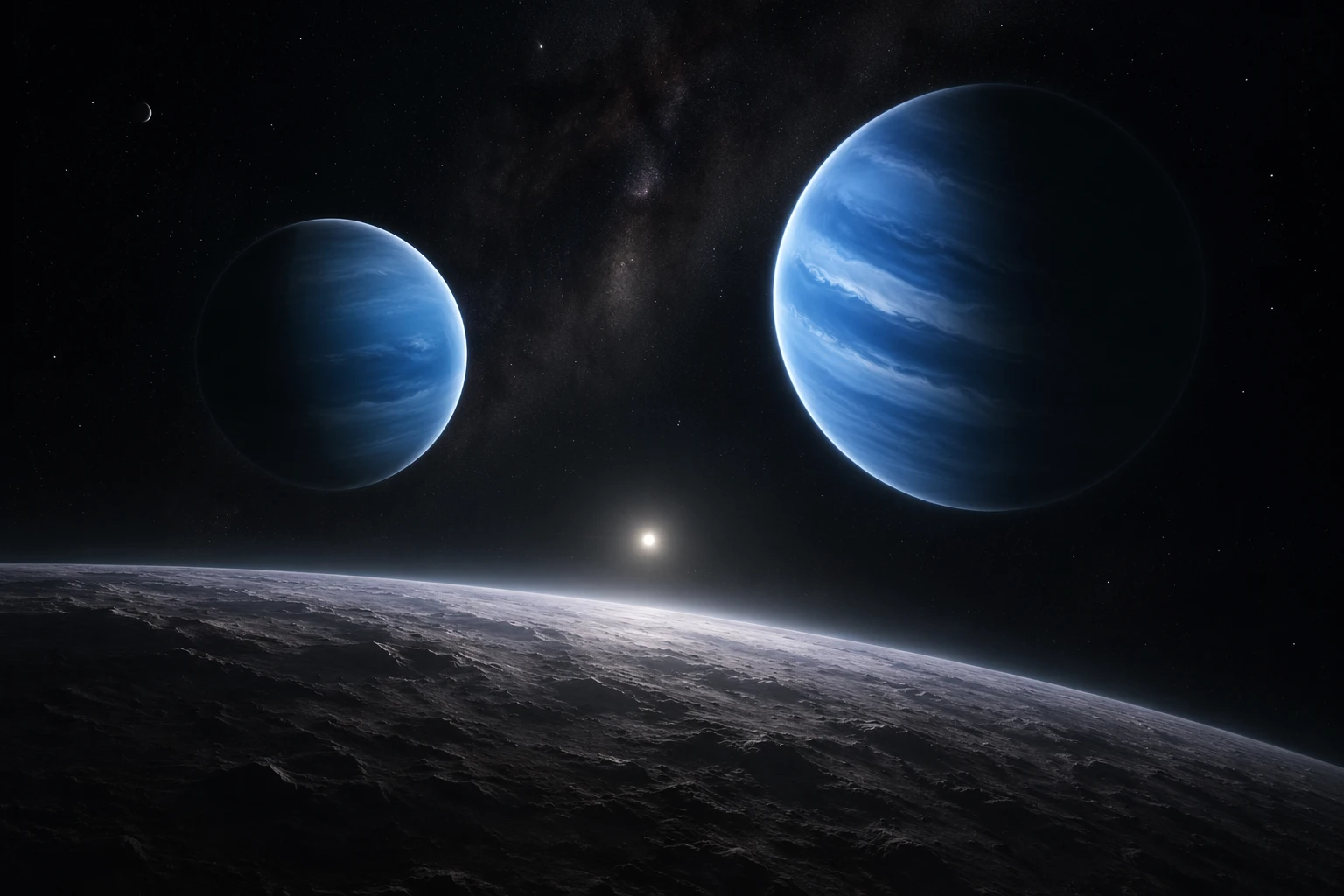
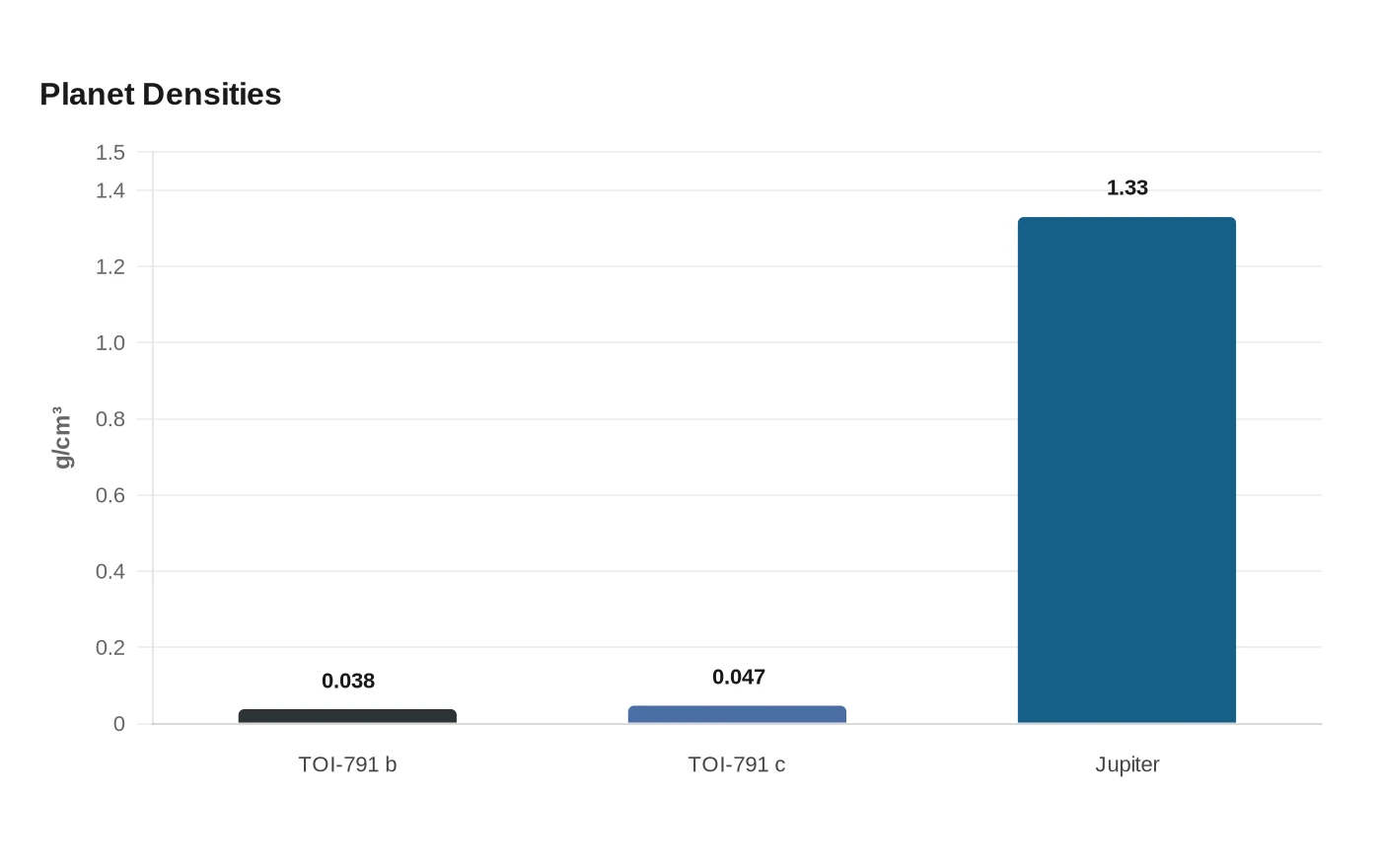
Astronomers have identified two giant exoplanets in the Volans constellation that are so diffuse their densities come in at 0.038 and 0.047 grams per cubic centimetre, lighter than Jupiter by a huge margin. The worlds, TOI-791 b and TOI-791 c, orbit an F7-type dwarf star about 1,110 light-years from Earth and now rank among the lowest-density giant planets ever measured.
TOI-791 b is 0.993 Jupiter radii across and completes one orbit every 139.29931 days. TOI-791 c is even larger, at 1.155 Jupiter radii, with a 232.01570-day orbit. NASA says the smaller planet has just 3.0% of Jupiter’s mass, while the larger carries only 5.9%, even though both are roughly Jupiter-sized. Jupiter’s own average density is 1.33 grams per cubic centimetre, which makes these two planets look almost impossibly puffed up by comparison.
The pair’s architecture is part of what makes them scientifically valuable. The planets sit within 0.07% of a second-order 5:3 orbital commensurability, and that near-resonance produces transit timing variations of up to 50 minutes. Those timing shifts let astronomers calculate the planets’ masses, turning a subtle gravitational rhythm into one of the clearest measurements yet of how little material these worlds actually contain.
The system was first flagged by NASA’s TESS mission, which accumulated 1,122 days of data on TOI-791 over seven years. Ground-based telescopes then helped refine the orbits and densities, while the collaboration behind the discovery included the University of Oxford, Université Côte d’Azur, Observatoire de la Côte d’Azur and the University of Birmingham. The study was published June 25, 2026 in Monthly Notices of the Royal Astronomical Society.
George Dransfield, a researcher at Oxford and Magdalen College, said the planets have densities comparable to “a nice blob of shaving foam, fresh from the can.” He and other scientists think the planets are probably dominated by hydrogen and helium, though Webb Space Telescope observations will be needed to pin down the chemistry and the colors of their skies. Dransfield has suggested they could look white or blue, depending on cloud cover.
The discovery pushes hard against current ideas about planet formation and atmospheric survival. If giant planets can form this light and remain inflated, astronomers have to explain how they collect gas, migrate through their birth disks and avoid losing their atmospheres over time. That question matters far beyond TOI-791: NASA counts nearly 6,300 confirmed exoplanets overall, yet fewer than 40 are thought to be super-puffs, and Oxford says only four other systems are known to host multiple ones.
Sources
- [1]usnews.com
- [2]ox.ac.uk
- [3]science.nasa.gov
- [4]academic.oup.com
- [5]cbsnews.com
- [6]magd.ox.ac.uk