Science
Astronomers Spot Linked Flares on Distant Stars
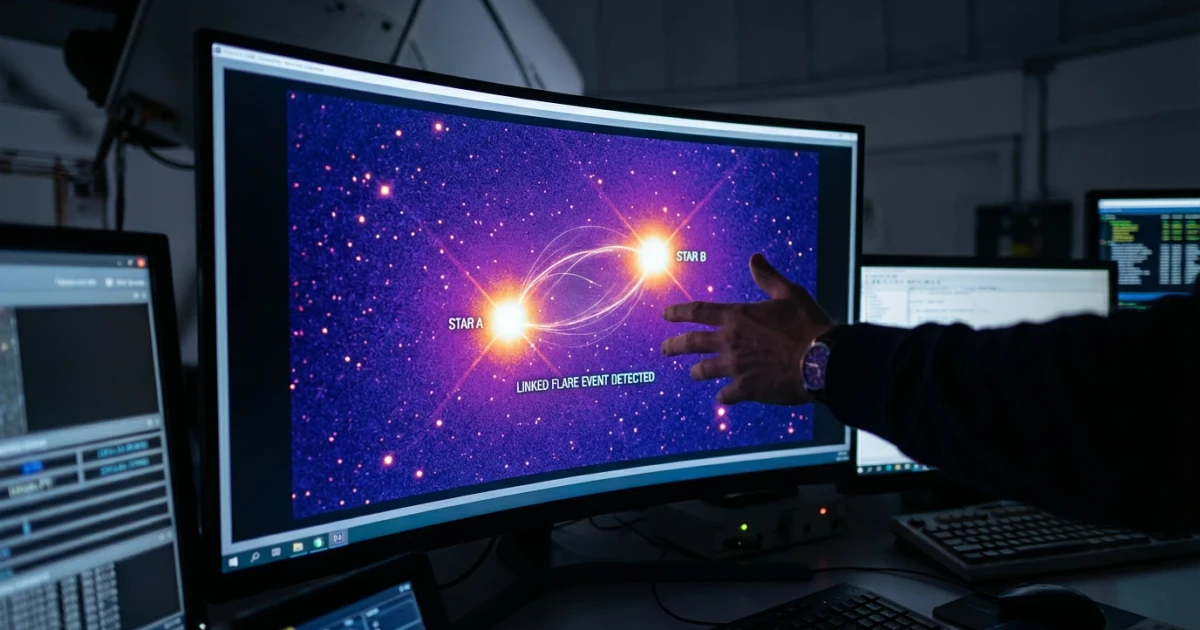
Astronomers have detected a surprising phenomenon: sympathetic flares on distant stars, where bursts of energy appear to trigger additional flares on the same or nearby stellar bodies. This finding sheds new light on how stars behave and could influence our understanding of the environments surrounding exoplanets.
What Are Sympathetic Flares?
Sympathetic flares are sequences of energetic outbursts that occur in close succession, often appearing as if one flare triggers another. While this phenomenon has been observed in our own Sun, the recent discovery marks one of the first times such linked flare events have been identified on stars far beyond our solar system. According to findings reported by The Daily Galaxy, these events help astronomers further unravel the complex magnetic interactions at play in stellar systems.
How Were These Flares Detected?
The identification of sympathetic flares relies on detailed analysis of stellar brightness over time. Modern space telescopes and missions, such as those documented in the NASA Exoplanet Archive and the ESA Cheops Mission Archive, record light curves—graphs of a star's brightness—which can reveal the telltale spikes of flare events. In this case, astronomers analyzing data sets noticed patterns where a strong flare on one star was quickly followed by another flare, either on the same star or on a binary companion.
- Sympathetic flares involve linked outbursts, possibly caused by magnetic field interactions.
- Modern observatories capture detailed brightness data, enabling detection of these phenomena.
- Linked flares have implications for the environments around exoplanets orbiting these stars.
Implications for Stellar Physics
The presence of sympathetic flares on distant stars suggests that complex magnetic interactions are not unique to our Sun. According to the VizieR Catalog of Superflares, such events can release immense amounts of energy, sometimes hundreds or thousands of times more powerful than typical solar flares. This discovery prompts new questions about how stellar magnetic fields interact, especially in systems with multiple stars or close-in giant planets that may influence stellar activity.
Consequences for Exoplanet Habitability
Sympathetic flares can impact the atmospheres and surface conditions of orbiting exoplanets. Large and frequent flare events may strip planetary atmospheres or expose surfaces to intense radiation, affecting the potential for habitability. Conversely, moderate flaring could drive chemical processes essential for life. As described in recent research on sympathetic stellar flares, understanding these events is crucial for assessing the real habitability of exoplanetary systems.
Looking Ahead: New Tools and Future Discoveries
With observatories like Kepler and XMM-Newton providing ever more detailed data, astronomers expect to identify more sympathetic flare events across the galaxy. These observations will help scientists refine models of stellar magnetism and guide the search for life-friendly worlds. As this discovery highlights, studying the violent behavior of distant stars is key to understanding both stellar evolution and the broader cosmic environment in which planets—and possibly life—exist.