Science
Astronomers Unveil Precise Power of Black Hole Jets
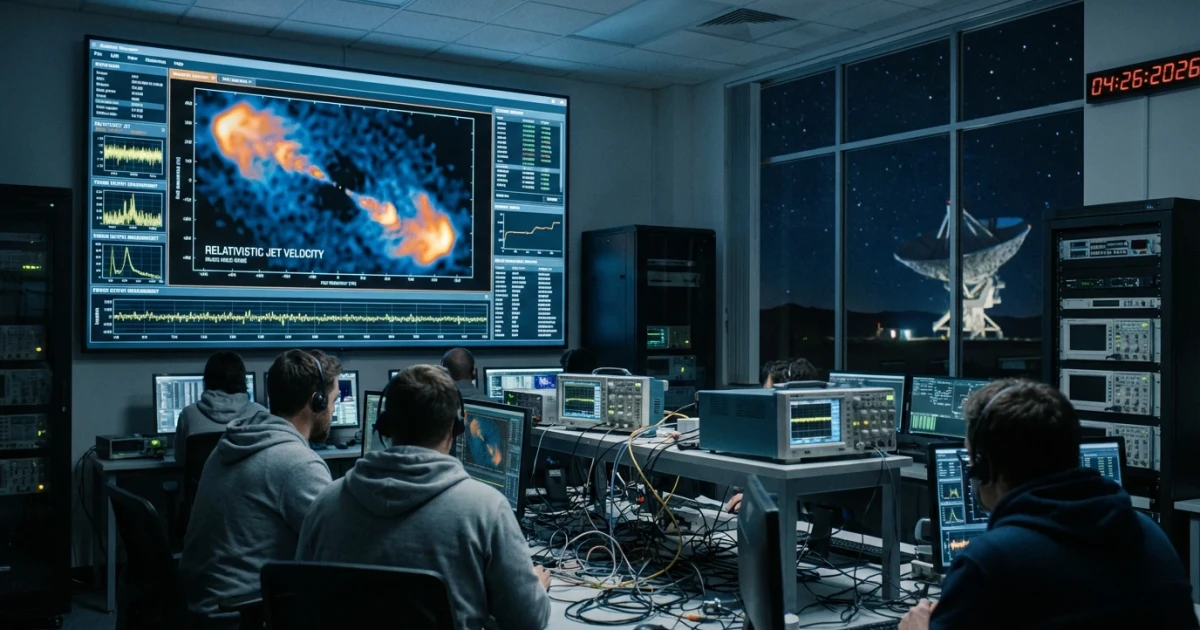
Astronomers have, for the first time, directly measured the immense power and speed of black hole jets, marking a pivotal advance in our understanding of some of the universe's most energetic and enigmatic features. This breakthrough measurement sheds new light on the dynamics of black holes and their influence on the galaxies they inhabit.
Black Hole Jets: Cosmic Engines
Black holes, regions of spacetime with gravitational pulls so strong that not even light can escape, are often surrounded by swirling disks of gas and dust known as accretion disks. In certain cases, these cosmic powerhouses launch jets—narrow beams of particles and radiation—that shoot out from their poles at speeds approaching that of light. These jets can extend for thousands or even millions of light-years, impacting the surrounding galaxy and intergalactic environment.
Historic Measurement of Jet Power and Speed
While black hole jets have been observed for decades, directly quantifying both their power and velocity had eluded astronomers until now. According to the report by ABC News, the recent achievement involves using advanced telescopes and data analysis to measure these characteristics with unprecedented precision. The findings provide crucial data for understanding how black holes interact with their host galaxies and the larger cosmic environment.
- Jet speeds measured are close to the speed of light, confirming long-held theoretical predictions supported by projects like MOJAVE and Fermi LAT catalogs.
- Jet power calculations reveal energies capable of impacting entire galaxies, as seen in the Event Horizon Telescope observations of the M87* black hole.
Implications for Galaxy Evolution
Black hole jets are believed to play a significant role in regulating star formation and distributing matter and energy throughout galaxies. By directly measuring the power of these jets, astronomers can now better quantify their feedback effects—how they heat up surrounding gas and influence galactic evolution. This insight is crucial for refining cosmological models and understanding why galaxies look the way they do today.
Data and Techniques Behind the Breakthrough
The success of this measurement arises from coordinated observations across multiple wavelengths, leveraging both space- and ground-based telescopes. The data underpinning these findings are referenced in extensive public archives, such as the Fermi LAT 4FGL Catalog for gamma-ray sources and the ESO Science Archive for black hole imaging. Peer-reviewed research, including the landmark study of the M87* black hole, provides the foundation for interpreting the measured speeds and energies.
- Gamma-ray observations reveal high-energy processes in jets.
- Radio and optical imaging track jet motion across vast distances.
- Spectral analysis enables energy and mass-flow estimates.
What This Means for Future Research
This first direct measurement opens the door to further studies of black hole jets in a variety of galaxies and environments. By comparing jets from different types of black holes, astronomers aim to uncover the mechanisms that drive their formation and evolution. The findings also help explain the link between supermassive black holes and the life cycles of galaxies, a central question in modern astrophysics.
Looking ahead, upcoming observatories and missions are expected to refine these measurements, unraveling more about the extreme physics near black holes. For those interested in exploring the data behind these discoveries, resources like the NASA/IPAC Extragalactic Database and EHT public data releases offer extensive catalogs for further investigation.
This achievement marks a milestone in our quest to understand the universe's most powerful engines—black holes—and the jets they unleash across the cosmos.