Business
Australia trade deficit widens to decade-high as exports slump
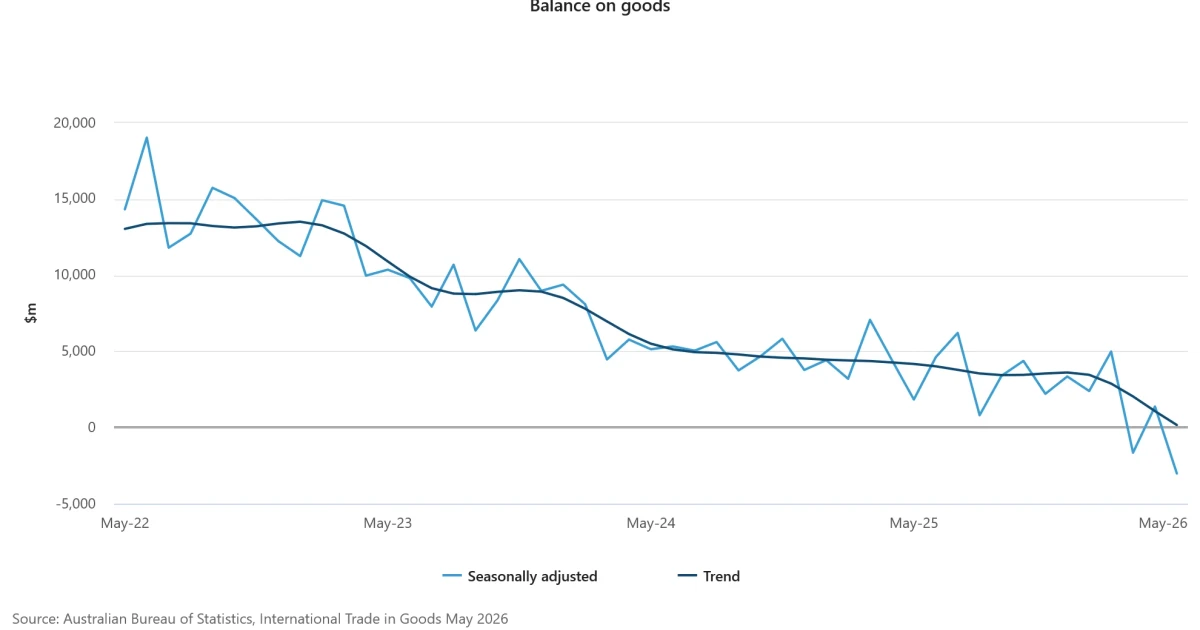
Australia’s goods trade balance swung sharply back into deficit in May, landing at A$3.0 billion after an A$1.4 billion surplus in April and missing economists’ expectations by a wide margin. The Australian Bureau of Statistics said the shortfall was the country’s biggest since late 2015, a reminder of how quickly Australia’s external accounts can turn when commodity shipments soften and import demand strengthens.
The ABS said the seasonally adjusted balance on goods fell by A$4.401 billion in May. Goods credits, or exports, dropped A$3.224 billion, or 6.9%, while goods debits, or imports, rose A$1.177 billion, or 2.6%. That combination turned what had been a large surplus in April into the second trade-in-goods deficit of 2026, and the first since the March deficit in the same series.
The export side did most of the damage. The ABS identified non-monetary gold and metal ores and minerals as the main drivers of the decline, with non-monetary gold falling 35% and iron ore, one of Australia’s most important export earners, down 9%. Imports moved the other way, led by non-industrial transport equipment, civil aircraft and confidentialised items, including stronger purchases of cars, aircraft and telecom equipment.
The May figures land at a sensitive moment for an economy still heavily tied to resource exports and Chinese industrial demand. A single month’s drop does not by itself signal a structural break, but the scale of the swing underscores how exposed Australia remains to price changes in gold and bulk commodities, as well as to shifts in overseas manufacturing activity. For Canberra, weaker export receipts can feed into revenue forecasts and the Australian dollar; for markets, they sharpen attention on whether the latest move is a one-off reset after April’s strength or part of a softer trend.
That broader concern has already surfaced in the ABS’s quarterly accounts. In the March quarter 2026, Australia’s current account deficit widened to A$27.1 billion, and trade in goods and services fell into deficit for the first time since the December quarter 2017. Iron ore and coal led the fall in mining commodity exports, while the ABS said Australia’s balance on goods and services still closed 2025 with a A$6.9 billion surplus. The latest monthly data suggest that cushion is getting thinner as exports become less reliable and imports keep climbing.
Sources
- [1]money.usnews.com
- [2]abs.gov.au