Business
Bank warns homeowners face £45 monthly mortgage rise on new deals

Homeowners rolling off fixed-rate mortgages in the next two years are likely to pay £45 more a month on average when they move to a new deal, the Bank of England said, a jump that still leaves hundreds of pounds a year to find in already stretched household budgets.
The Bank set out the figures in its Financial Stability Report, published on 7 July 2026 and based on data available up to 25 June 2026. It said the average rise for a typical owner-occupier compares with a £120 monthly increase for borrowers taking out new deals between the end of 2022 and the end of 2024, when refinancing costs were far steeper.

The latest warning lands as more than five million homeowners are now expected to see monthly mortgage repayments rise by the end of 2028, up from about four million in the Bank’s previous December forecast. The Bank said more than eight in 10 mortgage customers are on fixed-rate deals, which has delayed the full effect of higher rates for many households until now.
That delay is beginning to unwind because the Bank started raising interest rates at the end of 2021 to tackle inflation. Its July 2023 Financial Stability Report recorded Bank Rate rising from 0.1% in December 2021 to 5% by July 2023, a move that pushed up the cost of fresh borrowing and set up a wave of remortgaging pressure as cheap five-year fixes expire.
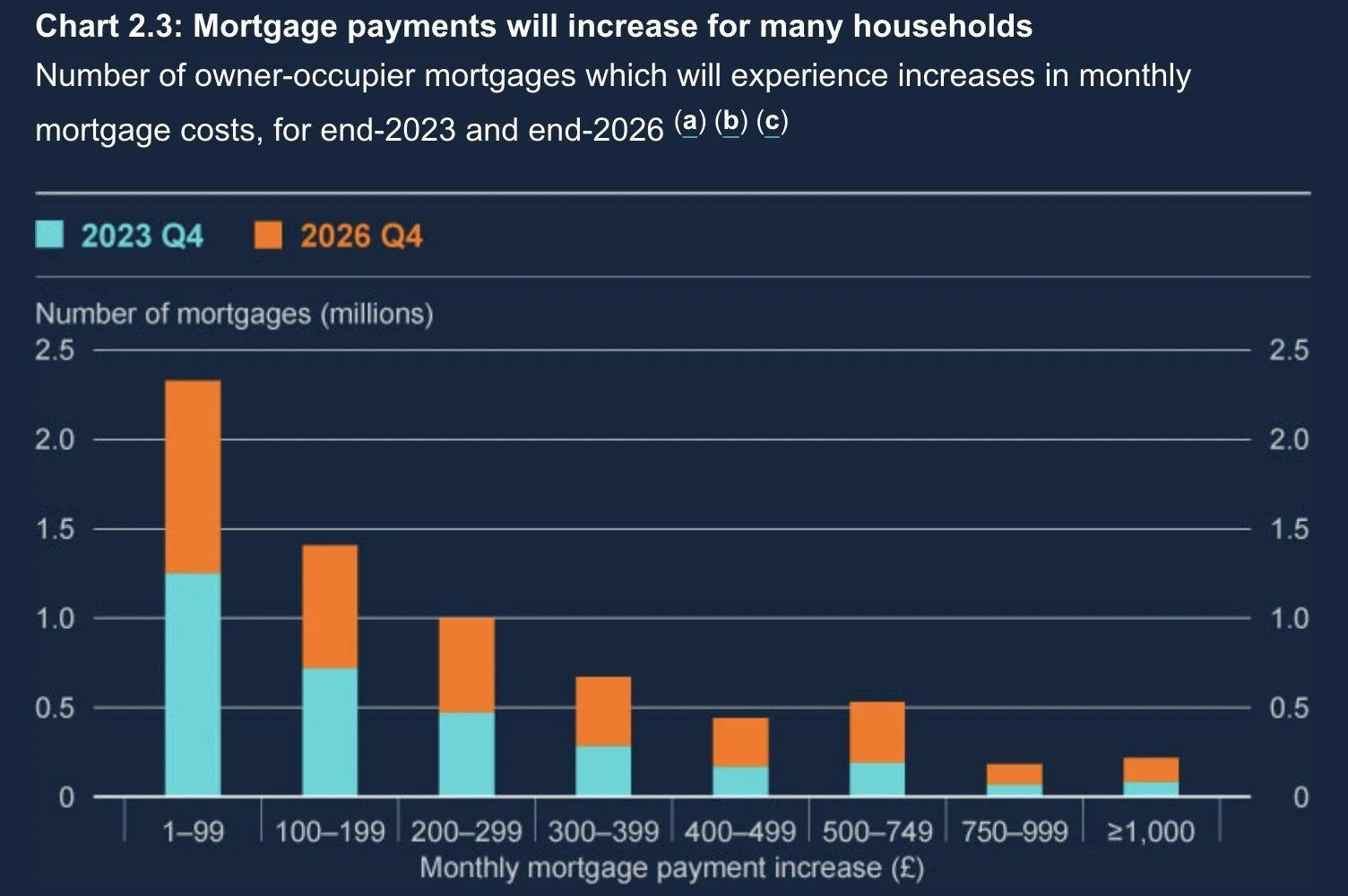
The strain is concentrated among borrowers who locked in long fixed terms before mid-2022, when mortgage pricing was still low. Around 1.8 million fixed-rate mortgages were due to expire in 2026, and separate reporting based on Bank data put the number of five-year fixed-rate regulated mortgages taken out in 2021 at 971,105. Earlier Bank reporting said around 3.6 million households, just over 40% of mortgage holders, were likely to see monthly payments rise over the following three years, while about 30% of homeowners had still not refinanced since rates began climbing.
For some borrowers, the move onto a new deal is far more severe than the average suggests. Earlier analysis indicated about 400,000 households could see monthly increases of 50% or more, with annual rises of up to £5,652 or £2,124 depending on the product they choose. That makes refinancing decisions and housing mobility more difficult over the next two years, especially for lower-income and more vulnerable borrowers, even as the Bank said household finances remain resilient overall.

The report also said vulnerabilities in risky asset valuations, sovereign debt markets and risky credit markets remain, and noted that developments in the Middle East have materially affected the global risk environment.
Sources
- [1]bbc.co.uk
- [2]bankofengland.co.uk
- [3]finance.yahoo.com
- [4]which.co.uk
- [5]telegraph.co.uk