World
BBC asks people worldwide what they think of America today
In Pew Research Center surveys across 36 countries, only a median 35% say the U.S. contributes to peace and stability, while 63% say it does not.
A country that still divides the world
Pew’s 2026 Global Attitudes Survey reached 42,151 adults in 36 countries between February 8 and May 13, 2026, with another 3,507 U.S. adults interviewed in late March. It followed Pew’s 2025 finding that the U.S. drew a 49% favorable and 49% unfavorable median rating across 24 countries. In that same 2025 survey, people in eight countries most often named the U.S. as the world’s leading economic power, while 12 countries leaned toward China.
The geography of affection is uneven. In 2025, the U.S. got its most favorable rating in Israel, where 83% viewed it positively, and majorities also saw it favorably in Brazil, Hungary, Japan, Kenya, Nigeria, Poland and South Korea. The weakest scores came from Sweden, where 79% had a negative opinion, and from neighboring Canada and Mexico, where more than six-in-ten adults viewed the U.S. negatively.

Where the American brand still travels
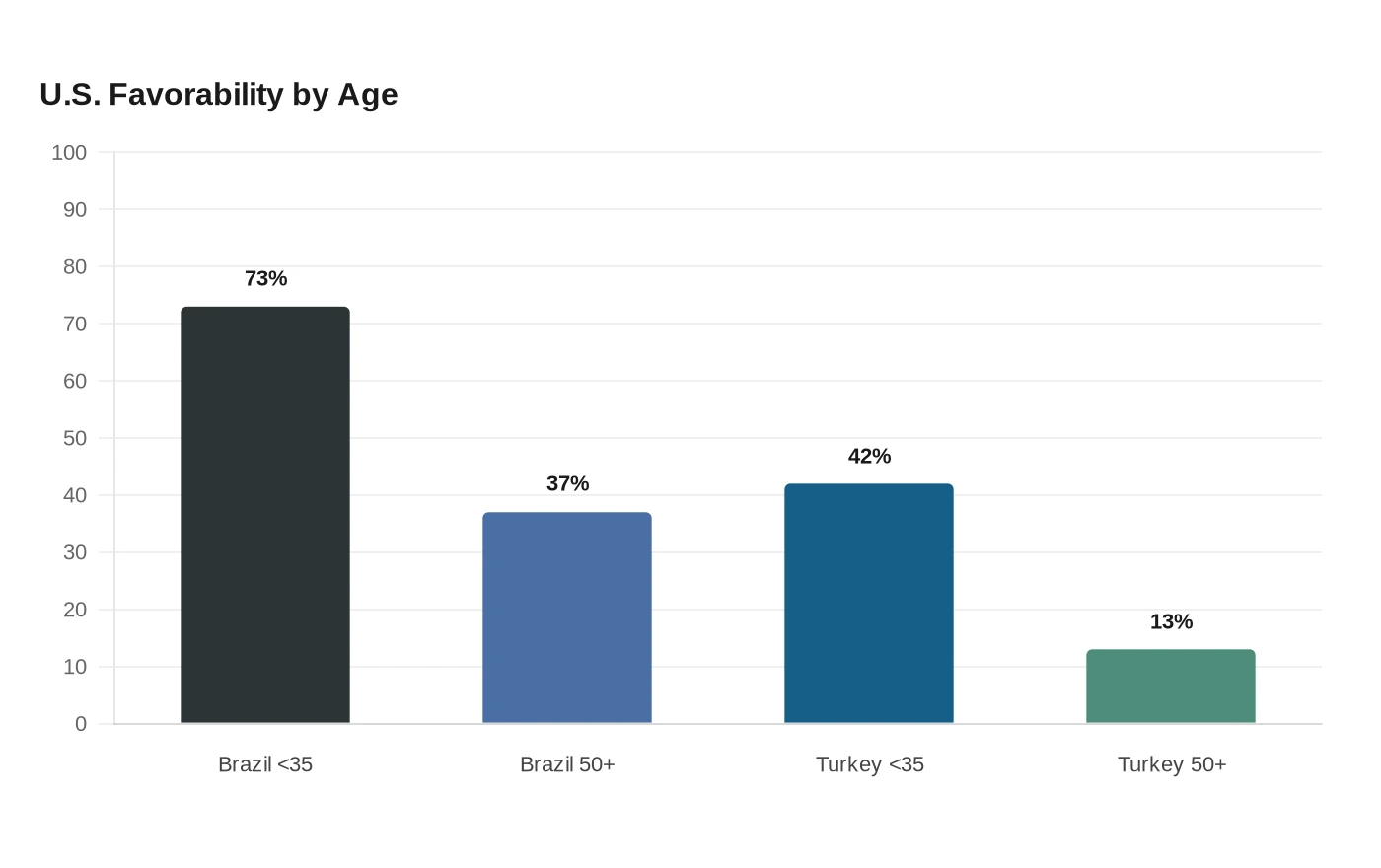
Even in countries where politics frustrate people, the U.S. has not lost every form of appeal. In Pew’s 2025 survey, views by age often tilted younger: in most countries, adults under 35 were more positive about the U.S. than those 50 and older. Brazil showed one of the largest gaps, with 73% of younger adults holding a favorable view compared with 37% of older adults, and Turkey showed a similar split at 42% versus 13%.
Pew also found that in 2025 the U.S. was named one of the most important allies by many publics, including as the most common response in 12 of the 24 non-U.S. countries surveyed and tied for the top response in three more.
Where trust breaks first

Foreign policy is where skepticism hardens fastest. In Pew’s 2026 survey, majorities in most countries said the United States does not promote peace and stability and does not take other countries’ interests into account on international issues. Scores were especially low in France, Greece, Italy, the Netherlands, Spain and Sweden, plus just 20% in Argentina.
The sharpest criticism comes from middle-income countries. In Pew’s 2026 survey, majorities in 16 of 17 middle-income nations said the U.S. interferes in other countries’ affairs a great deal or a fair amount, including roughly three-quarters or more in 12 countries. Thailand stood out at 81%, and India was the only country where this view remained a minority opinion, though even there more people said the U.S. interferes than said it does not, 47% to 30%.
Pew’s 2025 balance-of-power survey shows the same tension from another angle. The U.S. was the most common answer for a country’s most important ally in many places, yet it was also seen as a top threat in several others, including Canada and Mexico, with roughly a quarter or more of adults in Argentina, Brazil, Indonesia and South Africa also naming it that way.
Democracy, not just power, is on trial
The BBC’s question turns on whether America’s internal system still models the values it exports. In Pew’s 2025 survey, a median 50% across 24 countries said democracy works well in the U.S., while 46% said it works poorly, and most agreed the country has strong partisan conflict.
Americans themselves are not projecting certainty. Pew’s June 2026 survey found that 69% of U.S. adults were dissatisfied with how things were going in the country, and 59% thought the country’s best years were behind it. In another 2025 Pew measure, 52% of Americans said U.S. influence in the world had been getting weaker.
Sources
- [1]bbc.co.uk