Sports
BBC pundits predict 2026 World Cup winners, with England and Scotland eyeing surprises

France may be the consensus pick, but the 2026 World Cup is built to punish certainty. With 48 teams, 104 matches and three host nations, the tournament runs from the opening game in Mexico City on 11 June to the final in New York New Jersey on 19 July, and BBC pundits are already weighing safe favorites against bolder surprise calls. Scotland’s first finals in 28 years and England’s hunt for another breakthrough give British audiences a built-in storyline before the knockout rounds even begin.
The scale of the tournament changes the argument

This is the first World Cup to feature 48 teams, and FIFA says 1,248 players from 48 nations were confirmed when final squad lists were submitted on 2 June. FIFA also says 42 teams had already booked their places, a reminder that the field is both larger and more global than any previous edition, with 16 host cities spread across Canada, Mexico and the United States. That breadth matters because it pushes the competition away from a single-center rhythm and into a month of movement, recovery and adaptation.
Where the BBC panel and the market meet
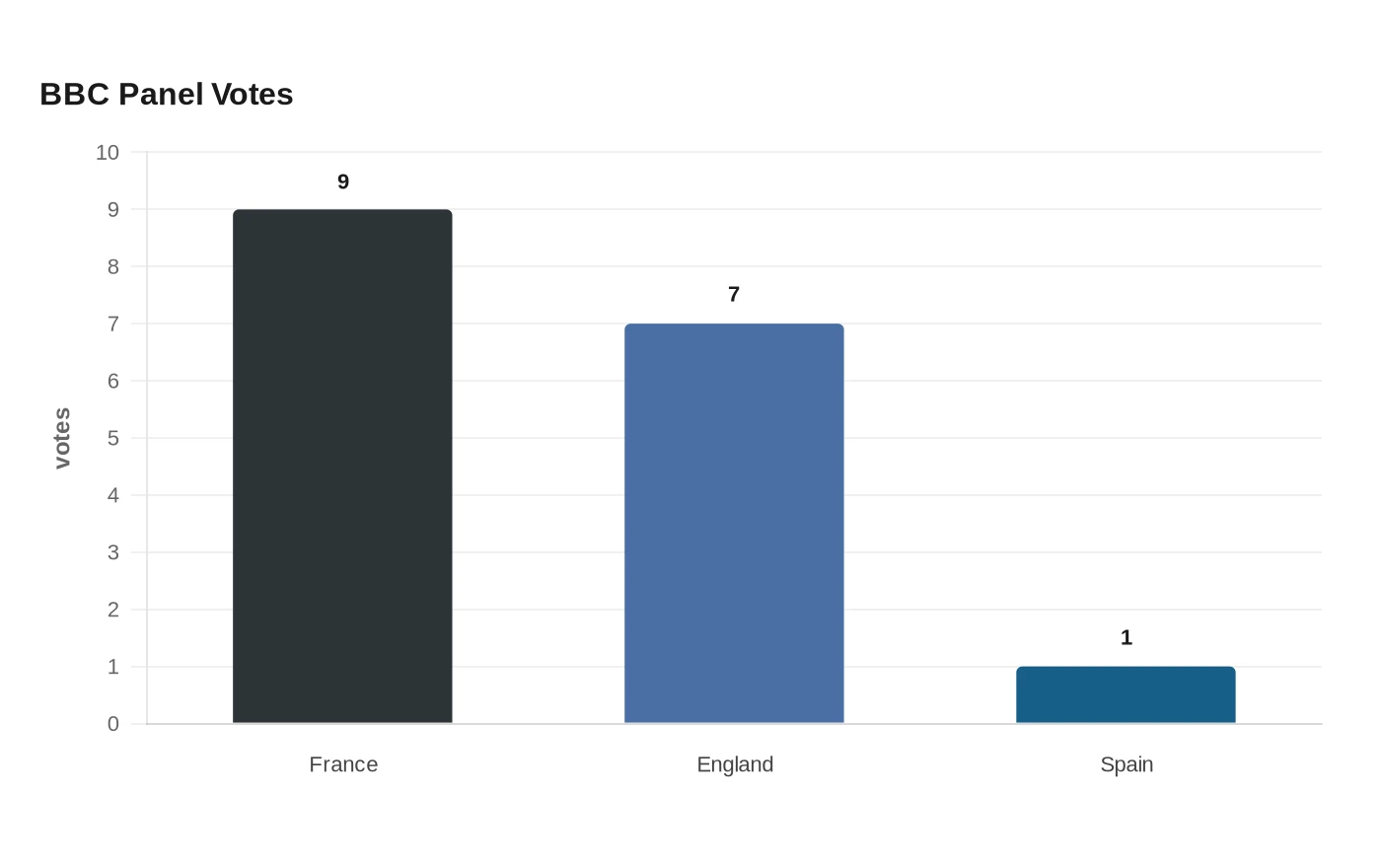
The BBC’s own panel tilted toward France, with nine votes, while England drew seven and Spain one, which gives the story a clear shape: a lot of respect for elite depth, but no runaway favorite. Alan Shearer backed France, but only if there is no in-house fighting, a warning that even the deepest squads can unravel under their own expectations. Micah Richards added a different lens, saying, “How teams deal with the humidity is going to play a big part,” which points to the tournament’s climate as much as its talent.
The market lines up with that broad view, but not perfectly. One recent DraftKings board had France and Spain both at +475, England at +700, Brazil at +850, Argentina at +900 and Portugal at +1000, while a BetMGM snapshot listed Spain at +400, England at +600, France at +650, Brazil at +750 and Argentina at +800. FIFA’s latest men’s rankings add another layer of consensus, with France first, Spain second, Argentina third, England fourth and Portugal fifth. The message is clear: the pundits are not hallucinating an England run, but they are also not crowning it as the likeliest outcome.
Scotland’s story is bigger than the bracket
Scotland’s return is the emotional counterweight to all the forecasting. Steve Clarke’s side ended a 28-year absence from the finals by qualifying for Group C, where they will meet Haiti, Morocco and Brazil, and their group matches are scheduled in Boston and Miami. The squad includes captain Andy Robertson, John McGinn, Kieran Tierney and Scott McTominay, while Billy Gilmour has withdrawn injured and been replaced by Tyler Fletcher.
That return carries real historical weight. Clarke has managed Scotland since May 2019 and previously took them to UEFA EURO 2020, their first major tournament for 23 years, but the national team’s World Cup record still shows a hard ceiling, with a best finish of the group stage and a last finals appearance in 1998. On the record books, Joe Jordan remains Scotland’s top World Cup scorer with four goals and Jim Leighton their most experienced finals player with nine appearances. Those numbers do not doom this squad, but they do explain why even optimistic projections for Scotland are rooted in survival, not fantasy.
England carry expectation, not just hope
England’s position is different, because expectation follows them into every major tournament. UEFA says England and France were the first European teams to book their places for the 2026 finals, and the qualifying format sends the 12 group winners straight through, with runners-up and selected Nations League teams forced into play-offs. England also open their group campaign against Croatia in Dallas on 17 June, which places them immediately into a high-pressure, high-visibility matchup in one of the tournament’s most scrutinized U.S. venues.
That is why the BBC split matters. Wayne Rooney, for one, sees England and Spain meeting in the final and wants England to win it, while the market keeps England just behind the top two. For U.S.-based viewers, that combination of expectation and geography creates a familiar pattern: England arrive with a loud support base, but the numbers still say they are chasing France and Spain rather than standing above them.
What North America changes on the ground
The biggest reality check is not tactical, it is logistical. This World Cup unfolds across 16 host cities, and Scotland’s Boston-Miami group route already shows how far teams and supporters may need to travel within one tournament, while the broader spread from Mexico City to Dallas to New York New Jersey makes climate, recovery and mobility part of the competitive equation. In that sense, Richards’ humidity warning is also a public-health warning for a summer tournament, because heat, travel fatigue and uneven access to resources will not affect every team, staff group or traveling fan equally.
France and Spain still look like the cleanest bets, England remain plausible but not dominant, and Scotland’s return is the kind of plotline that can survive any bracket. In a 48-team World Cup spread across a continent, the real surprise may be how often the first consensus proves only partly right.