Politics
Birthright citizenship fight tests 14th Amendment and Supreme Court precedent
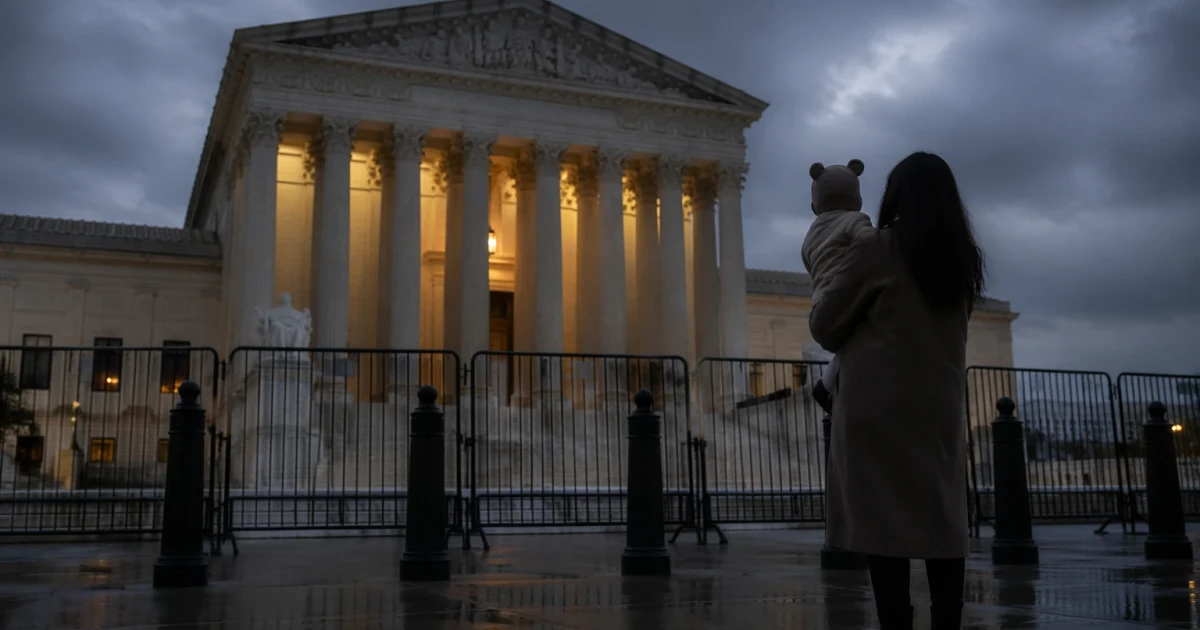
Birthright citizenship sits at the center of the Fourteenth Amendment’s promise that birth in the United States carries legal status, not just geography. The Supreme Court’s current fight over that rule reaches far beyond immigration politics: it tests whether the government can narrow citizenship for children born here to parents unlawfully or temporarily present, and whether that would fracture a principle that has anchored American law since Reconstruction.
The constitutional rule at issue
The Fourteenth Amendment was passed by the United States Congress on June 13, 1866 and ratified on July 9, 1868. The National Archives describes it as a Reconstruction measure designed to secure civil and legal rights after the Civil War, extending the Constitution’s protection to people who had been denied full citizenship in law and in practice. That history matters because birthright citizenship is not an abstract immigration policy. It is one of the clearest expressions of the post-Civil War effort to define equal civil status in the United States.
The current dispute turns on the phrase “subject to the jurisdiction” of the United States. The central question is whether children born on U.S. soil to parents who are unlawfully or temporarily present are covered by that clause and therefore citizens at birth. The same language also appears in the Immigration and Nationality Act, which makes the case legally broader than a single constitutional argument. A ruling to narrow that language would not just affect one group of children. It would invite new fights over who counts as a citizen from the moment of birth.
Why United States v. Wong Kim Ark still controls the debate
The landmark precedent is United States v. Wong Kim Ark, decided in 1898. Wong Kim Ark was born in San Francisco, California, in 1873 to Chinese immigrant parents. After a temporary trip to China, customs officials in San Francisco refused him reentry in 1895, saying he was not a citizen. That refusal forced the Supreme Court to decide whether birth on American soil, by itself, conferred citizenship.
The Court held that the citizenship Wong Kim Ark acquired by birth in the United States had not been lost or taken away. Cornell Law School’s Legal Information Institute summarizes the ruling as confirming that citizenship under the Fourteenth Amendment extends to U.S.-born children of foreign subjects or citizens when the child is born in the United States. In the Court’s modern framing in Trump v. Barbara, Wong Kim Ark understood the Citizenship Clause as incorporating the common law and granting citizenship to nearly all children born in the United States.
That precedent remains the spine of the modern birthright citizenship rule. It is also why efforts to narrow the clause run into immediate constitutional resistance. The Court did not treat citizenship as a discretionary benefit. It treated it as a legal consequence of birth under the Constitution.
How the fight to narrow birthright citizenship works
Anti-birthright-citizenship arguments tend to focus on two claims. First, they argue that undocumented immigration should not confer citizenship. Second, they argue that “subject to the jurisdiction” should be read narrowly enough to exclude children born to noncitizen parents who are in the country unlawfully or only temporarily. Those arguments are not new, but they are resurfacing in current litigation with direct stakes for children born in the United States to noncitizen parents.
The historical record makes that battle especially sensitive. Birthright citizenship was tested in an era of anti-Chinese discrimination, and Wong Kim Ark’s case came after customs officials in San Francisco blocked his return from China. The constitutional question was never just about one man’s paperwork. It was about whether federal and local authorities could use nationality, ancestry, or immigration status to deny the citizenship that birth on U.S. soil was supposed to secure.
That context helps explain why the issue remains so politically charged. It touches immigration enforcement, family status, and the basic legal identity of children born in the country. It also exposes a deeper institutional question: whether the meaning of constitutional citizenship can shift with political pressure, or whether precedent and text still set the boundary.
What would happen if the Court had ruled the other way
A narrower ruling would have produced immediate legal chaos. Hospitals, state agencies, and federal offices would face pressure to determine at birth whether a child’s parents were lawfully present, temporarily present, or outside the country’s jurisdiction in some narrower sense. Citizenship would become harder to verify, not easier, because the legal status of a newborn would depend on the immigration posture of parents at a specific moment.
That uncertainty would reverberate through government systems that rely on citizenship certainty. States issue birth records. Federal agencies use those records to administer benefits, passports, military service rules, and immigration classifications. If citizenship no longer followed a clear rule of birth on U.S. soil, lawyers and administrators would have to sort children into different categories from the start, opening years of litigation over who belongs where.
It would also shift the balance of federal power. Citizenship is one of the federal government’s core constitutional functions, and the Fourteenth Amendment has long served as the stable rule that prevents states from improvising their own definitions. A narrower reading would invite patchwork enforcement and unequal treatment, with citizenship protections depending on how aggressively different administrations interpret immigration status.
Why this case matters now
The current case is significant because it presses on a rule that has been treated as settled for generations. The Fourteenth Amendment linked citizenship to birth and jurisdiction in the aftermath of civil war, and Wong Kim Ark translated that promise into a concrete legal protection for people born in the country. If the Court were to construe that promise more narrowly, it would not simply adjust immigration policy. It would alter the legal meaning of American birth itself, replacing a bright-line constitutional rule with a system built on uncertainty and dispute.
Sources
- [1]nytimes.com
- [2]supremecourt.gov
- [3]archives.gov
- [4]law.cornell.edu