Health
Blood tests could transform Alzheimer’s diagnosis in specialty care
The U.S. Food and Drug Administration cleared the first blood test used to aid in diagnosing Alzheimer’s disease in 2025, and the first real shift is happening in specialty care. For patients with memory problems, that could mean a faster path to answers, fewer invasive procedures, and earlier decisions about treatment and follow-up.
Specialty care is where the change starts
The Alzheimer’s Association released its first evidence-based clinical practice guideline on blood-based biomarkers in July 2025, and it drew a clear boundary around where these tests belong for now. In patients with objective cognitive impairment who present to specialized memory-care settings, the guideline allows a high-sensitivity blood test to be used to triage patients, while a high-sensitivity, high-specificity blood test can be used as a confirmatory test in the diagnostic workup of Alzheimer’s disease.
Blood-based biomarker tests with at least 90% sensitivity and 75% specificity may help rule out Alzheimer’s pathology with high probability, but the recommendation is aimed at specialty care rather than general screening. In practice, that means the test is designed to help memory specialists decide who needs more workup, not to serve as a broad population checkup.
Why p-tau217 has become central

A large share of the excitement centers on phosphorylated tau, especially p-tau217. This biomarker has repeatedly emerged as one of the strongest blood markers for Alzheimer’s-related brain changes, and that strength shows up in both diagnosis and the biology of the disease itself.
A 2024 study found that a blood test using p-tau217 predicted an Alzheimer’s diagnosis with 88% to 92% accuracy. The same line of research performed far better than clinical evaluation alone, and further analysis found that measuring the proportion of p-tau217 by itself produced results similar to using both measures.
The marker is also useful because it tracks amyloid plaques in the brain, which remain the target of recently approved treatments. It can help identify the biology that determines whether a patient is eligible for disease-modifying therapy or a clinical trial.
The first FDA-cleared blood test is already here
That test is the Lumipulse G pTau217/ß-Amyloid 1-42 Plasma Ratio, and it is intended for adults 55 and older who are showing signs and symptoms of the disease.
The test helps identify amyloid plaques associated with Alzheimer’s disease. That makes it a practical tool for clinicians who are trying to decide whether symptoms are likely to reflect Alzheimer’s pathology, rather than another cause of cognitive decline.
What the accuracy data suggest for doctors and patients
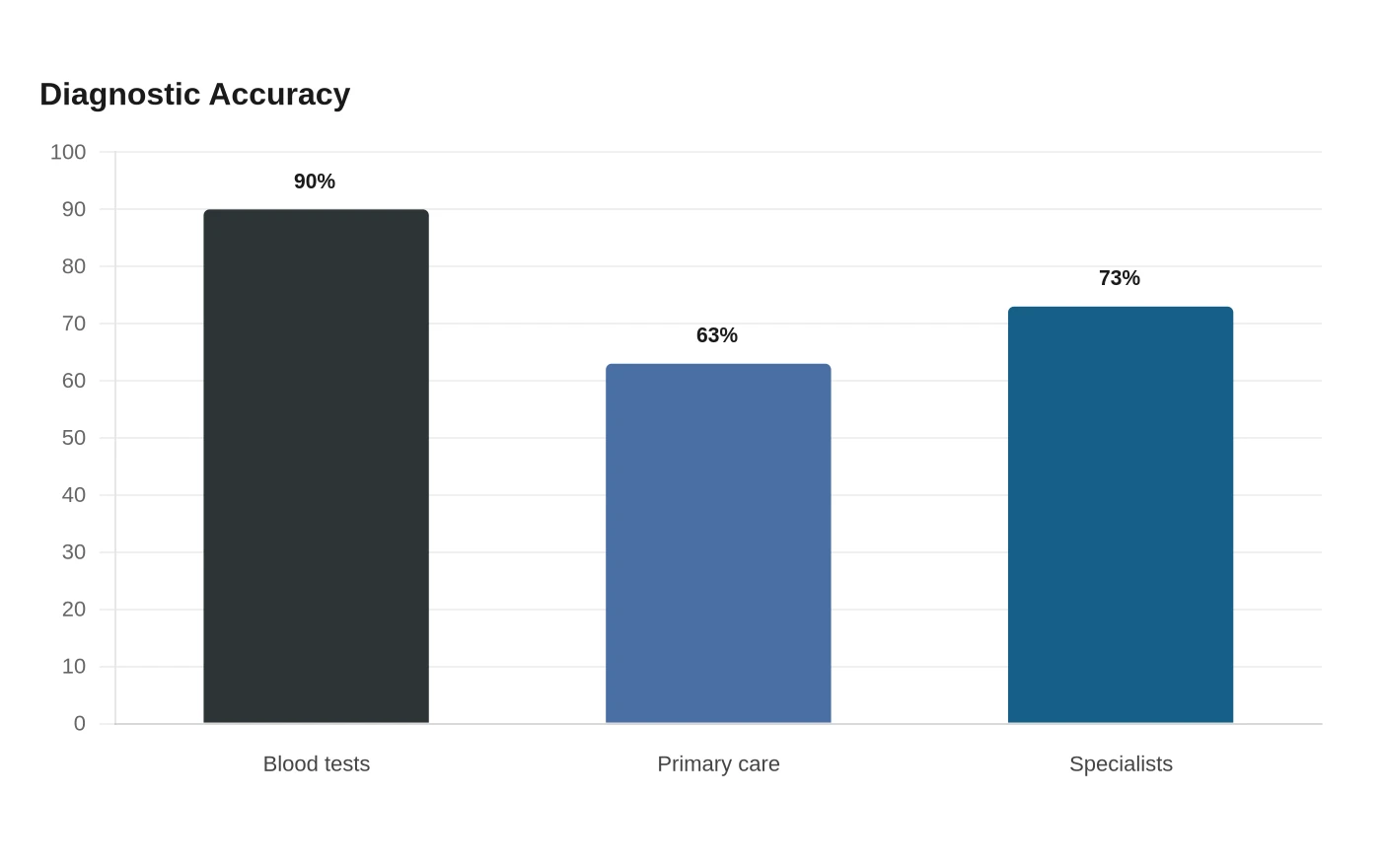
At the 2024 Alzheimer’s Association International Conference, researchers reported that blood tests were about 90% accurate in identifying Alzheimer’s disease among patients with cognitive symptoms seen in primary care and memory clinics. In that study, primary care physicians without the blood test were 63% accurate, and specialists were 73% accurate.
The likely payoff is not just a label, but a faster referral pathway to specialist evaluation, treatment planning, and, when appropriate, trial enrollment. The Alzheimer’s Association says dementia is often underdiagnosed, and that many people who do receive a diagnosis are unaware or uninformed of it.
What remains ready now, and what still is not
The blood tests closest to routine use are the ones that help triage or confirm Alzheimer’s pathology in specialty settings. They are not a universal replacement for PET scans or cerebrospinal fluid testing, both of which remain important when the diagnosis is unclear or when clinicians need a more complete picture.
The Alzheimer’s Association’s guidance is built around evidence-based use in specialized memory care, not broad screening of people without symptoms. The strongest current case for blood biomarkers is in patients who already have objective cognitive impairment and need a more efficient, less invasive diagnostic pathway.
The next frontier is prediction, not just diagnosis
A 2026 NIH report focused on a different blood biomarker, circular RNA, that may nearly triple the risk of near-term Alzheimer’s symptoms. That line of work suggests blood testing could someday help estimate when symptoms will begin, not just whether they are already present.
If that proves reliable, blood biomarkers could influence trial enrollment, monitoring, and even how patients plan for the future. For now, though, that remains a research frontier.
Sources
- [1]nytimes.com
- [2]aaic.alz.org
- [3]nih.gov
- [4]nia.nih.gov
- [5]fda.gov
- [6]jamanetwork.com