Business
Britain’s manufacturing growth slows to four-month low in July revision

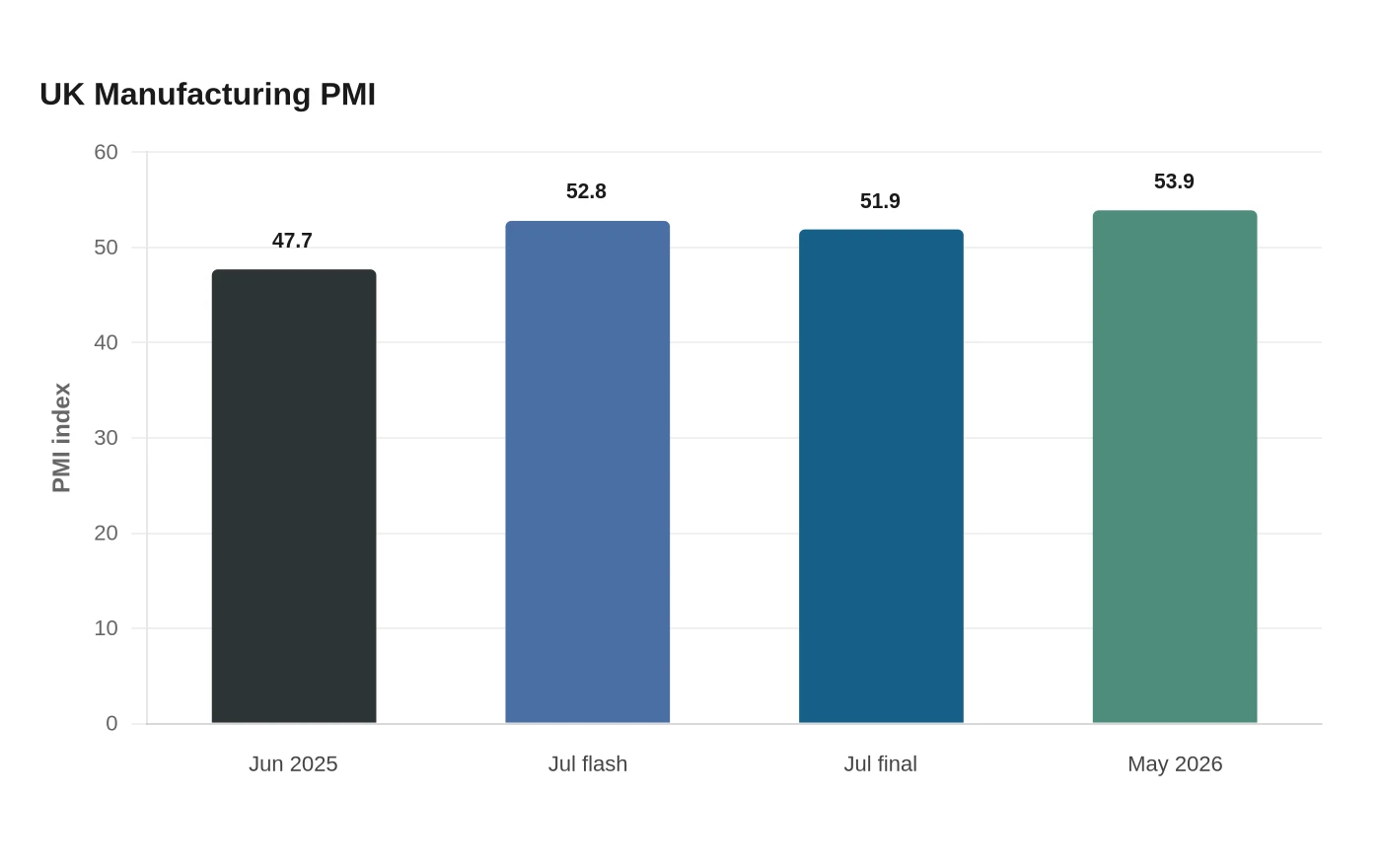
Britain’s manufacturing expansion lost pace in July, with S&P Global’s final PMI revised down to 51.9 from a flash estimate of 52.8 and June’s 52.5. The reading still marked a ninth straight month above 50, the threshold that signals growth, but it was the weakest in four months and showed the sector was advancing far more slowly than investors had hoped.
The downgrade matters because it suggests the drag from the Iran war and softer demand conditions was stronger than first thought. A lower final PMI usually means survey responses from factories were weaker than the initial snapshot, and that can quickly change how markets read the health of Britain’s industrial base. The pound eased toward 1.3450 after the revision, underscoring how closely currency traders watch the factory data for signs of momentum in a country where growth has remained fragile.


The wider backdrop shows how uneven the recovery has been. S&P Global put UK manufacturing at 47.7 in June 2025, a contraction reading that came with output, new orders and employment still falling. By May 2026, the final manufacturing PMI had climbed to 53.9, and S&P Global said the upturn had gathered pace even as supply chains stayed under pressure. July’s flash data initially looked more encouraging still, with manufacturing at 52.8, the output index at 53.6 and the composite PMI at 52.1, while services rose to 51.8 from 48.8. The final factory number now suggests that some of that early optimism was overstated.

That shift matters beyond Britain. Factory surveys feed expectations for exports, investment and hiring, and a weaker reading from a major U.S. ally can ripple through trade flows and industrial sentiment elsewhere. British manufacturers are sensitive to exchange-rate moves, financing costs and foreign orders, so a softer PMI can push companies to delay hiring, trim inventories or hold back on capital spending. For the Bank of England, the reading adds another piece of evidence that growth is uneven even as inflation pressures have not fully gone away. If the slowdown persists into August, it will strengthen the case that Britain’s manufacturing rebound is still more tentative than the flash numbers suggested.
Sources
- [1]reuters.com
- [2]pmi.spglobal.com
- [3]tradingeconomics.com
- [4]kfgo.com
- [5]fxstreet.com
- [6]cmegroup.com