Science
‘Burping’ Black Hole’s Outbursts Continue to Baffle Astrophysicists
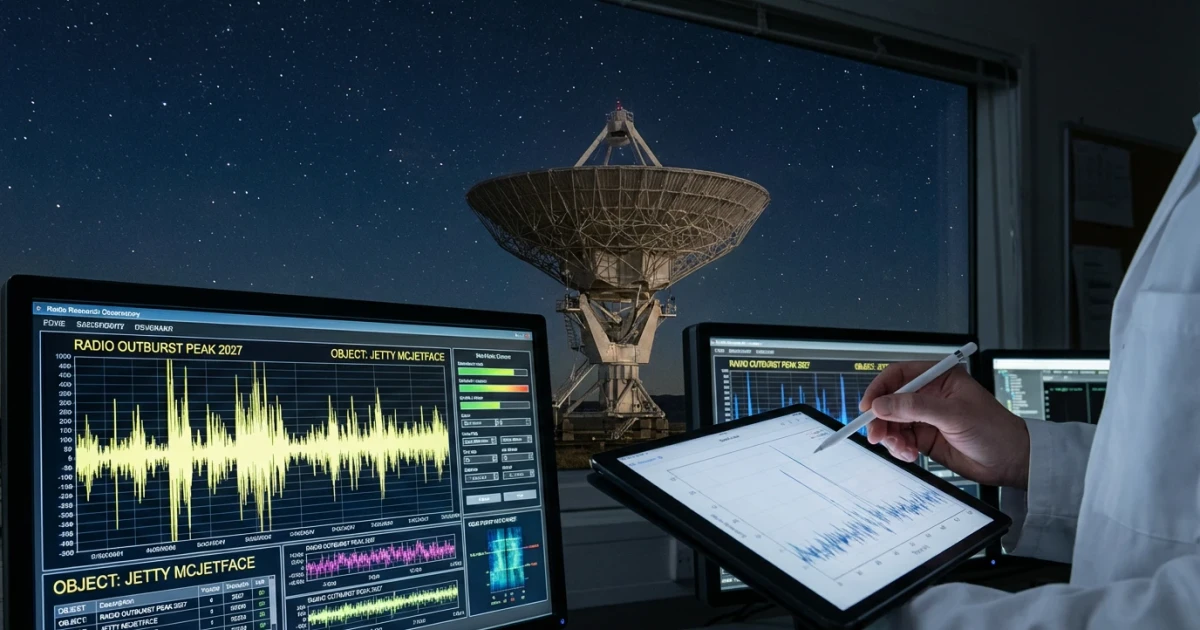
Astronomers worldwide are closely monitoring a remarkable cosmic phenomenon: a so-called ‘burping’ black hole, nicknamed Jetty McJetface, whose unpredictable outbursts are rewriting what scientists know about black holes and their jets.
Unusual Activity: Jetty McJetface’s Persistent Outbursts
The black hole, which made headlines for its dramatic displays, continues to emit powerful jets of radio waves from the aftermath of consuming a nearby star. This process, known as a tidal disruption event (TDE), typically results in a brief period of energetic emissions as material from the shredded star spirals into the black hole. However, Jetty McJetface has defied expectations by sustaining—and even ramping up—its radio jet emissions well beyond the norm.
- Jetty McJetface is the informal moniker for a black hole that’s been under observation since it devoured a star in a distant galaxy.
- Instead of fading, the black hole’s radio jet is growing in intensity, a phenomenon that may peak in 2027 according to current models.
- Such prolonged and increasing activity is rare for black holes following a TDE, making this event a focal point for astrophysical research.
What Makes This Black Hole Unique?
Most black holes that ‘burp’—or emit jets after consuming stellar material—do so for a short time before settling down. In Jetty McJetface’s case, the radio emissions have persisted, challenging the timeline and mechanics of how black hole jets are powered. As reported by Ars Technica, the black hole’s ability to keep ramping up its outbursts has surprised astrophysicists and prompted new investigations into the physics of accretion and jet formation.
This ongoing activity suggests that either more stellar material is being funneled into the black hole than previously thought, or that there are unknown processes at work sustaining its energy output. The extended observation window gives scientists an unprecedented opportunity to study the evolution of black hole jets in real time.
Implications for Black Hole Research
The continuing ‘burps’ from Jetty McJetface could rewrite parts of the astrophysical playbook:
- Challenges existing models of how long and how intensely black holes can emit after a TDE.
- Provides a live laboratory to test theories of jet mechanics and accretion disk behavior.
- May reveal new clues about how black holes interact with their host galaxies over longer timescales.
Looking Ahead: Eyes on 2027
Scientists predict that Jetty McJetface’s jet could reach its peak intensity in 2027, making the next few years critical for observations using radio telescopes around the world. The data collected may help solve mysteries about the nature of black hole feeding frenzies and jet production, with implications for our understanding of galaxy evolution and high-energy astrophysical phenomena.
For the astrophysics community and space enthusiasts alike, Jetty McJetface is a cosmic show not to be missed. As further observations continue, researchers hope to unravel the mechanisms behind this record-breaking ‘burping’ black hole and what it means for the universe at large.
Sources
- [1]Ars Technica