Business
China retail sales fall as economy leans more on exports
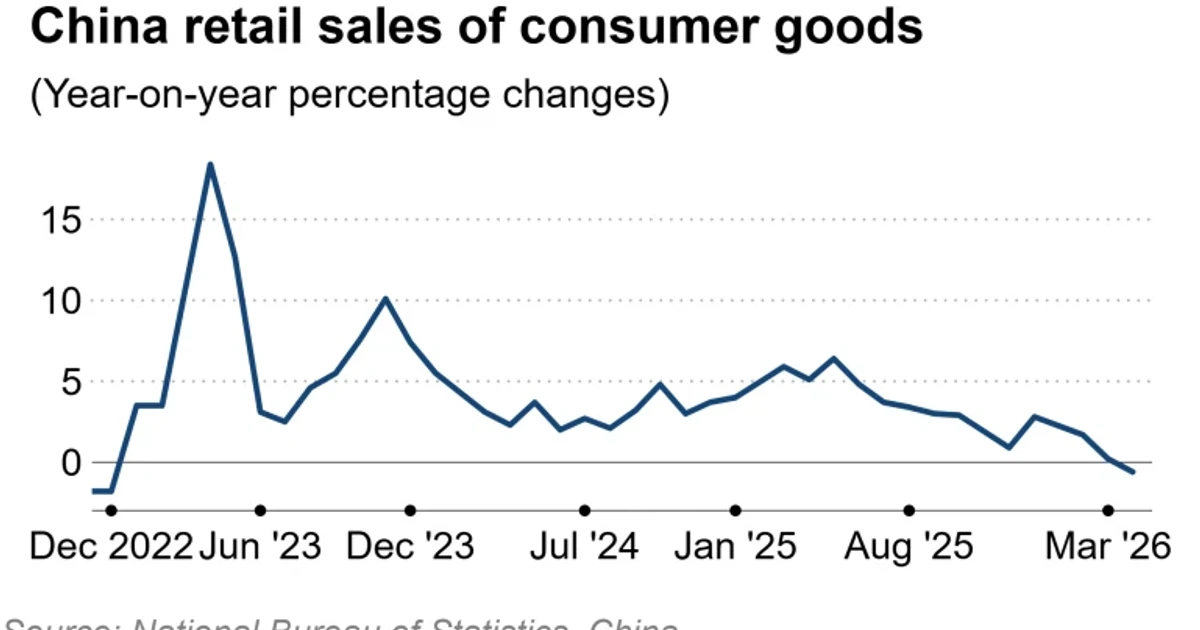
China’s consumers pulled back in May just as exports and factory output kept the economy moving, exposing how uneven the recovery has become. Retail sales fell 0.6% from a year earlier, the first annual decline since December 2022 and a sharp reversal from April’s 0.2% gain. Economists had expected flat growth, so the drop reinforced market worries that household demand was weakening again after earlier support measures faded.
The National Bureau of Statistics said total retail sales of consumer goods and services still rose 2.8% in the first five months of 2026, but that year-to-date figure masked a softer monthly picture. Industrial output rose 4.5% in May, up from 4.1% in April, showing that manufacturing was still benefiting from stronger external demand even as shoppers stayed cautious at home. That gap between exports and consumption is now at the center of China’s growth problem.
The property slump continued to weigh heavily on domestic demand. Fixed-asset investment fell 4.1% in the January-to-May period, a steeper decline than the 1.6% drop recorded in the first four months. Real-estate investment fell 16.2% in the same period, while new-home sales by floor area dropped 10.8%. Those figures matter because housing remains one of the most important channels for household wealth, local government revenue and consumer confidence in China.
The labor market offered little sign of a turnaround. China’s surveyed urban unemployment rate was 5.1% in May, down slightly from 5.2% in April, but still not strong enough to restore spending momentum. Fu Linghui, a spokesperson for the National Bureau of Statistics, said the economy remained broadly stable in May and that the foundation for steady growth still needed to be consolidated. Analysts said the weakness in retail spending reflected fading consumer subsidies and soft household confidence, with stronger exports helping to mask the depth of the domestic slowdown.
The latest data adds pressure on Beijing as it tries to keep growth within its official 2026 target range of 4.5% to 5%. If consumption does not recover, policymakers may have to lean more heavily on stimulus later in the year, even as the export engine continues to carry more of the burden than the household sector.
Sources
- [1]nytimes.com
- [2]cnbc.com
- [3]scmp.com
- [4]firstpost.com
- [5]tradingeconomics.com
- [6]globaltimes.cn
- [7]reuters.com