Business
China’s consumer spending weakens as industrial output stays resilient
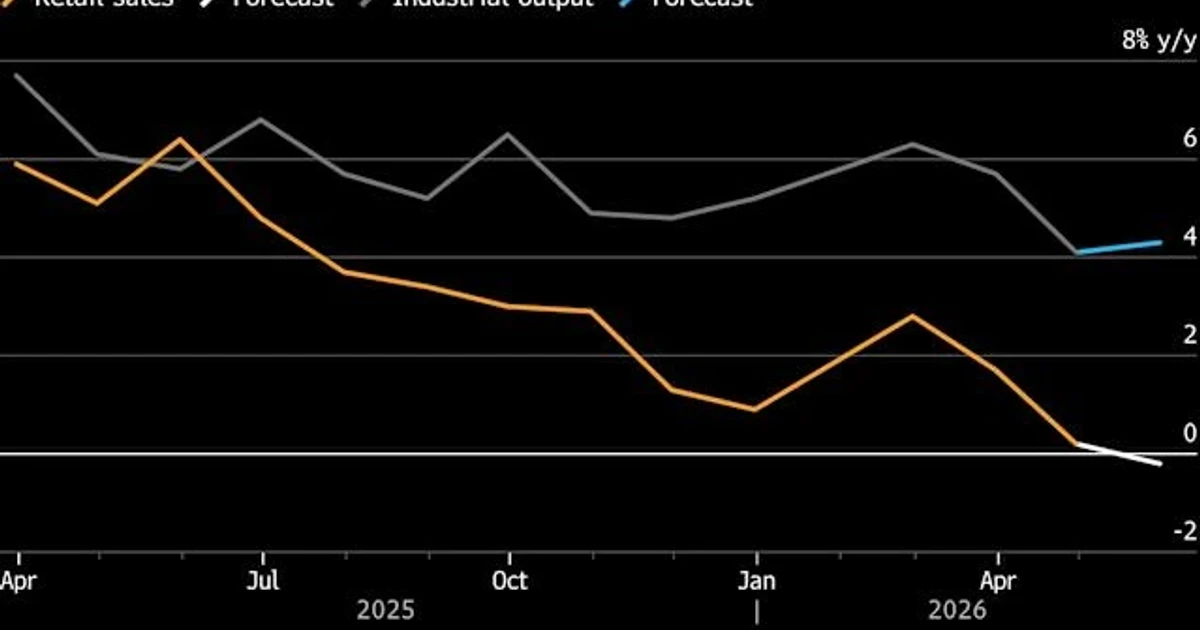
China’s economy split wider in May, with households pulling back while factories kept humming. Retail sales fell 0.6% from a year earlier, the first monthly decline since December 2022, even as industrial output rose 4.5% and high-tech manufacturing jumped 15.1%.
The gap matters because it shows how much of China’s growth is now being carried by exports and industry rather than by domestic demand. Fixed-asset investment also softened, falling 4.1% in the first five months of 2026 after a 1.6% contraction in January-April, while economists had expected only a 2% decline. For Beijing, the message is clear: production is still doing enough to support headline growth, but the consumer side of the economy is losing momentum.
The weakness is spreading beyond shops and malls. Domestic car sales fell for an eighth straight month in May, and separate industry data showed total car sales dropped 22.3% from a year earlier to 1.53 million vehicles. The China Passenger Car Association now expects full-year sales to fall 11%, a sharp reversal from its earlier forecast of a 1% decline. That slide is especially important because autos are one of the clearest gauges of household confidence and big-ticket spending.
Holiday data did little to change the picture. Travel over the five-day Labour Day break rose, and tourism spending increased, but spending per trip stayed weak. A Shanghai bar manager said shrinking corporate entertainment budgets had hurt his business, forcing him to lean on group deals to fill seats and squeezing margins in the process. The pattern suggests people are still moving around the country, but they are spending more cautiously once they arrive.
Policy makers are likely to take notice. Zhiwei Zhang of Pinpoint Asset Management said the weak retail numbers could push officials toward July “fine tuning” after second-quarter GDP data are released. Xu Tianchen of the Economist Intelligence Unit said May was marked by several divides, including between domestic and external demand, AI-related and traditional industries, and goods retail and services consumption. That split captures China’s dilemma: factories and tech-linked sectors can still post solid gains, but unless household demand recovers, the economy will remain more dependent on exports, with rising trade friction making that model harder to sustain.
Sources
- [1]finance.yahoo.com
- [2]money.usnews.com
- [3]whbl.com
- [4]english.news.cn
- [5]stats.gov.cn