Business
China’s economy grows at slowest pace since late 2022

China’s economy grew 4.3% in the second quarter, the weakest pace since late 2022, and the slowdown is already rippling beyond China’s borders through weaker demand for imports, commodities and corporate earnings. The National Bureau of Statistics said the April-to-June expansion was down from 5.0% in the first quarter, below economists’ 4.5% forecast and under Beijing’s 4.5% to 5% full-year target set in March, its least ambitious growth goal in decades.
The deceleration reflected a familiar mix of problems that China has struggled to shake: soft domestic demand, a prolonged property downturn and broad investment weakness. Urban fixed-asset investment fell 5.7% in the first six months of 2026, even as retail sales and industrial output improved in June. Production, exports and some high-tech manufacturing remained relatively resilient, but that was not enough to offset the drag from housing and investment.
The timing matters well outside Beijing. China is still the world’s second-largest economy and one of the biggest buyers of raw materials, so slower growth can weigh on iron ore, copper, energy demand and the earnings outlook for multinational companies that depend on Chinese consumers and factories. It also complicates inflation and trade forecasts in economies that have spent the past year calibrating policy around steadier Chinese demand.
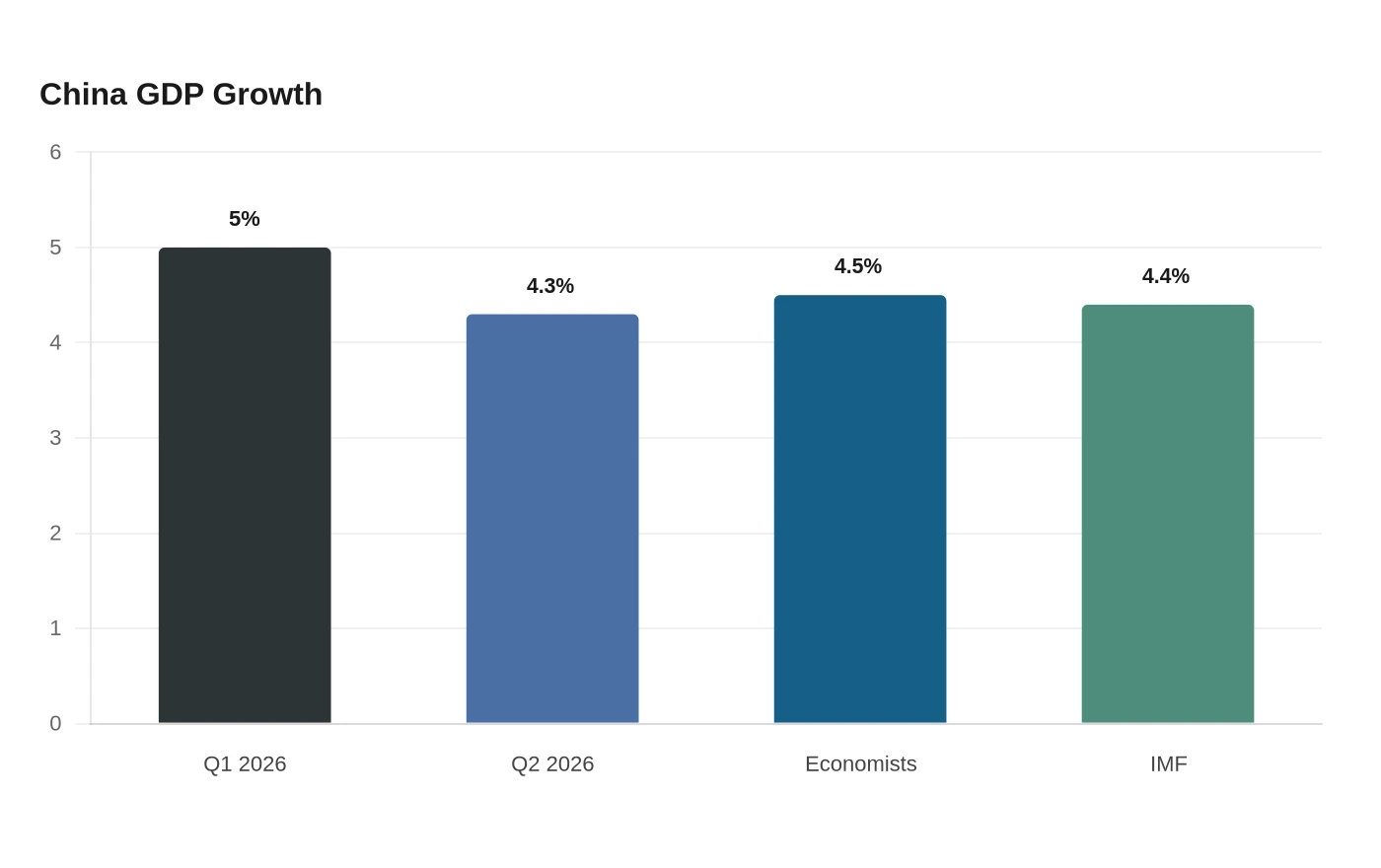
International institutions had already been warning that China was tracking near the low end of its target range. The International Monetary Fund projected 4.4% real GDP growth for 2026 in its April World Economic Outlook, while the World Bank said on July 7 that policy support, high-tech investment and buffers against global energy supply disruptions had partly offset weak domestic demand in the second quarter. That balance shifted as the quarter wore on and a renewed oil shock tied to the Iran war added another external hit.
Beijing still has room to respond, but the latest figures will sharpen pressure for more support. The March government work report also set targets of around 5.5% surveyed urban unemployment, more than 12 million new urban jobs and consumer inflation of around 2%. Policymakers have signaled they may prefer calibrated measures over a large new stimulus package, a choice that would leave China’s recovery more dependent on whether housing, investment and household demand can finally stabilize.
Sources
- [1]news.google.com
- [2]cnbc.com
- [3]msn.com
- [4]straitstimes.com
- [5]worldbank.org
- [6]imf.org
- [7]english.www.gov.cn