Science
Chinese Orbiter Demonstrates Laser Link Over Starlink Network
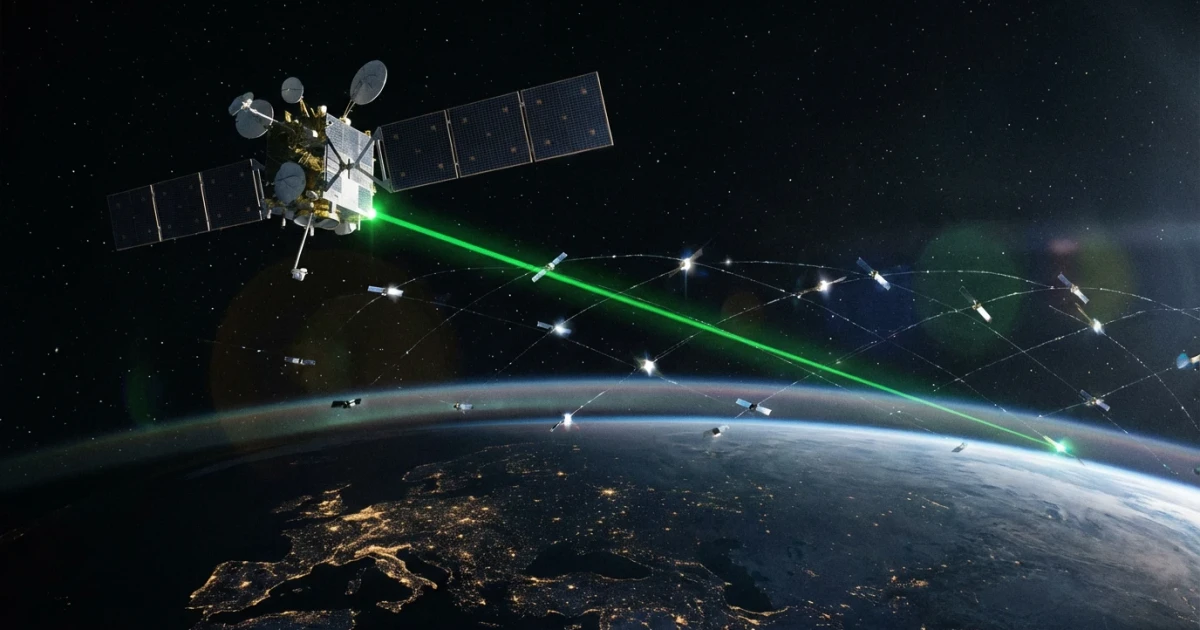
China’s space program has made headlines by demonstrating a space-to-ground laser communication link from a geostationary orbiter, reportedly achieving successful data transmission using only a 2-watt laser from approximately 36,000 km above Earth. The test, highlighted by The Daily Galaxy, suggests a notable advance in the field of spaceborne optical communications—particularly as it was conducted directly over the global coverage of SpaceX’s Starlink satellite network.
Laser Communication: Efficiency and Competition
This latest Chinese demonstration builds on years of laser communications developments in space. Laser links offer significant advantages over traditional radio frequency (RF) systems, including higher data rates, lower power requirements, and improved resistance to interference. According to open-source documentation from NASA and peer-reviewed research, laser communication systems can often achieve high-bandwidth links with just a few watts of power, depending on atmospheric conditions, pointing accuracy, and ground receiver sensitivity.
- The Chinese orbiter operated from geostationary orbit (~36,000 km altitude)
- Reported laser output was 2 watts, a low-power threshold for successful long-distance optical links
- Test occurred over territory covered by the Starlink network, which uses RF bands for internet service
While full technical details of the Chinese system remain proprietary, previous Chinese patent filings for space laser communications, such as CN108347066A, describe architectures compatible with modest onboard power and precise beam steering—both critical for overcoming the vast distance and atmospheric losses in geostationary-to-ground links.
Implications for Global Satellite Networks
This test’s significance lies in its potential impact on the rapidly evolving field of space-based communications. While Starlink’s constellation comprises thousands of low-Earth orbit satellites using RF communications, laser links from geostationary platforms could provide alternative or complementary capabilities, including:
- Higher data throughput for niche or secure use cases
- Reduced risk of RF interference or jamming
- Energy-efficient long-range communications
Peer-reviewed analysis in Scientific Reports underscores the challenge of maintaining high signal quality in such links. However, the Chinese demonstration, if independently verified, would confirm the feasibility of reliable, low-power optical links from GEO distances—an impressive technical benchmark.
Technical Context and Regulatory Environment
Internationally, satellite communication systems are subject to coordination with the International Telecommunication Union (ITU) and national regulatory bodies, such as the FCC Equipment Authorization Database for hardware operating in US territory. Laser systems—unlike RF transmitters—face fewer congestion issues but require precise alignment and atmospheric compensation. The Chinese patent record suggests ongoing investment in adaptive optics and tracking systems to enable such ambitious demonstrations.
Analysis: A Step Forward, and the Road Ahead
While the demonstration has drawn attention for allegedly "crushing" Starlink in efficiency, experts note that each technology serves different operational needs. Starlink’s mesh of thousands of LEO satellites is optimized for mass-market internet access, while laser links from high-orbit platforms may be best suited for specialized, high-throughput, or government applications.
This milestone highlights China’s ongoing push in space technology and the growing diversity of approaches to global connectivity. As more details emerge, industry analysts will closely watch for independent confirmation of test results, performance benchmarks, and possible future deployments.
For readers interested in the technical underpinnings and regulatory landscape of space-based laser communication, further details are available in the Chinese patent filing, recent research analyses, and ESA’s technical overview.