World
Climate lawsuit demands faster fossil fuel phaseout at Port of Rotterdam
On 12 May 2026, Advocates for the Future gave the Port of Rotterdam Authority six months to present a credible plan to wind down fossil-fuel activity, setting up a case that could test whether courts can force a government-owned port operator to accelerate the energy transition. The demand targets Europe’s biggest port and one of the most important fossil-fuel gateways on the continent.
The case targets the Port of Rotterdam Authority, which is jointly owned by the Dutch state and the municipality of Rotterdam and controls leases and infrastructure across the port area. The authority already makes agreements with customers on direct emissions in the port but refuses to make binding arrangements on indirect emissions, even though those are where the larger climate burden sits. Rotterdam is not just a local industrial site but a system-wide hub, with pipeline links to fossil centers in Antwerp and the Rhine-Ruhr area.
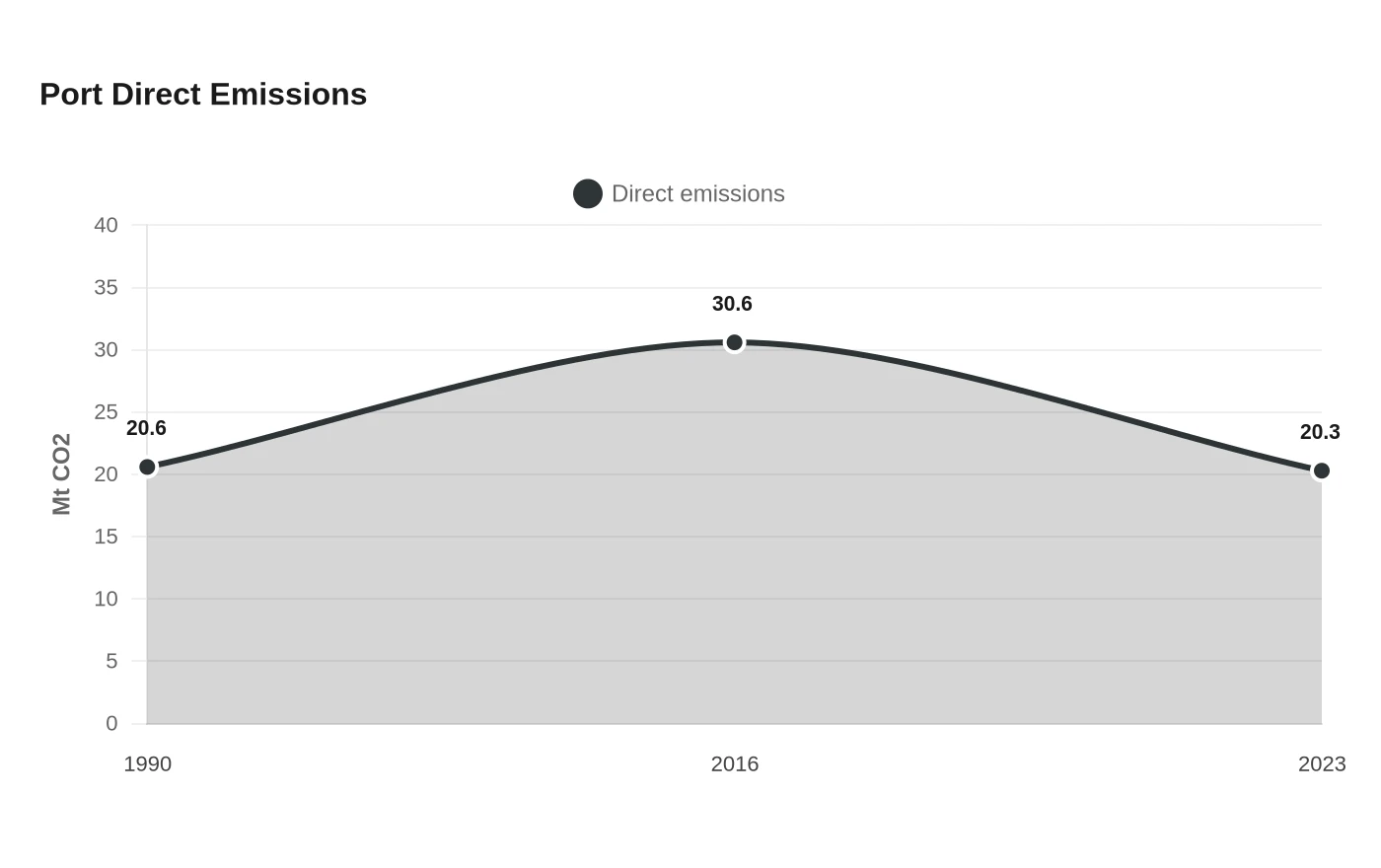
CE Delft estimated that greenhouse-gas emissions tied to fossil-fuel flows through the Port of Rotterdam reached 604 Mt CO2eq in 2023, more than 3.5 times the Netherlands’ annual national emissions. It also found that direct emissions in the port fell from 30.6 Mt CO2 in 2016 to 20.3 Mt CO2 in 2023, slipping below the 1990 reference level of 20.6 Mt CO2 for the first time.
The port is Europe’s largest bunkering port and among the top three bunkering ports worldwide, with about 10 million tonnes of fuel loaded there each year. In 2023, ships bunkered 9.9 million tonnes of fuel in Rotterdam, down from 10.6 million tonnes a year earlier, while LNG bunkering rose from 406,599 cubic meters to 619,243 cubic meters.

The Port of Rotterdam Authority is already stimulating the transition to a climate-neutral port and has made “climate neutral and circular” one of its four strategic priorities. Pressing companies to stop fossil-fuel activity would go beyond its role, clash with current Dutch and European climate policy, and be an ineffective way to cut worldwide carbon emissions. The authority also warns that a forced shutdown of fossil activity could hit energy security and the competitiveness of European industry.
The case targets a government-owned public system player rather than a single factory, pipeline, or permit. Earlier Dutch climate litigation includes Urgenda, Greenpeace against the Dutch government, Milieudefensie’s case against Shell and an International Court of Justice advisory ruling that states have a legal duty to protect the climate.
Sources
- [1]bbc.co.uk
- [2]portofrotterdam.com
- [3]advocatesforthefuture.org
- [4]nltimes.nl
- [5]cedelft.eu