Science
Clovis Toolmakers’ Quartz Crystal Choice Sheds Light on Ancient Craft
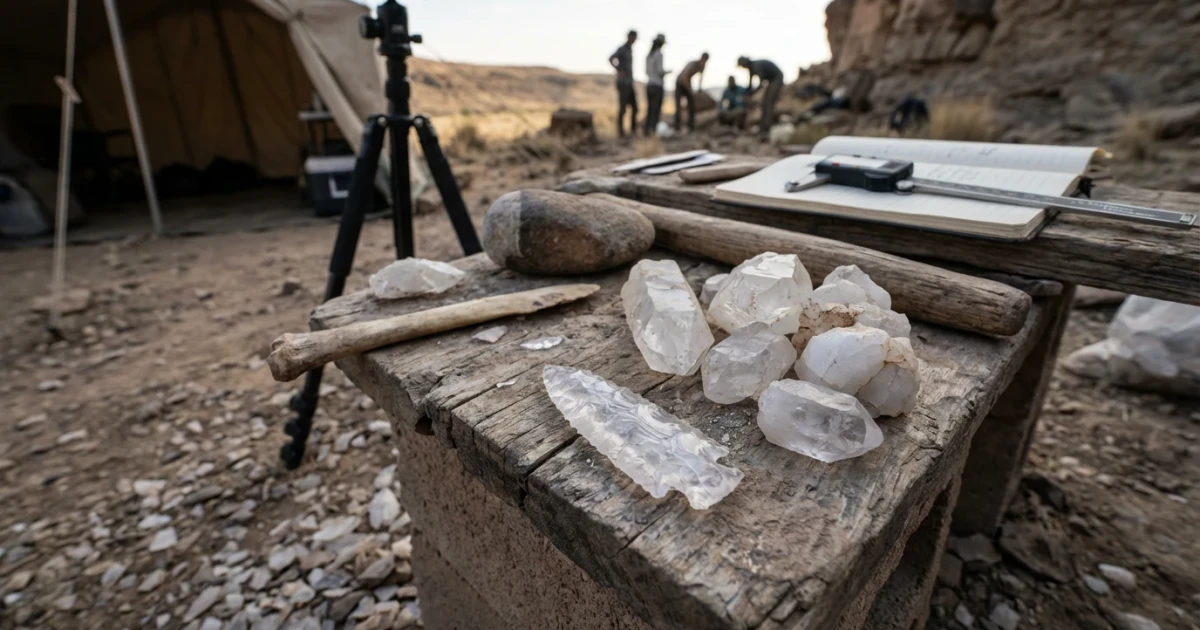
Clovis toolmakers, among North America’s earliest known inhabitants, have long fascinated archaeologists with their sophisticated stone tools. Recent research, highlighted by Phys.org, delves into why these ancient craftsmen deliberately chose difficult-to-work quartz crystal for some of their weapon points and cutting implements—a material choice that raises intriguing questions about the intersection of practicality, technology, and symbolism in the Clovis culture.
Quartz Crystal: A Challenging Material
Quartz crystal is notoriously tough and unpredictable to shape into sharp-edged tools. Compared to more common materials like chert or obsidian, quartz has a tendency to fracture erratically, requiring advanced skill and patience from the toolmaker. The recent study featured by Phys.org investigates artifact assemblages from the Gault Site in Texas, a key location yielding significant Clovis-era finds.
- Quartz crystal artifacts at the Gault Site are noticeably rarer than those made from other stones, making up only a small fraction of the total tool assemblage, as shown in the Clovis Lithic Technology Dataset.
- Experimental replication and lithic analysis, as detailed in recent research, confirm that knapping quartz crystal is considerably more demanding than shaping traditional tool stones.
Possible Explanations: Function Versus Symbolism
The study reported by Phys.org suggests that Clovis toolmakers might have chosen quartz crystal for both functional and non-functional reasons. On a practical level, quartz can produce extremely sharp edges, ideal for precision cutting. However, its scarcity and the effort required to shape it point to additional motivations.
- Some researchers argue that quartz crystal’s natural clarity and aesthetic qualities gave it special significance, possibly for ritual or symbolic purposes.
- The British Museum’s Clovis quartz crystal point exemplifies the care and skill invested in crafting such rare items, further supporting the idea of their elevated status.
According to Phys.org’s review of the new findings, the selection of quartz crystal may have marked certain tools as status objects or offerings, indicating social or ceremonial importance beyond everyday hunting and butchering tasks.
Insights from the Gault Site
The Gault Site, located in central Texas, has yielded hundreds of Clovis artifacts, including rare examples made from quartz crystal. Archaeologists analyzing these finds have noted that the context of discovery—often in association with other high-status materials—reinforces the interpretation of special meaning attached to quartz tools.
The peer-reviewed study, published in the Journal of Archaeological Science: Reports, used a combination of geochemical sourcing, microscopic residue analysis, and experimental knapping to reconstruct the choices and techniques of Clovis toolmakers. The research concluded that the effort invested in quartz crystal artifacts far exceeded that required for stone tools made from more workable local materials.
Broader Implications for Clovis Technology
These findings build on decades of research into Clovis culture and technology, often regarded as a hallmark of Paleoindian innovation in North America. The deliberate selection of challenging materials like quartz crystal suggests a complex web of practical needs, social expression, and possibly spiritual beliefs at play in early human societies.
- Clovis points, whether made from quartz or more common stones, are characterized by their distinctive fluting and fine craftsmanship.
- The presence of quartz crystal artifacts at multiple major Clovis sites indicates this was not an isolated phenomenon, but rather a repeated cultural choice.
Looking Ahead
As archaeologists continue to study Clovis sites with advanced analytical tools, the reasons behind material selection become ever clearer, highlighting the ingenuity and cultural depth of North America’s earliest toolmakers. The new research on quartz crystal tools opens the door to further questions about trade networks, symbolic behavior, and the technological prowess of the Clovis people—reminding us that even the smallest artifact can illuminate a rich and nuanced past.