Sheffield Schools Launch STEM Pipeline Program
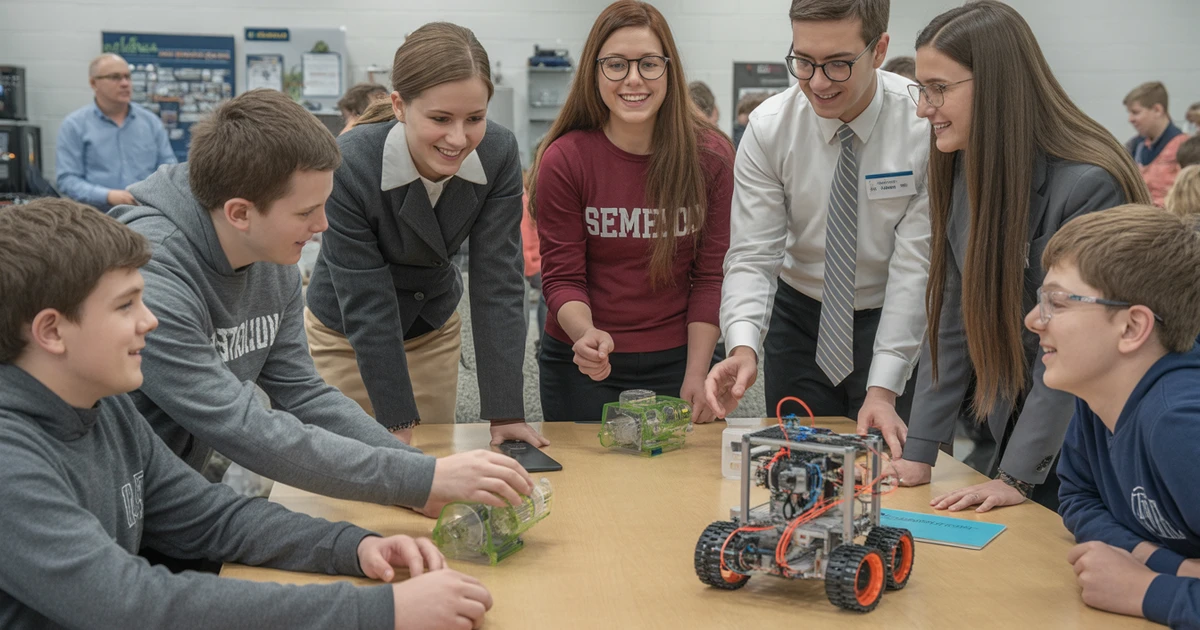
The STEM Pipeline Program, a pioneering educational initiative that will change the way education is delivered in rural areas of Iowa, has finally begun operating in the West Fork Community School District, Sheffield, Franklin County, on the first day of January 2026, that is, January 4, 2026. This project hopes to close the disconnect between classroom training and a career in science, technology, engineering, and mathematics.
The launch of the program at the West Fork Middle and High School campus for local educators, community leaders, and industry partners was a big step towards the students in this small community of about 1,200 residents.
The opening ceremony, held in a newly refurbished auditorium at the school, attracted an enthusiastic audience comprising parents, students, and representatives of nearby businesses. The ceremony was launched with an inspiring speech by Superintendent Dr Emily Harlan, who emphasised the program’s relevance in equipping the next generation with the skills needed to work in a fast-changing job market.
Harlan said, “In Sheffield, we think that all children should be able to have access to the opportunities that can make them passionate about innovating. This STEM Pipeline Program does not merely focus on education but also on creating the future in which our students can succeed in high-demand fields here in Iowa.
Overview and Major Features of the Program
The STEM Pipeline Program has been conceptualised as an all-encompassing program that begins in middle school and continues till high school graduation. It combines practical projects, mentoring by industry professionals, and collaboration with organisations in the local and state sectors to make the transition from learning to professional development smooth.
In contrast to the old-fashioned curricula, the given program focuses on the practical application of knowledge, including a coding workshop, a robotics competition, and the exploration of the environmental sciences, all informed by Franklin County’s agricultural heritage.
In its simplest form, the initiative will entail improvements in the curriculum at all levels. Middle school students will attend introductory courses on basic engineering principles, such as constructing simple circuits and developing sustainable farm models.
High school students, in turn, will explore more complex subjects, such as biotechnology, renewable energy, and data analytics. One of them is the use of virtual reality simulation, which allows students to take a virtual tour of technological sites or even experiment in a virtual laboratory, alleviating the burden of a small-town location.
The program is funded by a mix of state and federal grants, federal STEM education incentives, and local donations. The Iowa Department of Education provided more than $500,000 for the initial year, and Franklin County companies, including agrotech businesses and manufacturing plants, contributed. This financial support guarantees that families do not have to work hard to access resources such as 3D printers, coding software, and a guest speaker series.
Community Involvement and Partnerships
The first strength of the program is its entrenchment in the Sheffield community. The local businesses, such as those in the nearby Hampton area, have promised to offer internship and job-shadowing opportunities. An example is a collaboration with the regional renewable energy company, in which students will have the chance to work on solar panel installation, combining theoretical work with practical skills.
The economic benefits were highlighted at the launch by community leaders, including Mayor Jonathan Pierce. Pierce said that Sheffield has never treated opportunity and hard work as strangers. The program will help retain our youthful talent, improve our local economy, and make Franklin County competitive in the 21st century.
There has also been active parental participation in shaping the program. During the six-month town hall meetings, the families’ feedback was taken into consideration when determining aspects, including flexibility in scheduling after-school lessons and the incorporation of family-friendly STEM evenings. Such events will include demonstrations and hands-on activities, such as drone flying competitions and chemistry experiments, which will allow learning to take place outside of schools.
Educational leaders of West Fork schools are also very excited. Science teacher Marcus Reed (leader of a few modules) has a vision: We have seen students become enlightened when classroom ideas are applied to real-life problems.
This program enhances it by transforming curiosity into career opportunities. Reed’s zeal can be interpreted as a broader shift from the traditional teaching approach based on rote memorisation to project-based learning, which supports the development of critical thinking and teamwork skills.
Student Possibilities and Future Influence
For students, the STEM Pipeline Program offers scholarships, certification, and direct admission to postsecondary programs. Dual-enrollment agreements with local community colleges, such as North Iowa Area Community College, allow high-achieving students to earn credits toward associate degrees.
Also, the program will incorporate career counselling sessions to help students navigate fields such as aerospace engineering, cybersecurity, and biomedical research, which are expected to expand significantly in Iowa.
It has already commenced a pilot group of 50 students in grades 6-12, with full implementation planned in the following semester. The first events of the program are the hackathon dedicated to agricultural innovation, during which teams will create applications to maximise crop production with the help of AI. Experiences of this nature not only develop the technical capacity but also build confidence and strength, without which success in STEM professions is unattainable.
The long-term effect of the program might transform the educational environment of Sheffield. It is a solution to the national STEM talent shortage in the county, making Franklin County a prototype for rural districts nationwide. Based on data from comparable programs in another state, experts estimate that such initiatives would result in a 30% increase in STEM enrollment among participating schools.
Difficulties and Moving Forward
Although the launch is a success, there are still problems. Such rural communities as Sheffield often face issues related to low broadband connectivity and transportation limitations. In response, the district has been placing mobile hotspots and shuttles for program events.
In addition, the evaluation will be conducted continuously to monitor student progress, and the curriculum will be modified to address the needs of different students, including underrepresented students in STEM, such as girls and minorities.
It was an upbeat mood as the event was marked by a ribbon-cutting of a new STEM lab featuring state-of-the-art tools. Students such as 14-year-old Sophia Grant, who wants to be an environmental engineer, had something to thank: “It makes big things seem small, like our town, yet makes it possible with this program.
To conclude, the STEM Pipeline Program may be seen as a radical investment in the young people of Sheffield. Through its promotion of innovation and connection with the community, it will create a generation of problem-solvers prepared to face tomorrow’s challenges. This project is the light at the end of the tunnel as Franklin County looks ahead, as it has shown that even in the global STEM industry, rural America can be ahead of the others.