Science
Crescent Moon Shines Between Venus and Jupiter Tonight
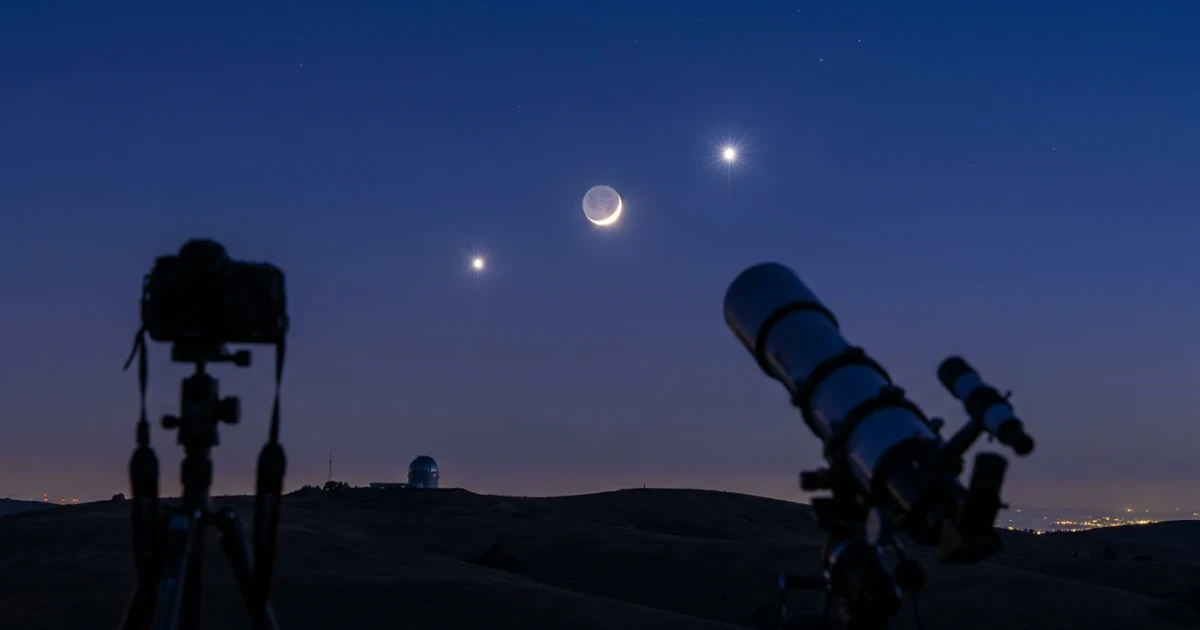
Stargazers across the globe have a reason to look up tonight as the crescent Moon positions itself dramatically between Venus and Jupiter in the evening sky. This picturesque arrangement, known as a conjunction, offers a rare and photogenic spectacle easily visible to the naked eye, according to BBC Sky at Night Magazine.
What Is Happening in the Night Sky?
On this special evening, the slender crescent Moon will appear nestled between the two brightest planets, Venus and Jupiter. A planetary conjunction occurs when celestial bodies appear close together in the sky from our viewpoint on Earth, even though they are separated by vast distances in space. This event is notable not just for its beauty, but also for its timing: Venus and Jupiter are currently among the brightest objects visible after sunset, making the trio an unmissable sight for both amateur and experienced observers.
According to interactive sky maps, the configuration will be most prominent shortly after twilight, when the Moon is high enough above the horizon to be easily spotted, and the sky is dark enough for the planets to shine through. Observers should look towards the western horizon, where Venus will appear as a bright white point, Jupiter as a steadier, golden light, and the crescent Moon between them.
Best Times and Viewing Tips
- When to Look: The conjunction peaks just after sunset, with the best views between 30 and 60 minutes after the Sun has dipped below the horizon.
- Where to Look: Face west or southwest. The trio will form a nearly straight line, with the Moon sandwiched between Venus (lower) and Jupiter (higher).
- Equipment: No telescope is necessary; the arrangement is easily visible to the naked eye, though binoculars can enhance the crescent Moon's detail.
For those seeking precise positions and rise/set times for their location, the In-The-Sky.org conjunction data page provides detailed tables, while the NASA JPL Horizons System offers official ephemeris data for Moon, Venus, and Jupiter.
Why This Conjunction Matters
While Moon-planet conjunctions are not uncommon, seeing the Moon framed so closely between the two brightest planets is a relatively rare treat and makes for impressive wide-field photographs. Both Venus and Jupiter are currently at favorable positions in their orbits, making them particularly bright and easy to spot.
This celestial alignment also provides an opportunity to appreciate the changing positions of the planets against the backdrop of the stars. For those interested in the technical background, the IAU Constellation Boundaries offer insights into which section of the sky the trio traverses tonight.
What to Watch For Next
Events like tonight's Moon-Venus-Jupiter conjunction are a reminder of the dynamic and ever-changing nature of the night sky. Observers are encouraged to check resources such as the Sky & Telescope weekly sky guide or the ESO Sky Calendar for upcoming astronomical highlights, including further planetary groupings, meteor showers, and lunar phases.
Conclusion
Whether you're an avid astronomer or just stepping outside to enjoy a beautiful evening, tonight's conjunction of the crescent Moon with Venus and Jupiter is worth a look. With clear skies and a western view, the spectacle is accessible to all, offering a reminder of the wonders visible in our own backyard—no special equipment required.