Health
Dementia risk factors vary sharply by country, USC study finds

Dementia prevention may need to be local, not universal: a USC-led analysis of more than 214,000 adults aged 50 and older found that the biggest modifiable risks vary sharply across 14 countries and regions. The study was published online July 12 in The Lancet Healthy Longevity and presented at the Alzheimer’s Association International Conference in London, putting geography, health systems and social conditions at the center of prevention policy.
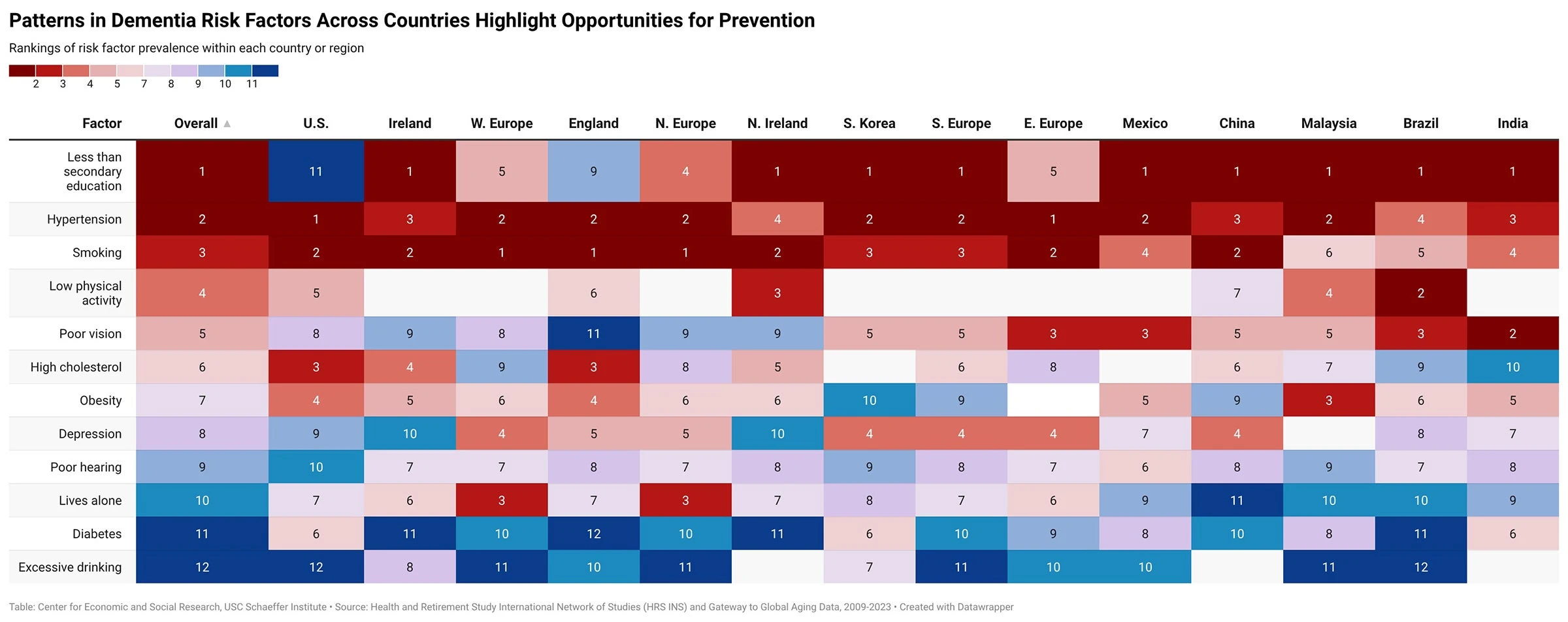
Emma Nichols, a research scientist at USC’s Center for Economic and Social Research, led the analysis with colleagues from Brown University and Johns Hopkins University. The team harmonized data from 11 nationally representative ageing studies collected between 2009 and 2023, covering Ireland, the United States, England, Northern Ireland, Eastern Europe, Western Europe, Northern Europe, Southern Europe, South Korea, Mexico, China, Malaysia, Brazil and India. Researchers examined 12 established binary dementia risk factors: low education, hearing loss, high LDL cholesterol, depression, physical inactivity, diabetes, smoking, hypertension, obesity, excessive alcohol consumption, social isolation and vision loss.

The differences were stark. USC Today highlighted that low education affected 86% of older adults in China but only 12% in the United States. High BMI affected 45% of Americans compared with 13% of people in India. Across all settings, more than half of participants had at least two dementia risk factors, and the risks tended to cluster in broadly similar patterns tied to cardiovascular disease, risky behavior, and social or sensory factors.
That mix matters for public health agencies deciding where to spend money and staff time. A country with poor blood-pressure control may get more from aggressive cardiovascular screening and treatment, while another may need stronger anti-smoking efforts, educational access or support that reduces social isolation. The study does not argue that the world needs separate disease theories for each country. It shows that a single prevention script misses how the same risks stack up differently depending on where people live.
The warning lands in a growing global disease burden. The World Health Organization says 57 million people were living with dementia worldwide in 2021, more than 60% of them in low- and middle-income countries, with nearly 10 million new cases each year. The 2024 Lancet Commission identified 14 modifiable risk factors that account for about 45% of global dementia cases, but the USC analysis suggests national and regional health systems should stop treating those risks as evenly distributed. Prevention will be more effective if it starts with local data, not global averages.
Sources
- [1]sciencedaily.com
- [2]pubmed.ncbi.nlm.nih.gov
- [3]today.usc.edu
- [4]who.int
- [5]thelancet.com
- [6]aaic.alz.org