Science
Did Thomas Edison Unwittingly Create Graphene in 1879? Exploring a Surprising Scientific Claim
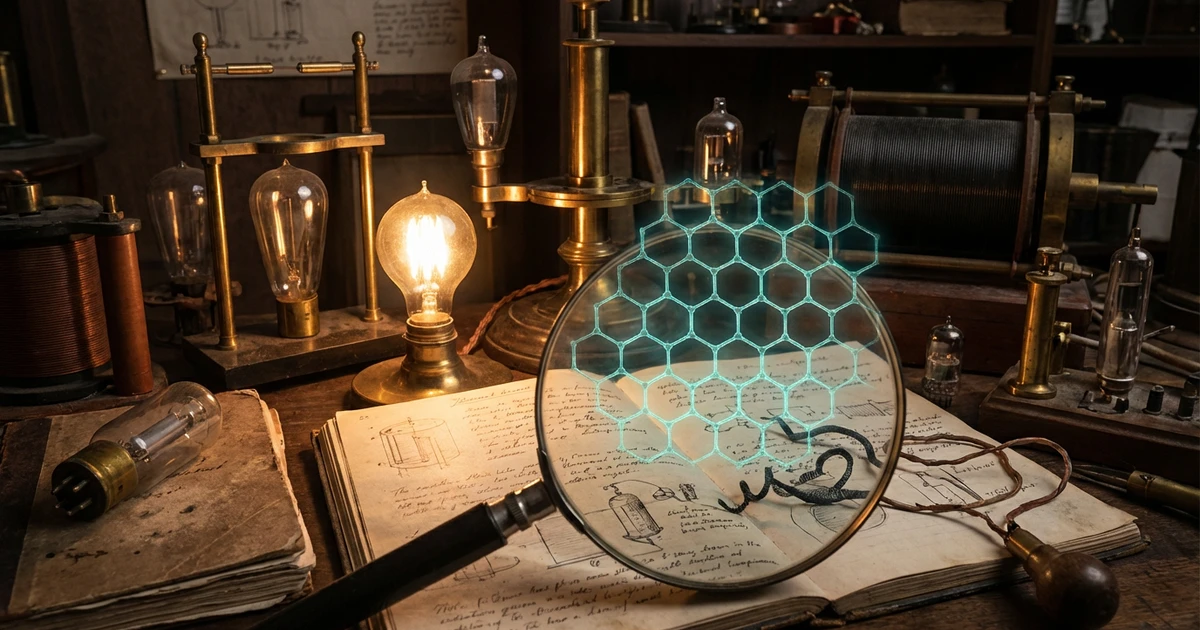
A bold new discussion has emerged in the world of science and technology: could graphene, the advanced material hailed for its strength and conductivity, have been accidentally created by Thomas Edison nearly 150 years ago? Recent conversation sparked by Ars Technica examines the historical and scientific evidence behind this intriguing possibility, raising questions about the timeline of one of the 21st century’s most celebrated discoveries.
What is Graphene and Why Does It Matter?
Graphene is a single layer of carbon atoms arranged in a two-dimensional honeycomb lattice. Since its formal isolation and identification in 2004, graphene has revolutionized materials science for its remarkable properties, such as:
- Extreme strength — roughly 200 times stronger than steel by weight
- High electrical conductivity — making it a prime candidate for next-generation electronics
- Flexibility and transparency — useful for future flexible screens and advanced sensors
Graphene’s discovery earned the 2010 Nobel Prize in Physics, highlighting its significance. However, the suggestion that Edison may have stumbled upon this material long before the modern era has prompted a re-examination of the history of carbon-based materials.
The Edison Connection: Revisiting 19th-Century Experiments
In 1879, Thomas Edison was deeply involved in research on light bulb filaments. Historical records show that Edison experimented with a variety of carbon-based materials, including carbonized bamboo and other plant fibers, in his quest to find the ideal filament for his incandescent lamp. The process involved heating organic material to high temperatures in the absence of oxygen, creating a form of carbon known as "carbon black."
What Ars Technica’s coverage raises is the possibility that, during these experiments, Edison may have inadvertently produced material closely resembling graphene — essentially, ultra-thin layers of carbon atoms.
Scientific Plausibility: Could Edison Have Made Graphene?
Modern graphene is typically obtained through techniques such as mechanical exfoliation (using adhesive tape to peel off layers from graphite) or chemical vapor deposition. Edison, of course, did not have access to such advanced tools. However, the process of carbonization he used can, under some conditions, yield thin layers of graphitic carbon.
Ars Technica notes that while Edison’s carbon filaments were not pure graphene, the methods used might have, on rare occasions, generated small amounts or thin sheets of graphene-like material. The precision and control needed to reliably produce monolayer graphene were likely far beyond 19th-century technology, but the accidental creation of microscopic amounts cannot be ruled out.
What Does This Mean for the History of Science?
This hypothesis, if further substantiated, could add a fascinating footnote to the history of graphene and carbon-based materials. It would not alter the fact that graphene’s unique properties were only understood and harnessed in the 21st century. However, it does highlight how scientific discovery often builds on unintended or poorly understood results from earlier eras.
- Edison’s carbon filaments may have contained layered carbon structures similar to graphene.
- No evidence suggests Edison recognized or utilized graphene’s properties.
- The formal identification and exploitation of graphene belong to modern researchers.
Conclusion: A Compelling Scientific Mystery
While there is no definitive proof that Thomas Edison actually created graphene, the suggestion opens a window into the accidental nature of scientific discovery and the complex history of material science. Edison’s relentless experimentation with carbon materials for light bulbs may have brought him tantalizingly close to one of the most revolutionary materials of the modern age, even if he never knew it.
For further reading on graphene and its discovery, visit the Nobel Prize summary page and Ars Technica.
Sources
- [1]Ars Technica