Science
Discovery of Lone Supermassive Black Hole Challenges Galactic Origins
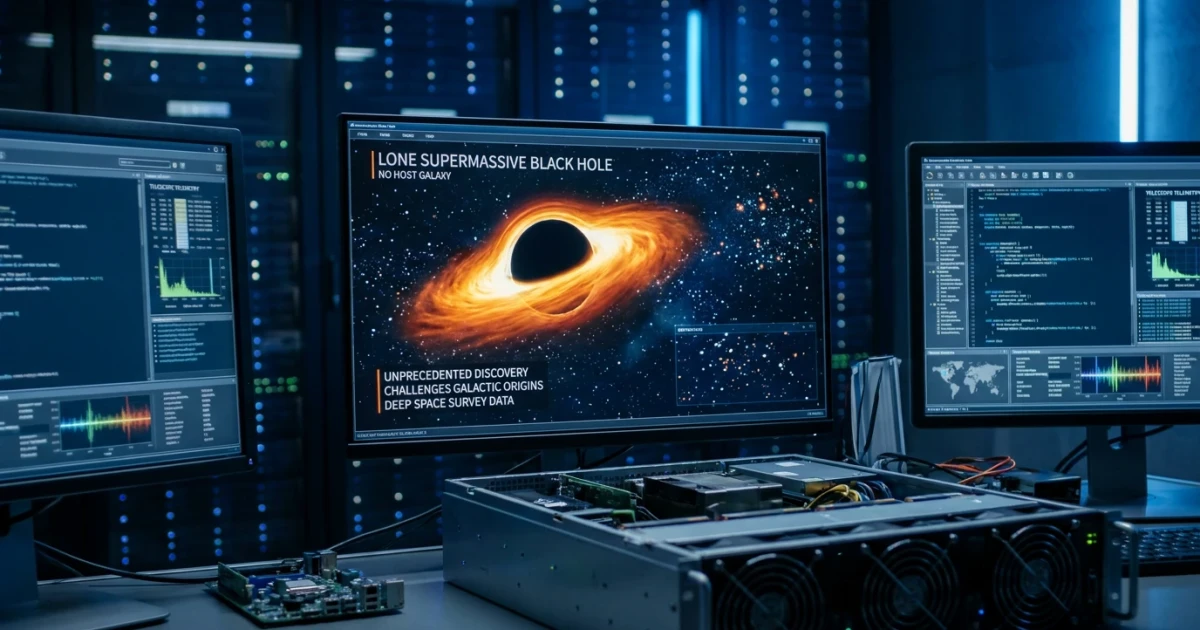
Astronomers have identified a supermassive black hole seemingly adrift without a host galaxy—a discovery that is upending long-held theories about the sequence of cosmic formation. The finding, widely reported by Gizmodo, is being hailed as a 'paradigm shift' in astrophysics, prompting experts to revisit the assumed relationship between galaxies and their central black holes.
Unprecedented Observation in Deep Space
Traditionally, supermassive black holes have been found at the centers of galaxies, where they exert immense gravitational influence and help shape the visible universe. This new observation, however, stands in stark contrast: the black hole appears isolated, with no detectable galaxy surrounding it. According to Gizmodo, this finding challenges the established astrophysical consensus that galaxies and their supermassive black holes form together or that galaxies are necessary for such black holes to exist.
How Was the Black Hole Detected?
While details of the detection method were not exhaustively reported, initial accounts suggest that astronomers used advanced telescopic arrays and sensitive instruments capable of identifying the unique signatures of supermassive black holes even in the absence of a visible host galaxy. The characteristics observed—such as gravitational lensing and high-energy emissions—matched those typically associated with black holes millions or billions of times the mass of the Sun, but no surrounding stars or galactic structure was found. For more on the data behind these discoveries, readers can explore the NASA/IPAC Extragalactic Database (NED).
Why This Discovery Matters
- Upends the co-evolution model: For decades, astronomers have assumed that supermassive black holes and galaxies form together, influencing each other's growth and evolution.
- Raises new questions: If supermassive black holes can exist without galaxies, how do they form, and what happens to their original host galaxies?
- Impacts cosmic history: The discovery could force a rewrite of galaxy formation models, as the sequence and causality of black hole and galaxy formation are now less clear.
Theories and Reactions
Astrophysicists are now debating several possible explanations:
- The black hole could be a relic from the early universe, formed before galaxies took shape.
- It may be the remnant of a galaxy that was stripped away or merged and left the black hole behind.
- Alternatively, it might have been ejected from its host galaxy by gravitational interactions, a process known to occur in rare cases.
Gizmodo characterized the discovery as a scientific milestone, reflecting expert opinions that this "breaks the rules of astrophysics." While no direct quotes were available, the reporting emphasized the surprise and excitement within the scientific community.
Looking Ahead: Redefining Cosmic Origins
This lone black hole's existence motivates astronomers to expand their search for similar objects and to revisit cosmological models. Further research will focus on identifying the mechanism that could produce a supermassive black hole without a galaxy and what this means for our understanding of the universe.
Readers interested in the underlying data and ongoing research can access resources like the Sloan Digital Sky Survey and the Chandra X-ray Observatory's black hole data, which provide more detail on black hole characteristics and distributions.
As new telescopes and surveys come online, the field of astrophysics may be poised for further surprises, with each discovery offering another piece of the cosmic puzzle. For now, the identification of a supermassive black hole without a galaxy stands as a dramatic reminder that the universe still holds many secrets, waiting to challenge our understanding of how it came to be.