Health
Duale defies court order in disputed US-funded Ebola facility case

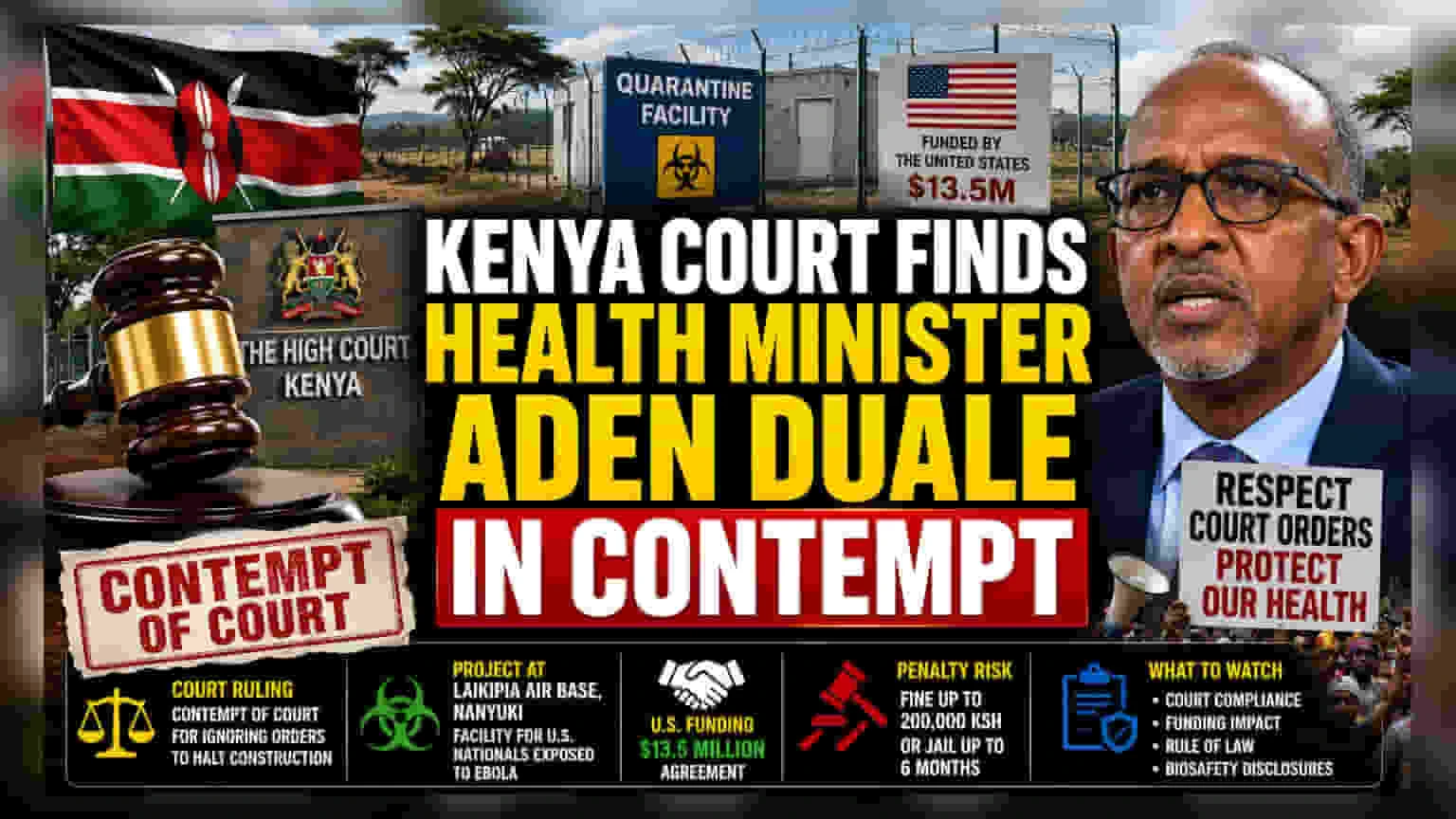
A court fight over a 50-bed Ebola quarantine centre at Laikipia Air Base has become a test of government obedience, public consent and trust in foreign-backed health projects. Health Cabinet Secretary Aden Duale was found in contempt after work on the facility continued despite court orders halting the plan, turning a public health arrangement into a broader clash over transparency and constitutional authority.
The dispute began after Katiba Institute filed an urgent petition on May 28, 2026. A day later, Justice Patricia Nyaundi issued conservatory orders suspending any Ebola exposure, quarantine, isolation or treatment facility in Kenya and barring the government from admitting or facilitating the entry of Ebola-exposed persons under the arrangement. The High Court confirmed those orders on June 2, 2026, yet the court later found that construction at the Laikipia site had gone on anyway.
On June 22, 2026, the court found Duale in contempt and ordered him to appear on June 23 for mitigation and sentencing. Duale then told the court he had "directed the immediate and complete cessation" of building work. The judge said the site work had continued after the stop-work order and that Duale’s public statements showed he intended construction to proceed.
At the centre of the row is an agreement tied to the United States and Ebola preparedness in East Africa. US officials said the plan involved a facility for US nationals exposed to Ebola, to be managed by US medical staff at Laikipia Air Base, about 200 km from Nairobi. Reporting on the arrangement said Washington had pledged about $13 million, or Ksh1.7 billion, for Kenya’s Ebola preparedness efforts, while the outbreak in the Democratic Republic of Congo had been described as having caused more than 200 deaths in one account and 676 infections and 136 deaths in another regional update.
The legal challenge has also drawn in questions of health equity. Katiba Institute and the Law Society of Kenya argued that the arrangement was secretive, unilateral and raised serious constitutional concerns over the rights to life, health, fair administrative action, public participation and parliamentary oversight. Petitioners also said Kenya’s healthcare system was already overstretched and might not be able to safely manage foreign Ebola patients.
Public anger spilled into the streets of Nanyuki and across Laikipia County, where hundreds protested and some demonstrations turned violent. The Kenyan doctors’ union issued a 48-hour strike alert, while Amnesty International welcomed the suspension of construction as "a positive step taken in compliance with the court order" but condemned alleged police violence during the protests, saying three protesters, including a 17-year-old student, were killed.
President William Ruto defended the project as part of a long-standing Kenya-US partnership in global health security and pandemic response, calling it one of 24 preparedness centres meant to strengthen Kenya’s response capacity. The United States embassy said the quarantine centre posed no risk to locals and said it was working with the Kenyan government to address objections. A call between Marco Rubio and Ruto on May 28 underscored how quickly a local land-use dispute became entangled in wider diplomatic and security coordination.
Sources
- [1]bbc.co.uk
- [2]kenyans.co.ke
- [3]the-star.co.ke
- [4]aljazeera.com
- [5]abcnews.com
- [6]state.gov