Science
Edison’s 1879 Lightbulb Experiments: Did History’s Iconic Invention Spawn Graphene?
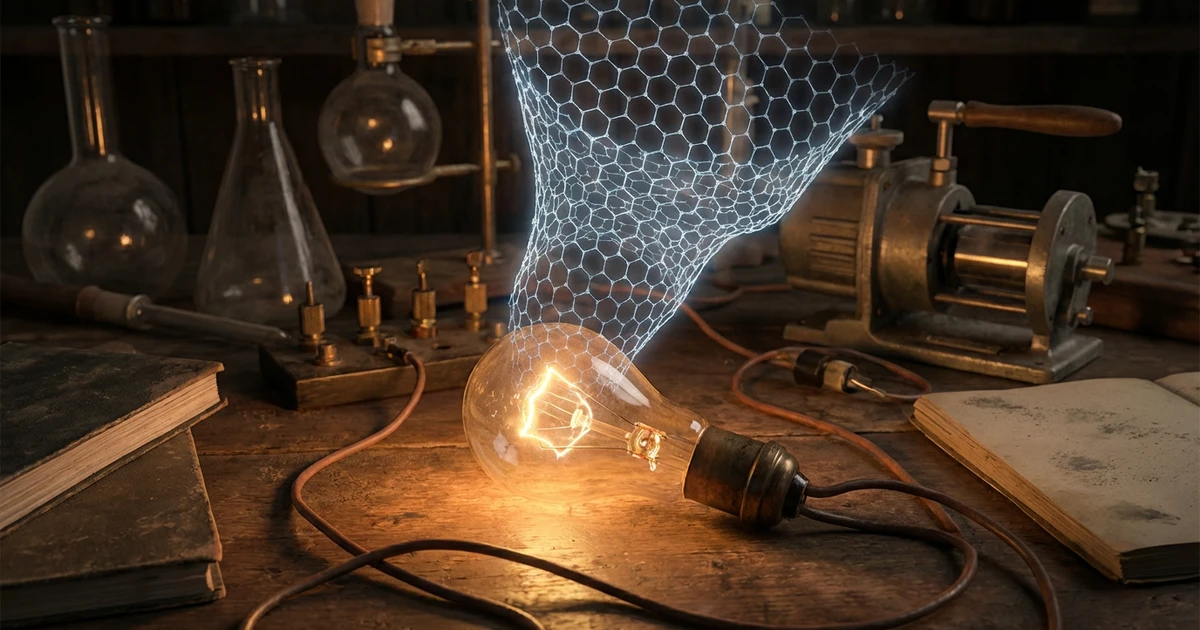
Thomas Edison’s legendary 1879 experiments with the incandescent lightbulb are widely regarded as a turning point in modern technology. Now, emerging analysis suggests history’s most famous inventor may have produced another revolutionary material—graphene—long before its scientific identification in the 21st century.
The Accidental Birth of Graphene?
Recent coverage from Phys.org highlights a provocative new interpretation of Edison’s original lightbulb research. In 1879, Edison was conducting experiments with carbonized bamboo filaments to achieve a long-lasting, practical electric light source. During these high-temperature tests, the extreme conditions inside the bulbs may have caused carbon atoms to arrange in a single-atom-thick, two-dimensional lattice—the very structure that defines graphene.
- Graphene is a single layer of carbon atoms arranged in a hexagonal lattice, renowned for its remarkable strength, electrical conductivity, and thinness.
- The material was first isolated and characterized in 2004, earning two scientists the Nobel Prize in Physics in 2010.
According to the report, Edison’s lightbulb manufacturing process inadvertently met the ideal conditions for forming graphene, albeit without the technology or scientific framework at the time to recognize or understand it.
Historic Experiments Revisited
Historians and materials scientists now suggest that the carbon films left on some of Edison’s test filaments could have included ultra-thin graphene layers. While Edison was focused on creating a durable filament to withstand prolonged electrical current, the side effect may have been the creation of one of today’s most exciting nanomaterials. However, since the tools to observe atomic-scale structures did not exist in the 19th century, this accidental synthesis went unnoticed for over a century.
Why the Discovery Matters
- If proven, this would predate the formal discovery of graphene by over 120 years.
- It suggests that innovations can have unintended consequences far beyond their original intent.
- It highlights the interconnectedness of scientific progress across generations.
Modern Implications and Future Research
Researchers are now calling for further examination of preserved Edison bulbs and filaments. With today’s advanced microscopy and spectroscopy techniques, it may be possible to definitively identify graphene in historical samples. If verified, Edison’s legacy would include not only the dawn of practical electric light but also an unintentional leap toward the nanotechnology revolution.
For those interested in the science of graphene, its properties continue to drive innovation in electronics, materials science, and energy storage. Read more about graphene research on Phys.org.
Looking Ahead
This development underscores how the impact of historic experiments can echo through time, shaping fields the original inventors could never have imagined. As science continues to reexamine the past with new tools, the story of Edison and graphene is a compelling reminder that major discoveries sometimes happen by accident—and are only recognized long after the fact.
Sources
- [1]Phys.org