Science
Europe eyes chance to become a haven for displaced researchers

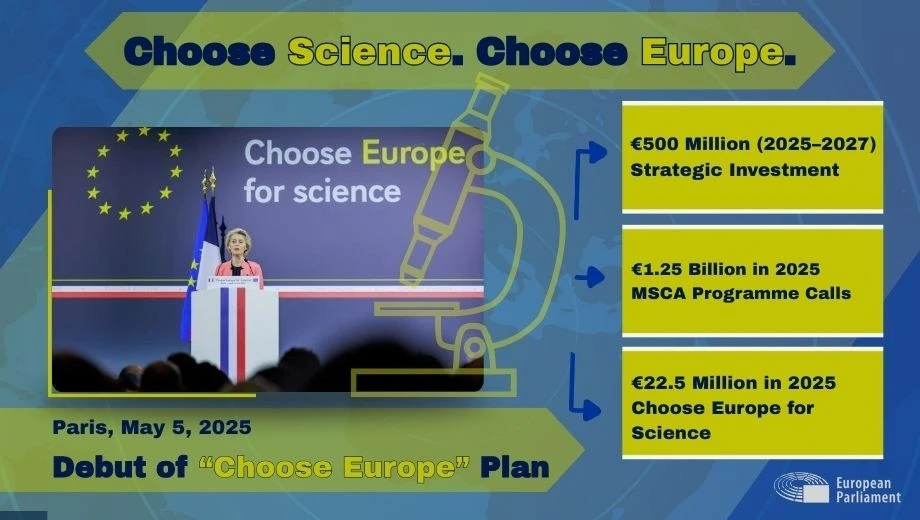
At the Sorbonne in Paris on 5 May 2025, the European Commission launched the Choose Europe initiative with an initial €500 million package for 2025 to 2027. Turmoil in U.S. science and wider geopolitical uncertainty have made the continent look like a safer harbor, but the real test is whether Europe can offer more than refuge and build an ecosystem strong enough to keep researchers, fund their labs and turn discoveries into companies or public goods.
A window opened by instability, not by luck
Europe already matters in the world’s research map. Nature Index data show the continent holds a larger share of Nature Index papers than the United States, even though China’s share is larger still. Europe is not starting from zero. It already has universities, public institutes and a deep scientific base that can draw researchers who want stability, scale and a predictable environment.
But the comparison is not just output. It is whether Europe can compete with the speed and concentration of the United States and China when it comes to turning research into influence. The pressure point is especially visible in fields that shape daily life and national power, including public health, climate science, artificial intelligence and industrial policy.
What Europe is offering now
By January 2026, the Commission said funding linked to the program had grown to nearly €900 million in EU money.

The Commission also said Europe now has 101 national and regional funding and support schemes designed to attract, retain and develop research talent, up from 65 in May 2025. The European Research Council has doubled its additional start-up funding for researchers moving to Europe, raising support from up to €1 million to up to €2 million so new arrivals can establish labs or teams.
Where Europe still falls short
The European Commission’s 2025 comparative analysis of public research and innovation funding shows the EU still lags the United States and China in absolute research-and-development spending and in how effectively it turns public research into private investment. Europe spent an estimated €403.1 billion on R&D in 2024, equal to 2.2% of GDP, but that scale has not erased the gap in converting ideas into fast-growing companies.
That is why Brussels has tied its science push to a startup-and-scaleup strategy, including a planned Scaleup Europe Fund aimed at deep-tech companies. If Europe wants displaced researchers to stay, it cannot stop at recruitment. It has to support the step after discovery, when a project needs venture capital, procurement access, regulatory clarity and the ability to scale across borders.
Its research strength is spread across a patchwork of national systems. That fragmentation makes it harder to move money, build teams and commercialize work quickly. The result is a continent that can produce world-class papers without always building the company infrastructure that keeps researchers rooted there.
Why talent is moving now
Ekaterina Zaharieva, the European Research Commissioner, said in 2025 that there were more than 70 national and regional initiatives aimed at attracting researchers. By January 2026, the Commission said the number had climbed to over 100.
At the same time, applications from U.S.-based researchers for prestigious European grants have risen, a sign that Europe’s message is resonating with scientists looking for stability and support. The risk is that some researchers treat Europe as a temporary landing zone rather than a permanent base for careers, labs and spinout companies.
What would actually make Europe competitive
If Europe wants to be more than a refuge, several conditions have to change together:
• Funding must be easier to access across borders, not trapped in national silos. • Researchers need a clearer route from grant to lab to company, with fewer delays in the middle. • Venture capital and scale-up financing have to be easier to find for deep-tech and science-based startups. • Bureaucracy has to move faster so that talent does not stall while paperwork catches up. • Public research has to connect more reliably to private investment and industrial deployment.