Health
FDA opens path for UniQure’s accelerated Huntington’s gene therapy filing
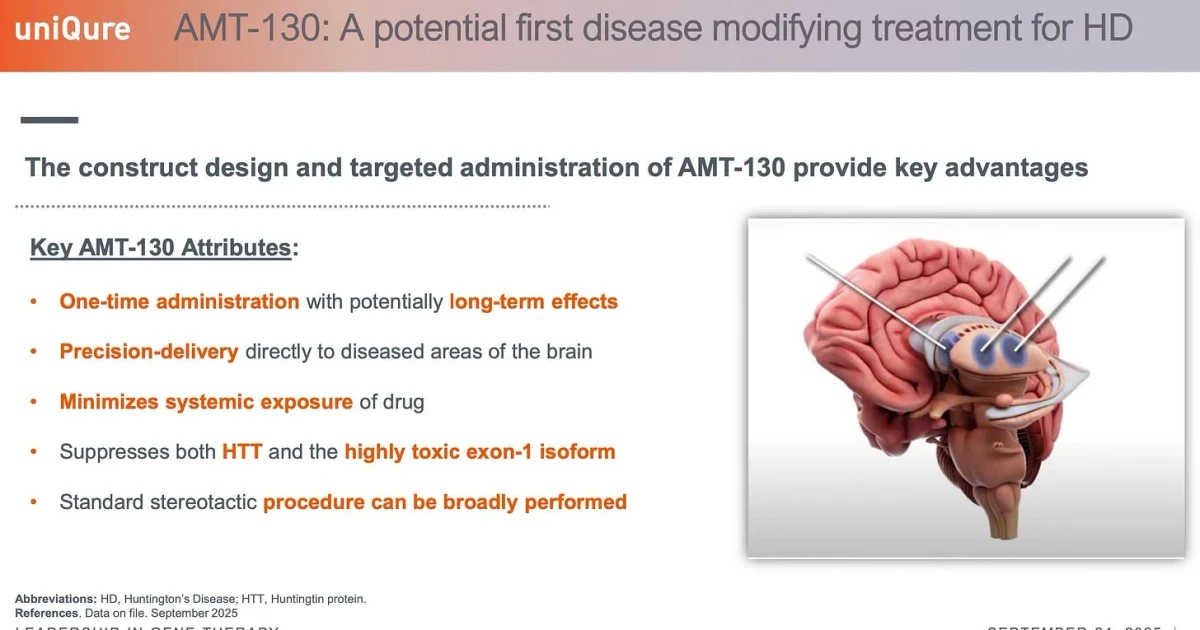
UniQure won a critical FDA shift for AMT-130, its experimental Huntington’s gene therapy, after regulators told the company a three-year analysis from its Phase 1/2 study could support an accelerated approval filing. The Dutch biotech said it now plans to submit a Biologics License Application in the third quarter of 2026, a turnaround that sent its shares up 70% on Wednesday.
The move marks a sharp reversal from March 2, when the FDA said it could not agree that UniQure’s Phase I/II data, compared with an external control, were enough to support a marketing application. Regulators then strongly recommended a prospective, randomized, double-blind, sham surgery-controlled study, a demand that underscored how much the agency had been pressing the company on evidence standards. One FDA official later said the agency “remains committed to working with UniQure” to identify a path that serves patients and families while upholding “gold-standard science.”
AMT-130 is one of the most ambitious therapies in development for a devastating inherited brain disease. UniQure administers it by MRI-guided, convection-enhanced stereotactic neurosurgical delivery directly into the striatum, a procedure that takes hours and delivers the treatment straight into the brain. The company says its U.S. study enrolled 26 patients with early manifest Huntington’s disease, with four control patients later crossing over to treatment. UniQure said in September 2025 that the therapy slowed disease progression by 75% at 36 months in high-dose patients, a result that had originally put the program on a path toward an early 2026 filing.
The FDA had already given the program Regenerative Medicine Advanced Therapy designation in June 2024 and Breakthrough Therapy designation in April 2025, signaling that regulators saw enough early promise to warrant closer interaction. That promise matters because Huntington’s disease has no approved treatment that can slow or stop the underlying decline. UniQure says the illness affects about 75,000 people across the U.S., Europe and the United Kingdom, gradually eroding motor function, cognition and behavior, often in young adulthood.

For patients and families, the latest FDA signal is encouraging but not a green light to access. The Huntington’s Disease Society of America called the announcement meaningful and said the community had delivered more than 47,000 petition signatures and more than 11,000 messages to Congress. Even with the agency’s new openness, UniQure still must file, win review and clear the case for approval with data strong enough to satisfy regulators that the treatment’s promise is real and durable.
Sources
- [1]cnbc.com
- [2]hdsa.org
- [3]uniqure.com