Technology
FERC orders grid operators to speed data center interconnections
The Federal Energy Regulatory Commission moved to give data centers and other huge power users a faster path onto the grid, but it left unanswered the question that matters most to everyone else: who waits, and who pays, when electricity is already tight. On June 18, the commission issued tailored show-cause orders to all six regional grid operators under its jurisdiction, giving each regional transmission organization or independent system operator and its transmission owners 60 days to defend existing tariffs or file changes for data centers, manufacturing plants and other large loads.
FERC said the action is meant to speed up the innovation economy and strengthen national security while protecting ratepayers. The commission is also asking the operators to justify or reform tariff rules in five categories, a sign that the fight is shifting from broad policy to the mechanics of cost allocation, reliability and upgrade requirements. What the order did not do was solve the supply-side problem. Data centers are already pushing U.S. electricity use to record highs, and in many regions they need more power than grids can currently supply, which means faster queue access will not automatically create new generation, transmission or local infrastructure.
The decision marks a more aggressive federal role in an area that has long been split between Washington and the states. FERC has historically regulated generation interconnection, while load interconnection has largely been handled by state authorities, making large-load hookups one of the clearest jurisdictional boundary fights in power policy. The commission’s docket, RM26-4-000, grew out of an October 2025 advanced notice of proposed rulemaking that followed a Department of Energy Section 403 proposal. In April, FERC said it would act by the end of June and said staff had reviewed more than 3,500 pages of public comments.
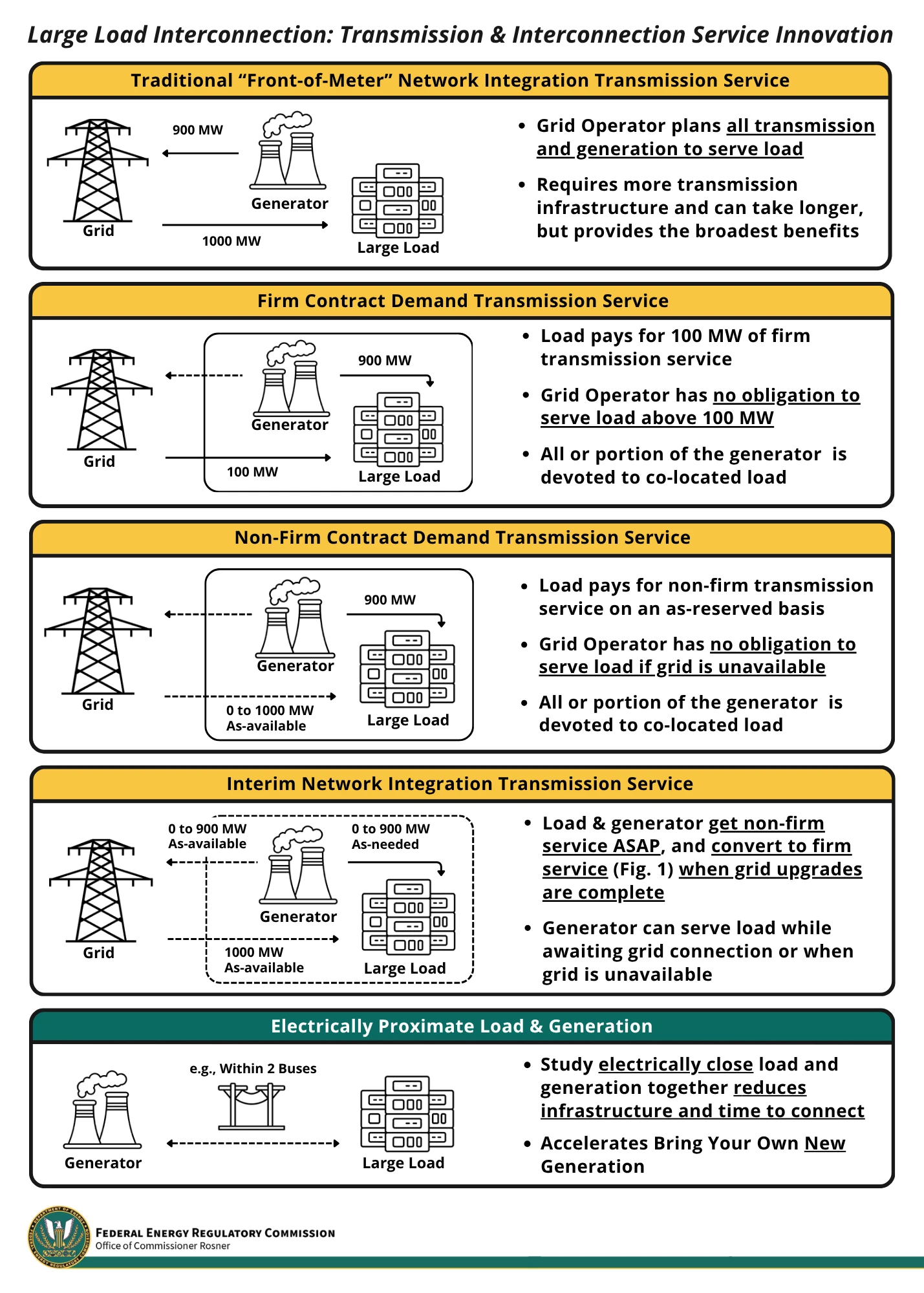
FERC has already tested the issue in PJM Interconnection, where the stakes are enormous. The Mid-Atlantic grid operator serves more than 67 million Americans across 13 states and Washington, D.C. In February 2025, FERC launched a review of co-location issues after a November 2024 technical conference and a complaint from Constellation Energy Generation, LLC. In December, it ordered PJM to create transparent rules for AI-driven data centers and other large loads co-located with generation, and in January 2026 it approved Southwest Power Pool’s High Impact Large Load initiative.

The reaction has split along familiar lines. Tech companies and data center developers have welcomed faster grid connections, while state regulators, lawmakers and ratepayer advocates have warned that the costs could shift onto customers if supply shortages persist. FERC Chair Laura V. Swett has signaled that the commission is willing to push close to the edge of its jurisdiction to get policy results. That makes the June 18 orders less like the end of the debate than the opening of a larger fight over power, price and priority.
Sources
- [1]techcrunch.com
- [2]ferc.gov
- [3]politico.com
- [4]reuters.com