Technology
Five Eyes warns AI could outsmart cyber defenses within months
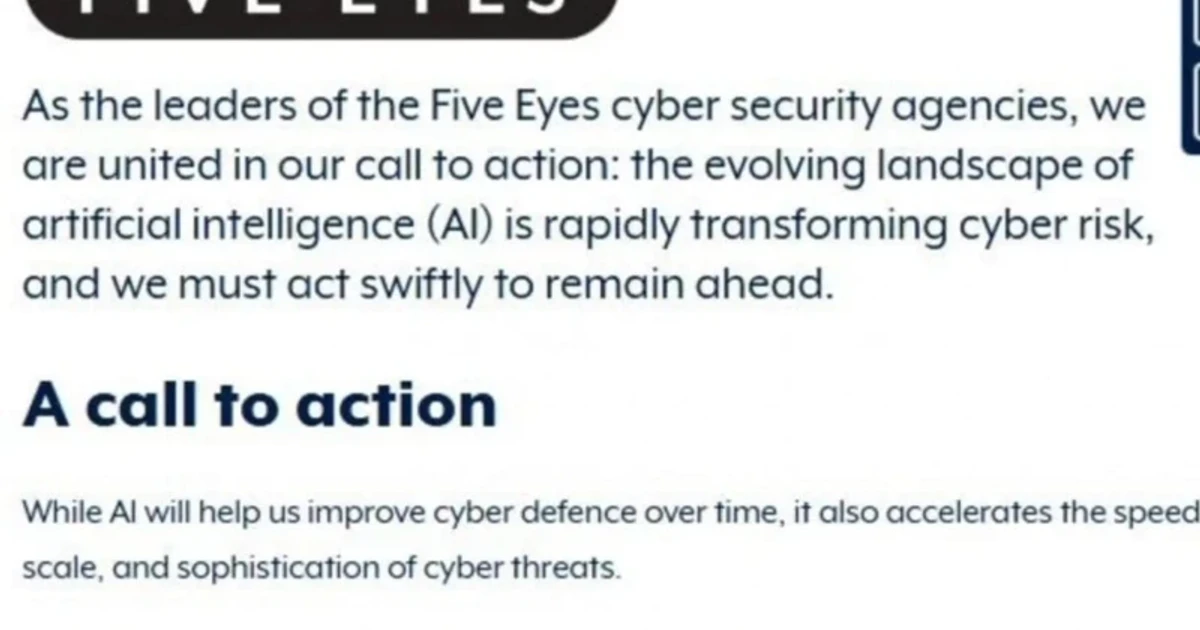
Intelligence agencies are warning that frontier AI may outpace current cyber defenses within months, not years, forcing banks, hospitals, utilities and election officials to rethink how they protect systems already under constant attack. In a joint statement, the Five Eyes cyber security agencies said the timeline is “not years, it is months,” and argued that AI is already lowering barriers for malicious actors while shrinking the time between vulnerability discovery and exploitation.
The warning lands as a practical one for institutions that still depend on patch cycles, manual triage and scarce specialist talent. The agencies said frontier models are expected to exceed current industry expectations and will transform both offensive and defensive cyber capabilities. Cyber risk, they said, can no longer be treated as a purely technical issue; it is now a core business and leadership responsibility tied to continuity, market confidence and long-term value.
The United Kingdom’s National Cyber Security Centre has already framed the next two years as a period of intensified pressure. Its assessment of the near-term impact of AI on the cyber threat concluded that AI will almost certainly increase the volume and impact of attacks, while also making it easier, faster and cheaper for attackers to discover and exploit weaknesses. The agency says frontier AI can automate tasks that once required specialist skills, including writing exploit code, understanding system architecture and using attack tools.
At the same time, the defensive side is moving just as quickly. The NCSC says AI can improve detection and triage, including spotting malicious emails and phishing campaigns. CISA has issued similar guidance, warning that agentic AI systems bring added risks such as an expanded attack surface, privilege creep, behavioral misalignment and obscure event records, even as they can be aligned with existing cybersecurity frameworks.

Governments are trying to get ahead of that shift with a burst of joint guidance. On May 1, 2026, CISA, Australia’s ASD ACSC and international partners released a guide for securing agentic AI services. On May 22, 2025, CISA, the NSA, the FBI and partners issued best practices for securing the data used to train and operate AI systems. In April 2026, the UK and U.S. helped publish global guidelines for secure AI system development, endorsed by agencies from 17 other countries.
The private sector is now openly acknowledging the same risk curve. In December 2025, OpenAI said its models’ cyber capabilities were rising and warned that future models could pose a “high” cybersecurity risk, including helping create working zero-day exploits or assist with complex intrusion operations. Anthropic then drew attention in early 2026 by saying one of its newest models was too capable at finding vulnerabilities to release publicly. For defenders, the message is stark: the old assumption that AI buys time is collapsing, and the institutions most exposed are the ones still treating cyber resilience as an IT problem instead of a leadership one.
Sources
- [1]cbsnews.com
- [2]ncsc.gov.uk
- [3]cisa.gov