Business
Germany private-sector activity contracts at fastest pace in 18 months

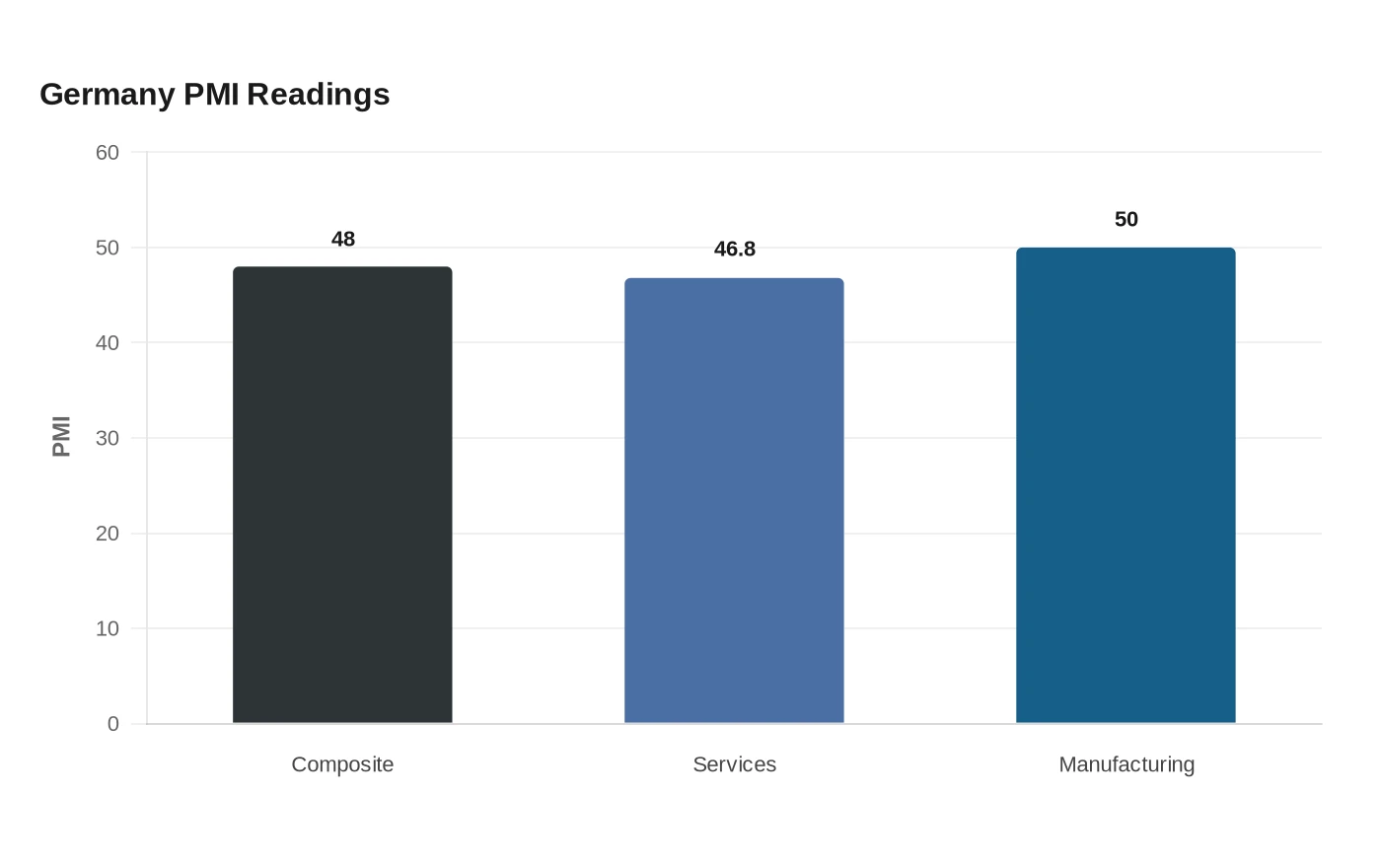
Germany’s private sector shrank in June at the fastest pace in 18 months, a setback led by a sharp deterioration in services and a reminder that Europe’s biggest economy is still struggling to regain momentum. The flash composite purchasing managers’ index fell to 48.0 from 48.8 in May, below the 49.6 forecast and under the 50 threshold that separates expansion from contraction.
The services sector carried most of the weakness. Its flash PMI dropped to 46.8 from 48.1, the softest reading since November 2022, while manufacturing only held just above the line at 50.0, down marginally from 50.1. That split matters because Germany has relied on industry to cushion a weak domestic recovery, but June showed factories were not strong enough to offset a broader loss of demand in services and the wider economy.
New business fell for a fourth straight month and at the fastest pace since December 2024, signalling that companies are still not seeing enough orders to justify a quick rebound. Business expectations for the next 12 months also weakened and stayed below their long-run average, a sign that managers are increasingly cautious about the outlook into the second half of the year.
There was some relief on the inflation side. Input-cost inflation cooled to a four-month low and firms’ output-price inflation slowed to its weakest pace in three months. That gives the European Central Bank a little more room to breathe after raising its deposit rate to 2.25% from 2.0% at its June meeting. Even so, softer prices did not offset the deeper problem in the data: activity is still shrinking, and shrinking faster.
The German reading also fits a wider European slowdown. The euro-zone flash composite PMI for the same period came in at 49.5, pointing to a milder regional contraction, but new orders across the bloc fell for a fourth consecutive month. In Germany, separate gauges have also been weak. The ifo Business Climate Index rose only to 84.9 in May from 84.5 in April, while industrial orders fell 1% month-on-month in June, underscoring how broad the demand slump has become.
Because flash PMI surveys are published before comparable official data, markets use them as an early signal for growth and inflation. For Berlin and the ECB, June’s numbers are a warning that the region’s recovery remains fragile, with second-quarter output now looking more likely to have stagnated or contracted than to have rebounded.
Sources
- [1]money.usnews.com
- [2]pmi.spglobal.com
- [3]spglobal.com
- [4]ecb.europa.eu
- [5]ifo.de
- [6]uk.finance.yahoo.com