World
Germany’s new coalition braces to contain AfD surge, outline agenda

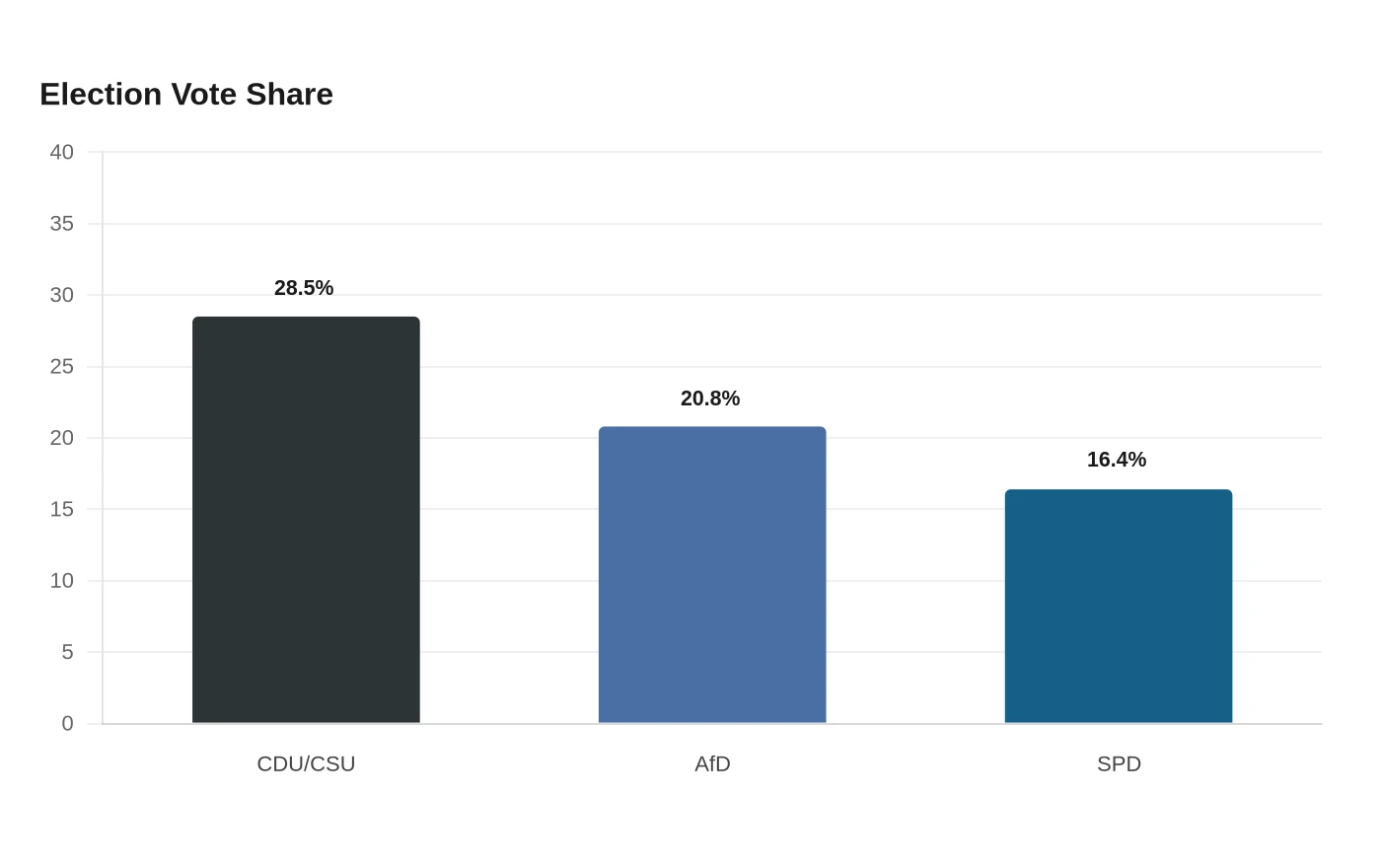
Germany’s new CDU/CSU-SPD coalition was assembled on the back of an election that left the Bundestag more fragmented and the far-right Alternative for Germany far stronger. The AfD won 20.8% of the second vote and 152 seats in the 2025 federal contest, becoming the second-strongest party, while the CDU/CSU bloc took 28.5% and 208 seats and the SPD fell to 16.4% and 120 seats. Voter turnout reached 82.5%, a sign of how much of the country was engaged in the vote that set up Friedrich Merz to become chancellor on May 6, 2025.
The coalition agreement signed on May 5, 2025 lays out a blunt response to the pressures driving the AfD’s rise. Its central promises include tax relief for low- and middle-income earners, continued pension stability, more police and judicial staff, stronger backing for the European Union and tighter limits on migration. That mix is designed to answer two strains of discontent at once: the cost of living and the sense among many voters that the state has lost control over borders and public order.

The political guardrail around the far right, Germany’s long-standing firewall against cooperation, was tested before the coalition even took office. On January 31, 2025, the CDU/CSU pushed through a non-binding immigration motion with AfD support, a move that broke a major taboo and ignited nationwide criticism. Protesters gathered outside CDU headquarters in Berlin, where police estimated the crowd at about 6,000 people. The backlash sharpened the question of whether the center-right could keep the AfD at arm’s length while also using its hard-line migration stance to win back voters.
That tension has not eased. In February 2025, Merz and Markus Söder publicly cast the center-right as the barrier against the AfD, arguing that conservative voters did not need to look to the far right for representation. By July 2026, however, polling has shown the AfD leading nationally in several surveys at roughly 26% to 29%, while the CDU/CSU sits around 20% to 24% and the SPD around 12% to 13%. For Merz’s coalition, the test is no longer rhetorical. It is whether governing on taxes, pensions, policing and migration can blunt a populist challenge that has already survived one election and is still climbing.
Sources
- [1]nytimes.com
- [2]bundeswahlleiterin.de
- [3]bundesregierung.de
- [4]deutschland.de
- [5]dw.com
- [6]politpro.eu