Science
Giant Dinosaur Discovery Rewrites Southeast Asia’s Prehistoric Past
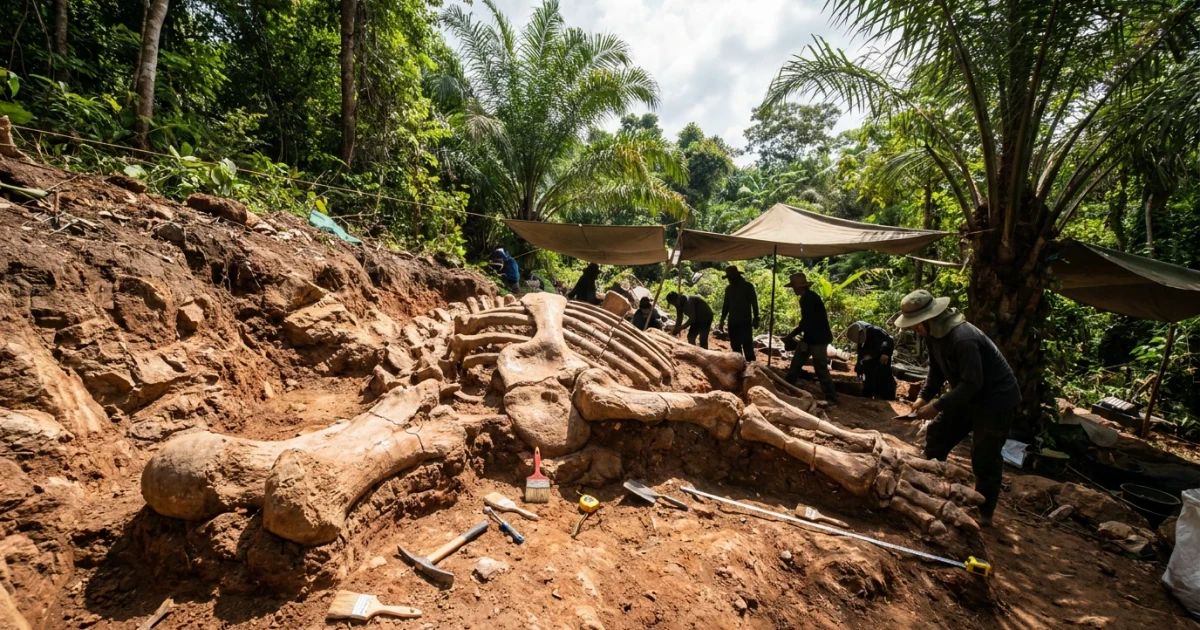
Thailand has become the center of international paleontological attention with the discovery of Southeast Asia’s largest dinosaur, a find that is reshaping scientific understanding of the region’s ancient ecosystems. The remains, excavated by a team of Thai and international researchers, represent a new species of giant sauropod and provide rare clues about the evolution of massive dinosaurs in Asia.
Unearthing a Prehistoric Giant
The fossilized bones were discovered in the Khon Kaen province of northeastern Thailand, an area already renowned for its rich dinosaur fossil record. According to NBC News, the remains include vertebrae, limb bones, and parts of the pelvis, all indicating an animal that far surpassed previous size records for the region’s dinosaurs.
- Estimated length: Over 30 meters (98 feet)
- Weight: Up to 50 tons, making it comparable to the largest titanosaurs found worldwide
- Age: Lived approximately 100 million years ago during the Cretaceous period
While Thailand has yielded several important dinosaur discoveries over the past three decades, this specimen is the most massive uncovered to date, as verified by the Department of Mineral Resources, Thailand.
Clues to Dinosaur Evolution in Asia
The new species, whose formal scientific name is pending, belongs to the sauropod group—the long-necked, plant-eating dinosaurs famous for their colossal size. According to research highlighted by National Geographic, the find helps fill a significant gap in the evolutionary history of Asian titanosaurs. Prior to this, most giant sauropod records came from South America and Africa, with only a handful known in Asia.
Paleontologists note that the specimen’s unique skeletal features—such as the shape of its vertebrae and pelvis—indicate it represents a previously unknown lineage. This suggests that the evolution of giant sauropods in Asia was more complex and widespread than previously believed, potentially involving unique environmental pressures or migration routes across ancient landmasses.
A New Perspective on Thailand’s Fossil Heritage
Thailand’s fossil sites have rapidly gained importance within the global scientific community. The interactive fossil maps show that the region is a hotspot for dinosaur discoveries, with dozens of sites yielding remains from the Jurassic and Cretaceous periods.
- Over 20 dinosaur species have been identified from Thai sites to date
- The country has produced some of the oldest known ornithomimosaurs ("ostrich dinosaurs") in Asia
- Recent finds include both predatory theropods and massive herbivores
This latest discovery underscores the region’s scientific potential, offering new opportunities to study the rise and diversity of dinosaurs in Southeast Asia. As the Natural History Museum explains, such finds also help reconstruct ancient environments and climate conditions, providing context for the spread of large dinosaurs across the supercontinent Gondwana.
Looking Ahead: Excavation and Research Continue
Researchers are continuing to excavate the Khon Kaen site, with many fossilized bones still encased in rock. Detailed analysis, including CT scanning and 3D reconstruction, is expected to yield further insights into the anatomy and lifestyle of this remarkable animal.
The team’s findings will be integrated into global dinosaur databases, enabling comparisons with other giant sauropods and informing broader questions about dinosaur evolution and extinction in the region. As the scientific community awaits the formal naming and publication of the new species, Thailand’s place in the story of the dinosaurs has never been more prominent.