Technology
Global smartphone shipments slump 11% as memory chip shortage bites

Global smartphone shipments fell 11% in the second quarter, hitting their lowest level for that period since 2013 as a prolonged memory chip shortage pushed up handset prices and cooled demand. The strain is landing hardest on entry- and mid-range phones, where suppliers are channeling memory toward AI data centers and leaving consumer electronics to absorb the higher costs.
That shift is forcing manufacturers to pass more of the bill to buyers, making affordable devices harder to build and harder to sell. For U.S. consumers, the next product wave is likely to bring fewer bargain models, longer upgrade cycles and more pressure on prices in the segments that have historically driven unit growth.

Apple was the clear exception. Its shipments rose 3% in the quarter, lifting global market share to a record 20% on resilient demand for its premium iPhone lineup and unchanged pricing. Samsung Electronics reclaimed the top spot with a 24% share, helped by strong sales of its Galaxy S26 series, better product availability and fewer price increases in markets including India and the Middle East.
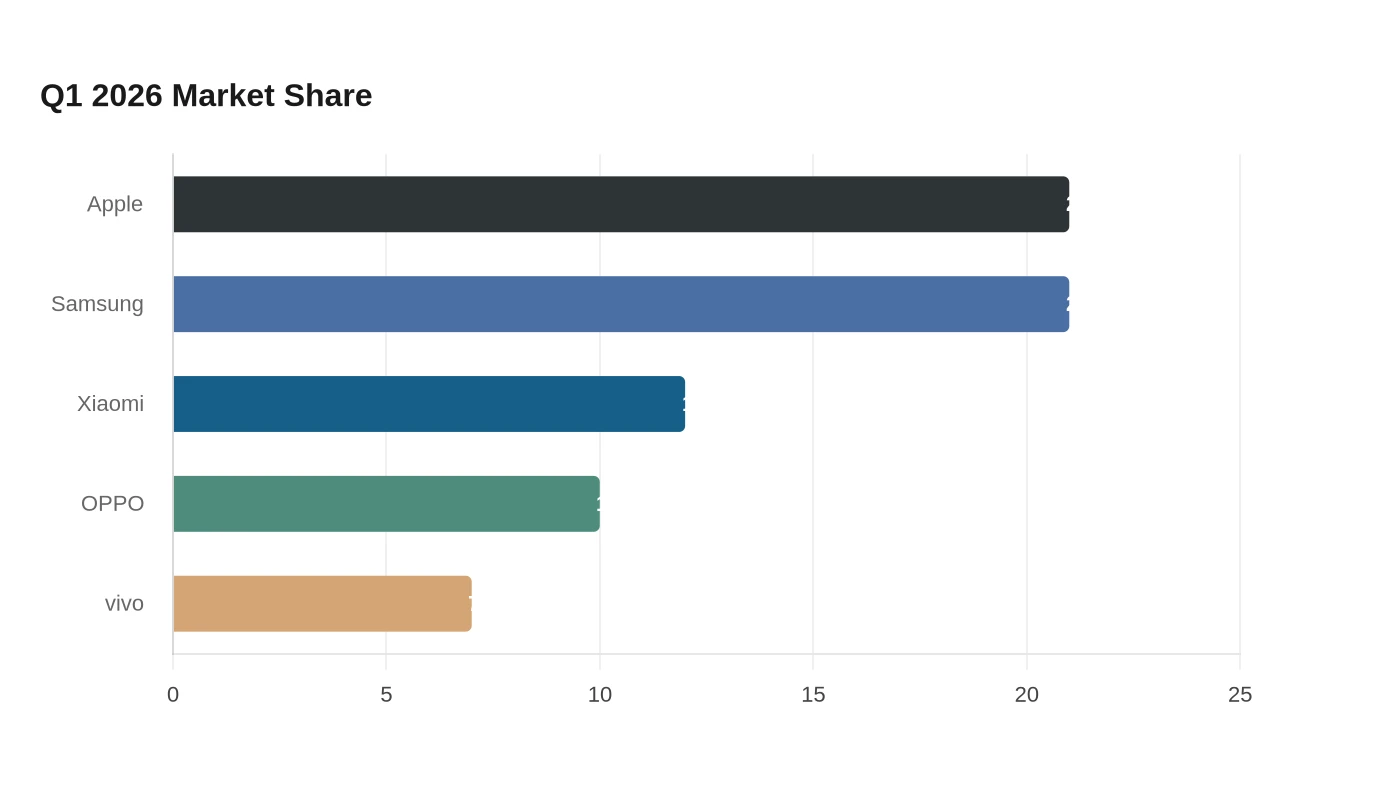
Xiaomi, OPPO and vivo posted the steepest shipment declines among the five biggest brands, and companies with deeper exposure to budget and mid-range phones are bearing the brunt of the memory squeeze. In Counterpoint Research’s first-quarter 2026 market-share table, Apple and Samsung were tied at 21%, while Xiaomi held 12%, OPPO 10% and vivo 7%.
Counterpoint expects global smartphone shipments to fall 12% in 2026 to just below 1.1 billion units, the lowest annual volume since 2013. IDC forecasts a 13.9% drop this year to 1.09 billion units, with average selling prices rising to a record $550 as vendors cut lower-end output and move upmarket. IDC forecasts the memory shortage began reshaping the market in 2025 and could last into 2027, as AI workloads redirect capacity toward high-margin products such as HBM and high-capacity DDR5. IDC forecasts the steepest declines will hit lower-end phones and markets with heavy sub-$200 device exposure, including the Middle East and Africa, Central and Eastern Europe and parts of Asia Pacific.
Sources
- [1]money.usnews.com
- [2]counterpointresearch.com
- [3]idc.com
- [4]cnbc.com