Business
How Bill Phillips Modeled the Economy With Water
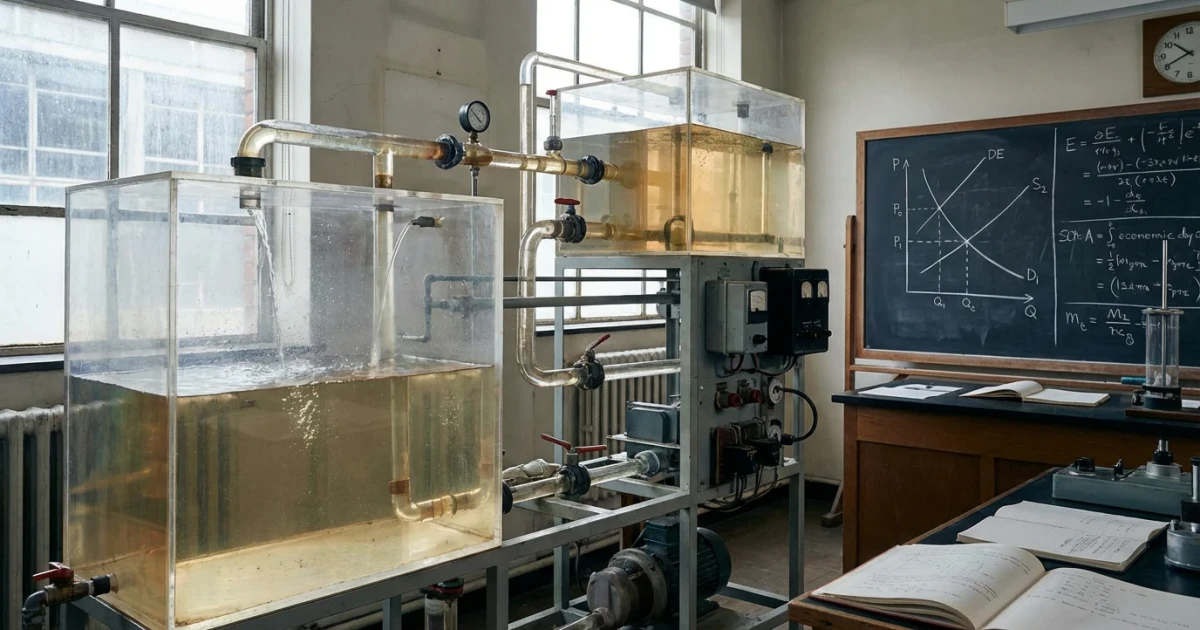
Bill Phillips, a New Zealand-born economist, forever changed the way we visualize and teach economics by creating a hydraulic computer that modeled national economies using nothing more than water, pipes, and tanks. His invention, known as the MONIAC (Monetary National Income Analogue Computer), remains a landmark in economic education and simulation.
Reimagining the Economy With Flowing Water
In the late 1940s, mainstream economics relied heavily on abstract equations and charts to explain how money moved through a national economy. Phillips, inspired by his engineering background, took a different approach. He sought to make these complex ideas tangible by building a physical model. Using a system of colored water, transparent tanks, and a network of pipes, the MONIAC allowed observers to literally see flows of money as water moved through the system, simulating income, spending, saving, taxation, and investment in real time.
- The MONIAC, completed in 1949, stood over six feet tall and was built from salvaged aircraft parts and Perspex.
- It was capable of modeling the UK economy, demonstrating how changes in government spending or interest rates could ripple through the system.
- Adjustable valves and pumps represented policy levers, showing how fiscal and monetary policies affect economic variables.
The Impact on Economic Education
The MONIAC quickly became a sensation among economists and students. Unlike blackboard equations, the machine offered a hands-on way to grasp complex concepts such as the Phillips Curve, which Phillips also developed to illustrate the relationship between unemployment and inflation. By visualizing the economy as a set of interconnected systems, the MONIAC made it easier to understand feedback loops, bottlenecks, and the effects of policy changes.
- Universities around the world, including Cambridge and Harvard, acquired their own MONIACs for teaching and demonstration purposes.
- As described by NPR, the machine inspired a generation of economists to think more deeply about how economies function as systems rather than isolated variables.
Legacy and Continuing Relevance
Although digital computers have since replaced analog models like the MONIAC, Phillips' water machine remains a powerful symbol of economic systems thinking. The model's influence persists in modern macroeconomic modeling, as seen in the work of Nobel laureates who have advanced simulation-based approaches to understanding the economy.
Today, surviving MONIACs are held in the collections of the Reserve Bank of New Zealand and several universities. They serve both as historic artifacts and as reminders of the value of making abstract ideas concrete. Phillips' hands-on approach continues to inspire educators and researchers to find new ways to make economics accessible and engaging.
Exploring Further
- Learn more about the MONIAC's construction and operation.
- Read a detailed history and analysis of the Phillips Machine.
- Understand the background and significance of Phillips' inventions.
As economics continues to evolve with new technologies, the legacy of Bill Phillips and his water-powered computer endures—reminding us that sometimes, the simplest models can offer the clearest insights into the workings of our complex world.