US News
How plants respond to touch, and why it makes them stronger

Wind and touch can leave plants shorter and sturdier, with slower stem elongation and thicker stems. Robert Krulwich and puppeteer Barnaby Dixon explore the phenomenon, thigmomorphogenesis. The evidence is strong for measurable responses, but weak for any claim that plants “feel” in the animal sense.
What thigmomorphogenesis means
The term refers to the plant response to physical disturbance such as wind or touch. In the classic pattern, stem elongation slows while stem diameter increases, producing shorter, sturdier plants that can better withstand mechanical stress, with growth shifting away from tall, slender stems and toward thicker, more robust structure — the formulation used in EBSCO Research Starters.
This is not a new idea dressed up in modern language. A review in Italus Hortus traces observations and descriptions of the mechanical effects of disturbance on plant growth and development back hundreds of years. PubMed lists a review titled Thigmomorphogenesis: The response of plant growth and development to mechanical stimulation: With special reference to Bryonia dioica.
Why touch can make plants stronger
The strengthening effect comes from a trade-off in growth. Instead of investing as much energy in vertical extension, mechanically stimulated plants typically put more into radial growth, which thickens stems and makes them less likely to snap or bend under load. Wind is a clear example: repeated movement pushes plants toward a more compact form, one that can better resist the same stress that triggered it.
A plant can appear to “respond” to touch without any need for a brain or nervous system in the animal sense. The change is visible in shape, but it starts as altered signaling inside the plant.
The chemistry behind the response
A hormone called jasmonate mediates plants’ responses to touch and can boost defenses against pests, Kerry Grens wrote in The Scientist. The touch response is not only about sturdier stems, but also about biochemical defense.
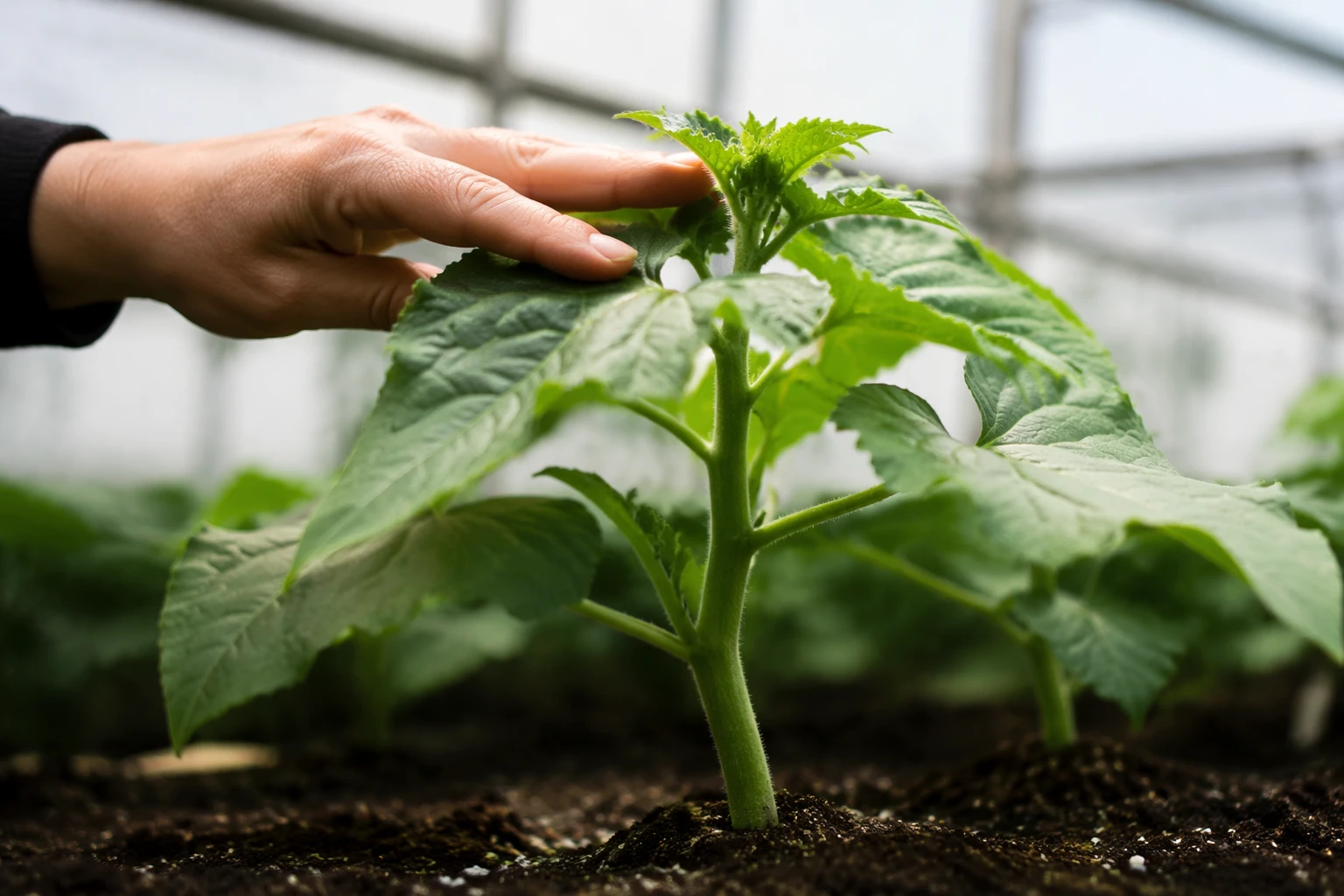
Jasmonate is one of the ways plants translate mechanical stimulation into action. Touch, brushing, and injury can activate pathways that change growth patterns and, in some cases, strengthen pest defenses.
Where the myth of the “stoic tree” breaks down
In her discussion of the “stoic trees” myth, Linda Chalker-Scott — an extension horticulturist and associate professor at Washington State University’s Puyallup Research and Extension Center in Washington — wrote, “Unless it causes visible damage, touching or brushing has little effect on plants.”
A brief brush does not automatically mean a meaningful biological response, and not every touch will leave a visible mark. But the broader thigmomorphogenesis literature shows that repeated or sustained mechanical stimulation can change plant form, which is why the phrase “little effect” should not be stretched into “no effect” in every case.
How to talk about plants without overstating the evidence
Two ideas need to stay separate. First, plants do respond to physical stimuli in measurable ways: they alter stem elongation, stem thickness, and defensive chemistry. Second, that response is not proof that plants experience touch the way animals do, or that they have feelings in the ordinary sense of the word.
A careful explanation sounds like this: • Plants sense mechanical stress. • Mechanical stimulation can alter growth and development. • Jasmonate can help mediate touch responses and pest defenses. • The result can be a shorter, sturdier plant.
Sources
- [1]cbsnews.com
- [2]ebsco.com
- [3]soihs.it
- [4]pubmed.ncbi.nlm.nih.gov
- [5]the-scientist.com
- [6]wpcdn.web.wsu.edu
- [7]capcity.news